Event submissions
Published
This submission belongs to the session S1. The Social Nature of Health and Well-Being of the event The 1st International Online Conference on Societies
Published date
19 Jan, 2026
Academic Editor
'%3e%3cpath%20d='M12.6657%2010.9104C12.4185%2010.325%2012.0599%209.79327%2011.6097%209.34482C11.1609%208.89508%2010.6293%208.5365%2010.0442%208.28888C10.0389%208.28626%2010.0337%208.28495%2010.0285%208.28233C10.8446%207.69279%2011.3752%206.73249%2011.3752%205.64904C11.3752%203.8542%209.92103%202.39999%208.1262%202.39999C6.33136%202.39999%204.87715%203.8542%204.87715%205.64904C4.87715%206.73249%205.40774%207.69279%206.22393%208.28364C6.21869%208.28626%206.21345%208.28757%206.20821%208.29019C5.62129%208.5378%205.09463%208.89284%204.64265%209.34613C4.1929%209.79493%203.83432%2010.3266%203.58671%2010.9117C3.34345%2011.4845%203.21226%2012.0987%203.20023%2012.7209C3.19988%2012.7349%203.20233%2012.7488%203.20744%2012.7619C3.21255%2012.7749%203.22022%2012.7867%203.22998%2012.7968C3.23975%2012.8068%203.25142%2012.8147%203.26431%2012.8202C3.2772%2012.8256%203.29105%2012.8284%203.30504%2012.8284H4.09109C4.14874%2012.8284%204.19459%2012.7825%204.1959%2012.7262C4.2221%2011.7148%204.62823%2010.7676%205.34617%2010.0497C6.08899%209.30683%207.0755%208.89808%208.1262%208.89808C9.17689%208.89808%2010.1634%209.30683%2010.9062%2010.0497C11.6242%2010.7676%2012.0303%2011.7148%2012.0565%2012.7262C12.0578%2012.7838%2012.1037%2012.8284%2012.1613%2012.8284H12.9474C12.9613%2012.8284%2012.9752%2012.8256%2012.9881%2012.8202C13.001%2012.8147%2013.0126%2012.8068%2013.0224%2012.7968C13.0322%2012.7867%2013.0398%2012.7749%2013.0449%2012.7619C13.0501%2012.7488%2013.0525%2012.7349%2013.0522%2012.7209C13.0391%2012.0947%2012.9094%2011.4855%2012.6657%2010.9104ZM8.1262%207.9024C7.52486%207.9024%206.9589%207.6679%206.53312%207.24211C6.10733%206.81633%205.87283%206.25037%205.87283%205.64904C5.87283%205.0477%206.10733%204.48174%206.53312%204.05596C6.9589%203.63018%207.52486%203.39567%208.1262%203.39567C8.72753%203.39567%209.29349%203.63018%209.71927%204.05596C10.1451%204.48174%2010.3796%205.0477%2010.3796%205.64904C10.3796%206.25037%2010.1451%206.81633%209.71927%207.24211C9.29349%207.6679%208.72753%207.9024%208.1262%207.9024Z'%20fill='%235D1EE1'/%3e%3c/g%3e%3c/svg%3e) Gregor Wolbring
Gregor WolbringCitation
Sara Diogo Gonçalves, Lisete Morais, Maria Monteiro, Raquel Garcia Diogo, Ana Caramelo, Bridging Attitudes and Practice: How Primary Care Nurses Approach Alcohol Consumption, in Proceedings of The 1st International Online Conference on Societies, 21 January–23 January 2026, MDPI: Basel, Switzerland
Share
Email
Facebook
Twitter
LinkedIn
Bridging Attitudes and Practice: How Primary Care Nurses Approach Alcohol Consumption

Sara Diogo Gonçalves 1
'%3e%3cpath%20d='M12.6647%2010.9104C12.4176%2010.325%2012.0589%209.7933%2011.6088%209.34485C11.16%208.89511%2010.6283%208.53653%2010.0432%208.28891C10.038%208.28629%2010.0327%208.28498%2010.0275%208.28236C10.8437%207.69282%2011.3743%206.73252%2011.3743%205.64907C11.3743%203.85423%209.92005%202.40002%208.12522%202.40002C6.33038%202.40002%204.87618%203.85423%204.87618%205.64907C4.87618%206.73252%205.40677%207.69282%206.22296%208.28367C6.21772%208.28629%206.21248%208.2876%206.20724%208.29022C5.62031%208.53783%205.09365%208.89287%204.64167%209.34616C4.19192%209.79496%203.83334%2010.3266%203.58573%2010.9117C3.34247%2011.4846%203.21128%2012.0987%203.19925%2012.721C3.1989%2012.735%203.20135%2012.7489%203.20646%2012.7619C3.21157%2012.7749%203.21924%2012.7868%203.22901%2012.7968C3.23877%2012.8068%203.25045%2012.8148%203.26334%2012.8202C3.27623%2012.8256%203.29007%2012.8284%203.30406%2012.8284H4.09012C4.14776%2012.8284%204.19362%2012.7825%204.19493%2012.7262C4.22113%2011.7148%204.62726%2010.7676%205.34519%2010.0497C6.08802%209.30686%207.07452%208.89811%208.12522%208.89811C9.17592%208.89811%2010.1624%209.30686%2010.9052%2010.0497C11.6232%2010.7676%2012.0293%2011.7148%2012.0555%2012.7262C12.0568%2012.7839%2012.1027%2012.8284%2012.1603%2012.8284H12.9464C12.9604%2012.8284%2012.9742%2012.8256%2012.9871%2012.8202C13%2012.8148%2013.0117%2012.8068%2013.0214%2012.7968C13.0312%2012.7868%2013.0389%2012.7749%2013.044%2012.7619C13.0491%2012.7489%2013.0515%2012.735%2013.0512%2012.721C13.0381%2012.0947%2012.9084%2011.4856%2012.6647%2010.9104ZM8.12522%207.90243C7.52388%207.90243%206.95792%207.66793%206.53214%207.24215C6.10636%206.81636%205.87185%206.2504%205.87185%205.64907C5.87185%205.04773%206.10636%204.48177%206.53214%204.05599C6.95792%203.63021%207.52388%203.3957%208.12522%203.3957C8.72655%203.3957%209.29252%203.63021%209.7183%204.05599C10.1441%204.48177%2010.3786%205.04773%2010.3786%205.64907C10.3786%206.2504%2010.1441%206.81636%209.7183%207.24215C9.29252%207.66793%208.72655%207.90243%208.12522%207.90243Z'%20fill='%235D1EE1'/%3e%3c/g%3e%3c/svg%3e)
Lisete Morais 2
Maria Monteiro 2,3
Raquel Garcia Diogo 4
Ana Caramelo 2,3,5
1. Clinical Academic Center of Trás-os-Montes and Alto Douro (CACTMAD), University of Trás-os-Montes and Alto Douro, 5000-801 Vila Real, Portugal
2. School of Health, University of Trás-os-Montes and Alto Douro, 5000-801 Vila Real, Portugal
3. RISE-Health Research Network, Faculty of Medicine, University of Porto, 4200-319 Porto, Portugal
4. School of Science and Technology, University of Trás-os-Montes and Alto Douro, 5000-801 Vila Real, Portugal
5. Clinical Academic Center of Trás-os-Montes and Alto Douro (CACTMAD), 5000-801 Vila Real, Portugal
Abstract
Introduction:
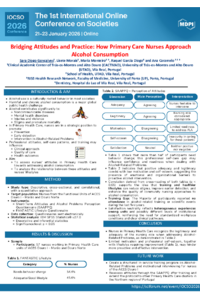
Alcohol consumption remains a significant public health problem due to its physical, mental, and social consequences. Nurses play a key role in identifying and managing alcohol-related issues in primary health care. This study aims to assess nurses’ attitudes towards alcohol consumption and to reflect on the development of specialized nursing competencies.
Methods:
A descriptive, cross-sectional, and correlational study with a quantitative approach was conducted among 57 nurses working in the Functional Units of the Douro I – Marão and Douro Norte Primary Health Care Cluster. Data were collected electronically using the Short Attitudes and Alcohol Problems Perception Questionnaire (SAAPPQ) and the FANTASTIC Lifestyle Questionnaire. Statistical analysis was performed using IBM SPSS Statistics 27.0, applying descriptive and inferential statistics, with a significance level set at p<0.05.
Results:
Most participants showed an “agreeing” perception of attitudes and alcohol-related problems in the dimensions of appropriateness and legitimacy but a “disagreeing” perception regarding motivation and self-esteem. For the satisfaction dimension, perceptions were neutral. More than half of the nurses (54.4%) reported lifestyles that need improvement. A significant negative correlation was found between lifestyle and perceived adequacy in alcohol-related attitudes. Most nurses had not attended scientific events on this topic in the past five years.
Conclusions:
The findings highlight the importance of continuous education to strengthen nurses’ skills and confidence in addressing alcohol-related issues. This study reinforces the relevance of community and public health nurses in promoting responsible, autonomous, and evidence-based interventions within primary health care. Although conducted within a specific regional context, the results may inform broader nursing education and policy initiatives aimed at improving alcohol-related care in similar primary health settings. Future studies should explore these associations across diverse healthcare systems to enhance the generalizability of these findings.
Keywords
Nurses
Alcohol
Attitudes
Primary Health Care
Poster
Sem nome (38.1 x 54.2 cm).pdf
DigComp and Its Limits: New Human Resource Management Constructs for Generative AI Skills
Technology and hope: AI potential in healthcare