Event submissions
Published
This submission belongs to the session S1. The Social Nature of Health and Well-Being of the event The 1st International Online Conference on Societies
Published date
19 Jan, 2026
Academic Editor
'%3e%3cpath%20d='M12.6657%2010.9104C12.4185%2010.325%2012.0599%209.79327%2011.6097%209.34482C11.1609%208.89508%2010.6293%208.5365%2010.0442%208.28888C10.0389%208.28626%2010.0337%208.28495%2010.0285%208.28233C10.8446%207.69279%2011.3752%206.73249%2011.3752%205.64904C11.3752%203.8542%209.92103%202.39999%208.1262%202.39999C6.33136%202.39999%204.87715%203.8542%204.87715%205.64904C4.87715%206.73249%205.40774%207.69279%206.22393%208.28364C6.21869%208.28626%206.21345%208.28757%206.20821%208.29019C5.62129%208.5378%205.09463%208.89284%204.64265%209.34613C4.1929%209.79493%203.83432%2010.3266%203.58671%2010.9117C3.34345%2011.4845%203.21226%2012.0987%203.20023%2012.7209C3.19988%2012.7349%203.20233%2012.7488%203.20744%2012.7619C3.21255%2012.7749%203.22022%2012.7867%203.22998%2012.7968C3.23975%2012.8068%203.25142%2012.8147%203.26431%2012.8202C3.2772%2012.8256%203.29105%2012.8284%203.30504%2012.8284H4.09109C4.14874%2012.8284%204.19459%2012.7825%204.1959%2012.7262C4.2221%2011.7148%204.62823%2010.7676%205.34617%2010.0497C6.08899%209.30683%207.0755%208.89808%208.1262%208.89808C9.17689%208.89808%2010.1634%209.30683%2010.9062%2010.0497C11.6242%2010.7676%2012.0303%2011.7148%2012.0565%2012.7262C12.0578%2012.7838%2012.1037%2012.8284%2012.1613%2012.8284H12.9474C12.9613%2012.8284%2012.9752%2012.8256%2012.9881%2012.8202C13.001%2012.8147%2013.0126%2012.8068%2013.0224%2012.7968C13.0322%2012.7867%2013.0398%2012.7749%2013.0449%2012.7619C13.0501%2012.7488%2013.0525%2012.7349%2013.0522%2012.7209C13.0391%2012.0947%2012.9094%2011.4855%2012.6657%2010.9104ZM8.1262%207.9024C7.52486%207.9024%206.9589%207.6679%206.53312%207.24211C6.10733%206.81633%205.87283%206.25037%205.87283%205.64904C5.87283%205.0477%206.10733%204.48174%206.53312%204.05596C6.9589%203.63018%207.52486%203.39567%208.1262%203.39567C8.72753%203.39567%209.29349%203.63018%209.71927%204.05596C10.1451%204.48174%2010.3796%205.0477%2010.3796%205.64904C10.3796%206.25037%2010.1451%206.81633%209.71927%207.24211C9.29349%207.6679%208.72753%207.9024%208.1262%207.9024Z'%20fill='%235D1EE1'/%3e%3c/g%3e%3c/svg%3e) Gregor Wolbring
Gregor WolbringCitation
Shadab Ahamad, Mahima Sharma, C Sreenivas, Gaurav Bhardwaj, Anagha Tulsi, Prachi Kukshal, Quality of Life and Financial Burden in Congenital Heart Disease Care: A Large-Scale Survey of Pre- and Post-Treatment Outcomes in a Free Tertiary Hospital, in Proceedings of The 1st International Online Conference on Societies, 21 January–23 January 2026, MDPI: Basel, Switzerland
Share
Email
Facebook
Twitter
LinkedIn
Quality of Life and Financial Burden in Congenital Heart Disease Care: A Large-Scale Survey of Pre- and Post-Treatment Outcomes in a Free Tertiary Hospital
'%3e%3cpath%20d='M12.6647%2010.9104C12.4176%2010.325%2012.0589%209.7933%2011.6088%209.34485C11.16%208.89511%2010.6283%208.53653%2010.0432%208.28891C10.038%208.28629%2010.0327%208.28498%2010.0275%208.28236C10.8437%207.69282%2011.3743%206.73252%2011.3743%205.64907C11.3743%203.85423%209.92005%202.40002%208.12522%202.40002C6.33038%202.40002%204.87618%203.85423%204.87618%205.64907C4.87618%206.73252%205.40677%207.69282%206.22296%208.28367C6.21772%208.28629%206.21248%208.2876%206.20724%208.29022C5.62031%208.53783%205.09365%208.89287%204.64167%209.34616C4.19192%209.79496%203.83334%2010.3266%203.58573%2010.9117C3.34247%2011.4846%203.21128%2012.0987%203.19925%2012.721C3.1989%2012.735%203.20135%2012.7489%203.20646%2012.7619C3.21157%2012.7749%203.21924%2012.7868%203.22901%2012.7968C3.23877%2012.8068%203.25045%2012.8148%203.26334%2012.8202C3.27623%2012.8256%203.29007%2012.8284%203.30406%2012.8284H4.09012C4.14776%2012.8284%204.19362%2012.7825%204.19493%2012.7262C4.22113%2011.7148%204.62726%2010.7676%205.34519%2010.0497C6.08802%209.30686%207.07452%208.89811%208.12522%208.89811C9.17592%208.89811%2010.1624%209.30686%2010.9052%2010.0497C11.6232%2010.7676%2012.0293%2011.7148%2012.0555%2012.7262C12.0568%2012.7839%2012.1027%2012.8284%2012.1603%2012.8284H12.9464C12.9604%2012.8284%2012.9742%2012.8256%2012.9871%2012.8202C13%2012.8148%2013.0117%2012.8068%2013.0214%2012.7968C13.0312%2012.7868%2013.0389%2012.7749%2013.044%2012.7619C13.0491%2012.7489%2013.0515%2012.735%2013.0512%2012.721C13.0381%2012.0947%2012.9084%2011.4856%2012.6647%2010.9104ZM8.12522%207.90243C7.52388%207.90243%206.95792%207.66793%206.53214%207.24215C6.10636%206.81636%205.87185%206.2504%205.87185%205.64907C5.87185%205.04773%206.10636%204.48177%206.53214%204.05599C6.95792%203.63021%207.52388%203.3957%208.12522%203.3957C8.72655%203.3957%209.29252%203.63021%209.7183%204.05599C10.1441%204.48177%2010.3786%205.04773%2010.3786%205.64907C10.3786%206.2504%2010.1441%206.81636%209.7183%207.24215C9.29252%207.66793%208.72655%207.90243%208.12522%207.90243Z'%20fill='%235D1EE1'/%3e%3c/g%3e%3c/svg%3e)
Shadab Ahamad 1
Mahima Sharma 1
C Sreenivas 1
Gaurav Bhardwaj 2
Anagha Tulsi 3
Prachi Kukshal 1
1. Department of Genomics Research, Sri Sathya Sai Sanjeevani Research Foundation, Palwal, Haryana-121102, India
2. Sri Sathya Sai Sanjeevani International Centre for Child Heart Care and Research, Palwal, Haryana-121102, India
3. Department of Pediatric Cardiac Surgery, Sri Sathya Sai Sanjeevani International Centre for Child Heart Care and Research, Palwal, Haryana-121102, India
Abstract
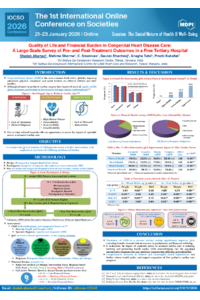
Background: Congenital heart disease (CHD) is the most common birth defect globally, imposing substantial physical, emotional, and social burdens on affected children and their families. Although advances in pediatric cardiac surgery have improved survival, quality-of-life (QoL) outcomes, particularly in low-resource settings, remain underexplored. Free tertiary referral hospitals offer an opportunity to assess the impact of equitable access to advanced cardiac care.
Objective: To evaluate the QoL of families of CHD patients before and after intervention, with emphasis on psychosocial wellbeing and financial burden.
Methods: A hospital-based survey was conducted among CHD patients undergoing intervention at a free tertiary referral hospital in India between 2018 and 2025. A validated 20-item QoL questionnaire was administered preoperatively and at postoperative intervals, assessing physical functioning, emotional wellbeing, social integration, and financial burden. Responses were recorded using a four-point Likert scale (never–always) and analyzed using paired statistical methods (SPSS).
Results: Of approximately 12,500 interventions, 9,068 patients completed preoperative and 3,033 (33.4%) postoperative surveys; financial data were available for 6,716 (74.1%) families. Preoperatively, 71.1% reported significant physical, psychological, or social challenges, which declined to ~1% one month post-intervention (p < 0.05). Regarding financial capacity, without free treatment, 58.3% could not afford surgery, 26.4% would incur debt, and only 3.1% could fully fund care. Based on family income–treatment cost analysis, only 17.7% could cover up to 75% of total intervention expenses.
Conclusion: Surgical correction of CHD in a no-cost tertiary setting significantly improves QoL, extending benefits beyond clinical recovery to psychosocial and financial wellbeing. These interim findings underscore the impact of equitable access to advanced cardiac care in reducing hardship and promoting health equity, while acknowledging that the one-third postoperative response rate may introduce response bias affecting generalizability.
Keywords
Congenital heart disease
Financial burden
Healthcare access
India
Psychosocial wellbeing
Poster
Sciforum-155149 (Shadab Ahamad).pdf
Technology and hope: AI potential in healthcare
SOCIAL SUSTAINABILITY AS AN ATTRACTIVE LEVER FOR A SPORT TOURISM EVENT: THE CASE OF RUNNING