Event submissions
Published
This submission belongs to the session S3. Sport/Leisure/Recreation/Tourism of the event The 1st International Online Conference on Societies
Published date
19 Jan, 2026
Academic Editor
'%3e%3cpath%20d='M12.6657%2010.9104C12.4185%2010.325%2012.0599%209.79327%2011.6097%209.34482C11.1609%208.89508%2010.6293%208.5365%2010.0442%208.28888C10.0389%208.28626%2010.0337%208.28495%2010.0285%208.28233C10.8446%207.69279%2011.3752%206.73249%2011.3752%205.64904C11.3752%203.8542%209.92103%202.39999%208.1262%202.39999C6.33136%202.39999%204.87715%203.8542%204.87715%205.64904C4.87715%206.73249%205.40774%207.69279%206.22393%208.28364C6.21869%208.28626%206.21345%208.28757%206.20821%208.29019C5.62129%208.5378%205.09463%208.89284%204.64265%209.34613C4.1929%209.79493%203.83432%2010.3266%203.58671%2010.9117C3.34345%2011.4845%203.21226%2012.0987%203.20023%2012.7209C3.19988%2012.7349%203.20233%2012.7488%203.20744%2012.7619C3.21255%2012.7749%203.22022%2012.7867%203.22998%2012.7968C3.23975%2012.8068%203.25142%2012.8147%203.26431%2012.8202C3.2772%2012.8256%203.29105%2012.8284%203.30504%2012.8284H4.09109C4.14874%2012.8284%204.19459%2012.7825%204.1959%2012.7262C4.2221%2011.7148%204.62823%2010.7676%205.34617%2010.0497C6.08899%209.30683%207.0755%208.89808%208.1262%208.89808C9.17689%208.89808%2010.1634%209.30683%2010.9062%2010.0497C11.6242%2010.7676%2012.0303%2011.7148%2012.0565%2012.7262C12.0578%2012.7838%2012.1037%2012.8284%2012.1613%2012.8284H12.9474C12.9613%2012.8284%2012.9752%2012.8256%2012.9881%2012.8202C13.001%2012.8147%2013.0126%2012.8068%2013.0224%2012.7968C13.0322%2012.7867%2013.0398%2012.7749%2013.0449%2012.7619C13.0501%2012.7488%2013.0525%2012.7349%2013.0522%2012.7209C13.0391%2012.0947%2012.9094%2011.4855%2012.6657%2010.9104ZM8.1262%207.9024C7.52486%207.9024%206.9589%207.6679%206.53312%207.24211C6.10733%206.81633%205.87283%206.25037%205.87283%205.64904C5.87283%205.0477%206.10733%204.48174%206.53312%204.05596C6.9589%203.63018%207.52486%203.39567%208.1262%203.39567C8.72753%203.39567%209.29349%203.63018%209.71927%204.05596C10.1451%204.48174%2010.3796%205.0477%2010.3796%205.64904C10.3796%206.25037%2010.1451%206.81633%209.71927%207.24211C9.29349%207.6679%208.72753%207.9024%208.1262%207.9024Z'%20fill='%235D1EE1'/%3e%3c/g%3e%3c/svg%3e) Michele Filippo Fontefrancesco
Michele Filippo FontefrancescoCitation
ELENI ROMPOTI, Zopounidis Konstandinos, Human Resource Management and Labor Relations in Tourism and Cultural Enterprises: Evidence from Crete, in Proceedings of The 1st International Online Conference on Societies, 21 January–23 January 2026, MDPI: Basel, Switzerland
Share
Email
Facebook
Twitter
LinkedIn
Human Resource Management and Labor Relations in Tourism and Cultural Enterprises: Evidence from Crete
'%3e%3cpath%20d='M12.6647%2010.9104C12.4176%2010.325%2012.0589%209.7933%2011.6088%209.34485C11.16%208.89511%2010.6283%208.53653%2010.0432%208.28891C10.038%208.28629%2010.0327%208.28498%2010.0275%208.28236C10.8437%207.69282%2011.3743%206.73252%2011.3743%205.64907C11.3743%203.85423%209.92005%202.40002%208.12522%202.40002C6.33038%202.40002%204.87618%203.85423%204.87618%205.64907C4.87618%206.73252%205.40677%207.69282%206.22296%208.28367C6.21772%208.28629%206.21248%208.2876%206.20724%208.29022C5.62031%208.53783%205.09365%208.89287%204.64167%209.34616C4.19192%209.79496%203.83334%2010.3266%203.58573%2010.9117C3.34247%2011.4846%203.21128%2012.0987%203.19925%2012.721C3.1989%2012.735%203.20135%2012.7489%203.20646%2012.7619C3.21157%2012.7749%203.21924%2012.7868%203.22901%2012.7968C3.23877%2012.8068%203.25045%2012.8148%203.26334%2012.8202C3.27623%2012.8256%203.29007%2012.8284%203.30406%2012.8284H4.09012C4.14776%2012.8284%204.19362%2012.7825%204.19493%2012.7262C4.22113%2011.7148%204.62726%2010.7676%205.34519%2010.0497C6.08802%209.30686%207.07452%208.89811%208.12522%208.89811C9.17592%208.89811%2010.1624%209.30686%2010.9052%2010.0497C11.6232%2010.7676%2012.0293%2011.7148%2012.0555%2012.7262C12.0568%2012.7839%2012.1027%2012.8284%2012.1603%2012.8284H12.9464C12.9604%2012.8284%2012.9742%2012.8256%2012.9871%2012.8202C13%2012.8148%2013.0117%2012.8068%2013.0214%2012.7968C13.0312%2012.7868%2013.0389%2012.7749%2013.044%2012.7619C13.0491%2012.7489%2013.0515%2012.735%2013.0512%2012.721C13.0381%2012.0947%2012.9084%2011.4856%2012.6647%2010.9104ZM8.12522%207.90243C7.52388%207.90243%206.95792%207.66793%206.53214%207.24215C6.10636%206.81636%205.87185%206.2504%205.87185%205.64907C5.87185%205.04773%206.10636%204.48177%206.53214%204.05599C6.95792%203.63021%207.52388%203.3957%208.12522%203.3957C8.72655%203.3957%209.29252%203.63021%209.7183%204.05599C10.1441%204.48177%2010.3786%205.04773%2010.3786%205.64907C10.3786%206.2504%2010.1441%206.81636%209.7183%207.24215C9.29252%207.66793%208.72655%207.90243%208.12522%207.90243Z'%20fill='%235D1EE1'/%3e%3c/g%3e%3c/svg%3e)
ELENI ROMPOTI 1
Zopounidis Konstandinos 2
1. School of Production Engineering and management, Τechnical University of Crete, Chania, 73100, Greece
2. The Financial Engineering Laboratory, Technical University of Crete, 73100 Chania, Greece
Abstract
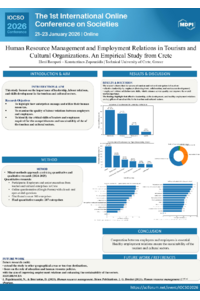
This paper, entitled “Human Resource Management and Labor Relations in Tourism and Cultural Enterprises: Evidence from Crete”, presents the findings of a postdoctoral research conducted at the Technical University of Crete, Greece. This study aims to highlight the significance of leadership, the quality of labor relations, and the development of skills in the sectors of tourism and culture—two fields of strategic importance not only for the Greek economy but also for the broader study of the sociology of tourism.
The methodology adopted a mixed-methods approach, combining quantitative and qualitative research. In the quantitative phase, questionnaires were distributed to 500 tourist and cultural enterprises across all prefectures of Crete, mapping management practices and human resource strategies. In the qualitative phase, in-depth interviews were conducted with employees, providing insights into workplace experiences, levels of job satisfaction, and the social dynamics shaping labor relations.
The results demonstrate that business success depends on two interrelated pillars: First, the leadership capabilities of employers, who are responsible for cultivating a culture built on trust, collaboration, and continuous learning. Second, the employees’ competencies—both technical (hard skills) and social (soft skills)—which enhance productivity, improve service quality, and ultimately shape the visitors' experience. At a sociological level, these labor relations and skills transcend the workplace, generating social identities, professional status, and collective experiences that influence how tourism is perceived and experienced as a social and cultural phenomenon.
In conclusion, this study shows that the synergy between management and the workforce functions not only as a mechanism of competitiveness but also as a social driver shaping the resilience, sustainability, and legitimacy of the tourist and cultural sectors. The contribution of this research is therefore twofold: it provides practical guidance for human resource management and enriches sociological discourse on tourism as domain where labor, economy, and society intersect.
Keywords
Human Resource Management
Labor Relations
Tourism and Cultural Enterprises
Poster
Eleni Rompoti-Poster.pdf
Equal in Sharing, Unequal in Care: Social Differences in Attitudes toward Shared Parental Leave in European Societies
Gender specificity of teachers' stress sources and health problems: evidence from a network analysis