Event submissions
Events3rd Conference on Future Challenges in Sustainable Urban Planning & Territorial Management
Published
This submission belongs to the session M. Miscellaneous of the event 3rd Conference on Future Challenges in Sustainable Urban Planning & Territorial Management
Published date
19 Jan, 2026
Academic Editor
'%3e%3cpath%20d='M12.6657%2010.9104C12.4185%2010.325%2012.0599%209.79327%2011.6097%209.34482C11.1609%208.89508%2010.6293%208.5365%2010.0442%208.28888C10.0389%208.28626%2010.0337%208.28495%2010.0285%208.28233C10.8446%207.69279%2011.3752%206.73249%2011.3752%205.64904C11.3752%203.8542%209.92103%202.39999%208.1262%202.39999C6.33136%202.39999%204.87715%203.8542%204.87715%205.64904C4.87715%206.73249%205.40774%207.69279%206.22393%208.28364C6.21869%208.28626%206.21345%208.28757%206.20821%208.29019C5.62129%208.5378%205.09463%208.89284%204.64265%209.34613C4.1929%209.79493%203.83432%2010.3266%203.58671%2010.9117C3.34345%2011.4845%203.21226%2012.0987%203.20023%2012.7209C3.19988%2012.7349%203.20233%2012.7488%203.20744%2012.7619C3.21255%2012.7749%203.22022%2012.7867%203.22998%2012.7968C3.23975%2012.8068%203.25142%2012.8147%203.26431%2012.8202C3.2772%2012.8256%203.29105%2012.8284%203.30504%2012.8284H4.09109C4.14874%2012.8284%204.19459%2012.7825%204.1959%2012.7262C4.2221%2011.7148%204.62823%2010.7676%205.34617%2010.0497C6.08899%209.30683%207.0755%208.89808%208.1262%208.89808C9.17689%208.89808%2010.1634%209.30683%2010.9062%2010.0497C11.6242%2010.7676%2012.0303%2011.7148%2012.0565%2012.7262C12.0578%2012.7838%2012.1037%2012.8284%2012.1613%2012.8284H12.9474C12.9613%2012.8284%2012.9752%2012.8256%2012.9881%2012.8202C13.001%2012.8147%2013.0126%2012.8068%2013.0224%2012.7968C13.0322%2012.7867%2013.0398%2012.7749%2013.0449%2012.7619C13.0501%2012.7488%2013.0525%2012.7349%2013.0522%2012.7209C13.0391%2012.0947%2012.9094%2011.4855%2012.6657%2010.9104ZM8.1262%207.9024C7.52486%207.9024%206.9589%207.6679%206.53312%207.24211C6.10733%206.81633%205.87283%206.25037%205.87283%205.64904C5.87283%205.0477%206.10733%204.48174%206.53312%204.05596C6.9589%203.63018%207.52486%203.39567%208.1262%203.39567C8.72753%203.39567%209.29349%203.63018%209.71927%204.05596C10.1451%204.48174%2010.3796%205.0477%2010.3796%205.64904C10.3796%206.25037%2010.1451%206.81633%209.71927%207.24211C9.29349%207.6679%208.72753%207.9024%208.1262%207.9024Z'%20fill='%235D1EE1'/%3e%3c/g%3e%3c/svg%3e) Salvador Garcia-Ayllon
Salvador Garcia-AyllonCitation
Margarita Martínez-Díaz, In Search of Equity: Advances and Gaps in Transport Planning for Diversity, in Proceedings of 3rd Conference on Future Challenges in Sustainable Urban Planning & Territorial Management, 20 January–22 January 2026, MDPI: Basel, Switzerland
Share
Email
Facebook
Twitter
LinkedIn
In Search of Equity: Advances and Gaps in Transport Planning for Diversity

Margarita Martínez-Díaz 1
1. Universitat Politècnica de Catalunya
Abstract
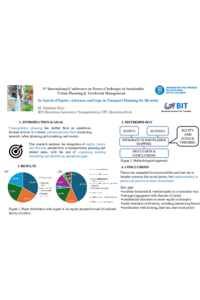
In recent years, user-centric approaches have gained prominence in transport planning. This shift is driven by two key factors: the need to better understand individual travel behaviors in order to design effective services or influence modal choices, and the renewed recognition of mobility as a critical factor for quality of life and access to opportunities. For example, studies have shown that women often face greater mobility challenges than men, stemming from more complex travel patterns linked to caregiving responsibilities, lower income levels, and heightened safety concerns. Similarly, mobility barriers for older adults and individuals with disabilities have been increasingly acknowledged. In response, policy measures have emerged—such as off-peak public transport enhancements or on-demand stops for women, and accessibility features like ramps and designated seating for users with limited mobility. Despite these advances, transport systems remain inequitable, with persistent disparities across user groups and geographic areas. Moreover, the concept of diversity in transport planning is frequently limited to categories such as gender, age, income, or physical ability, while other critical dimensions—such as cultural, geographical, or institutional diversity—are often overlooked. There is also a pressing need for more interdisciplinary approaches that integrate transportation engineering with social sciences, planning, and policy studies, to better address the multifaceted nature of diversity in mobility systems. In this context, this study is grounded in an Integrated Knowledge Mapping of relevant literature, encompassing theoretical frameworks, methodological approaches, and key empirical insights across the field. It aims to examine how the concepts of diversity and equity are commonly understood within transport planning, and how they are operationalized in analytical practices. Its final goal is to identify critical gaps in research, this is, areas that remain underexplored and must be addressed to advance the goal of inclusive and accessible mobility for all.
Keywords
Equity
Diversity
Transport Planning
Manuscript
Short_MMD_SUPTM 2026_In Search of Equity_Advances and Gaps in Transport Planning.pdf
Poster
MMD_Poster In Seach of Equity.pdf
From Environment to Accidents: Understanding Pedestrian Safety through Spatial Analysis in Taipei
Urban planning and design guidelines for integrating autonomous mobility into cities