Event submissions
Published
This submission belongs to the session S1. The Social Nature of Health and Well-Being of the event The 1st International Online Conference on Societies
Published date
23 Jan, 2026
Academic Editor
'%3e%3cpath%20d='M12.6657%2010.9104C12.4185%2010.325%2012.0599%209.79327%2011.6097%209.34482C11.1609%208.89508%2010.6293%208.5365%2010.0442%208.28888C10.0389%208.28626%2010.0337%208.28495%2010.0285%208.28233C10.8446%207.69279%2011.3752%206.73249%2011.3752%205.64904C11.3752%203.8542%209.92103%202.39999%208.1262%202.39999C6.33136%202.39999%204.87715%203.8542%204.87715%205.64904C4.87715%206.73249%205.40774%207.69279%206.22393%208.28364C6.21869%208.28626%206.21345%208.28757%206.20821%208.29019C5.62129%208.5378%205.09463%208.89284%204.64265%209.34613C4.1929%209.79493%203.83432%2010.3266%203.58671%2010.9117C3.34345%2011.4845%203.21226%2012.0987%203.20023%2012.7209C3.19988%2012.7349%203.20233%2012.7488%203.20744%2012.7619C3.21255%2012.7749%203.22022%2012.7867%203.22998%2012.7968C3.23975%2012.8068%203.25142%2012.8147%203.26431%2012.8202C3.2772%2012.8256%203.29105%2012.8284%203.30504%2012.8284H4.09109C4.14874%2012.8284%204.19459%2012.7825%204.1959%2012.7262C4.2221%2011.7148%204.62823%2010.7676%205.34617%2010.0497C6.08899%209.30683%207.0755%208.89808%208.1262%208.89808C9.17689%208.89808%2010.1634%209.30683%2010.9062%2010.0497C11.6242%2010.7676%2012.0303%2011.7148%2012.0565%2012.7262C12.0578%2012.7838%2012.1037%2012.8284%2012.1613%2012.8284H12.9474C12.9613%2012.8284%2012.9752%2012.8256%2012.9881%2012.8202C13.001%2012.8147%2013.0126%2012.8068%2013.0224%2012.7968C13.0322%2012.7867%2013.0398%2012.7749%2013.0449%2012.7619C13.0501%2012.7488%2013.0525%2012.7349%2013.0522%2012.7209C13.0391%2012.0947%2012.9094%2011.4855%2012.6657%2010.9104ZM8.1262%207.9024C7.52486%207.9024%206.9589%207.6679%206.53312%207.24211C6.10733%206.81633%205.87283%206.25037%205.87283%205.64904C5.87283%205.0477%206.10733%204.48174%206.53312%204.05596C6.9589%203.63018%207.52486%203.39567%208.1262%203.39567C8.72753%203.39567%209.29349%203.63018%209.71927%204.05596C10.1451%204.48174%2010.3796%205.0477%2010.3796%205.64904C10.3796%206.25037%2010.1451%206.81633%209.71927%207.24211C9.29349%207.6679%208.72753%207.9024%208.1262%207.9024Z'%20fill='%235D1EE1'/%3e%3c/g%3e%3c/svg%3e) Gregor Wolbring
Gregor WolbringCitation
Guilherme Welter Wendt, Understanding Sexual Abuse Risk: A Brazilian School-Based Study, in Proceedings of The 1st International Online Conference on Societies, 21 January–23 January 2026, MDPI: Basel, Switzerland
Share
Email
Facebook
Twitter
LinkedIn
Understanding Sexual Abuse Risk: A Brazilian School-Based Study

Guilherme Welter Wendt 1
1. Department of Medical Sciences, Health Sciences Center, Western Parana State University, Francisco Beltrão Campus, Francisco Beltrão, 85601, Brazil
Abstract
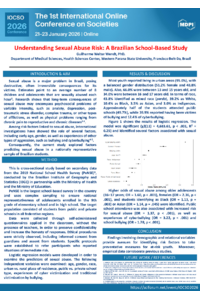
Sexual abuse is a widespread issue in Brazil, and its effects are very damaging, if not irreversible, for victims. This type of violence is a deep-rooted, alarmingly widespread problem in Brazilian society, and the effects on lives can be extensive. Long-lasting effects may include psychosocial problems, with varying levels of intensity (for example, anxiety, depression, post-traumatic stress disorder, or complex trauma), and physical issues that may range from chronic pain to reproductive concerns, or even chronic illnesses. For this reason, the current study explored predictors of sexual abuse in a nationally representative sample of students completing a school-based survey in 2019. Logistic regression models were developed using the following independent variables: age, gender, race, urban vs. rural, public vs. private, cyber victimization and traditional victimization by bullying. Findings indicated that age (16-17 versus younger; OR = 1.60, p < .001), female gender (OR = 2.36, p < .001) and indigenous and racial identities who identified as black (OR = 1.13, p = .003) or Asian (OR = 1.14, p = .045) increased the likelihood of sexual abuse. Findings also indicated students in public schools had higher odds of reporting sexual abuse (OR = 1.37, p < .001) than private school students. Those who experienced cyberbullying (OR = 3.22, p < .001) and school bullying (OR = 1.78, p < .001) reported greater odds for sexual abuse than their non-bullied classmates. Aligning with both national and international studies, these results provide testimony as to the extent and prevalence of sexual abuse. Findings involving demographic and relational variables provide avenues for prevention, such as in identifying risk factors to take preventative measures for at-risk youth. Enhancements in accessing support services are needed, as well societal awareness regarding this form of traumatic violence experienced by youth.
Keywords
Children
Sexual Abuse
Risk Factors
Poster
TemplateSocietiesConferenceWendt.pdf
Integration and Belonging Through Relationships: Immigrant Youths’ Experiences of Community-Based Mentoring