Event submissions
Published
This submission belongs to the session S4. Cold atoms and atom based quantum technology of the event The 1st International Online Conference on Atoms
Published date
27 Jan, 2026
Academic Editor
'%3e%3cpath%20d='M12.6657%2010.9104C12.4185%2010.325%2012.0599%209.79327%2011.6097%209.34482C11.1609%208.89508%2010.6293%208.5365%2010.0442%208.28888C10.0389%208.28626%2010.0337%208.28495%2010.0285%208.28233C10.8446%207.69279%2011.3752%206.73249%2011.3752%205.64904C11.3752%203.8542%209.92103%202.39999%208.1262%202.39999C6.33136%202.39999%204.87715%203.8542%204.87715%205.64904C4.87715%206.73249%205.40774%207.69279%206.22393%208.28364C6.21869%208.28626%206.21345%208.28757%206.20821%208.29019C5.62129%208.5378%205.09463%208.89284%204.64265%209.34613C4.1929%209.79493%203.83432%2010.3266%203.58671%2010.9117C3.34345%2011.4845%203.21226%2012.0987%203.20023%2012.7209C3.19988%2012.7349%203.20233%2012.7488%203.20744%2012.7619C3.21255%2012.7749%203.22022%2012.7867%203.22998%2012.7968C3.23975%2012.8068%203.25142%2012.8147%203.26431%2012.8202C3.2772%2012.8256%203.29105%2012.8284%203.30504%2012.8284H4.09109C4.14874%2012.8284%204.19459%2012.7825%204.1959%2012.7262C4.2221%2011.7148%204.62823%2010.7676%205.34617%2010.0497C6.08899%209.30683%207.0755%208.89808%208.1262%208.89808C9.17689%208.89808%2010.1634%209.30683%2010.9062%2010.0497C11.6242%2010.7676%2012.0303%2011.7148%2012.0565%2012.7262C12.0578%2012.7838%2012.1037%2012.8284%2012.1613%2012.8284H12.9474C12.9613%2012.8284%2012.9752%2012.8256%2012.9881%2012.8202C13.001%2012.8147%2013.0126%2012.8068%2013.0224%2012.7968C13.0322%2012.7867%2013.0398%2012.7749%2013.0449%2012.7619C13.0501%2012.7488%2013.0525%2012.7349%2013.0522%2012.7209C13.0391%2012.0947%2012.9094%2011.4855%2012.6657%2010.9104ZM8.1262%207.9024C7.52486%207.9024%206.9589%207.6679%206.53312%207.24211C6.10733%206.81633%205.87283%206.25037%205.87283%205.64904C5.87283%205.0477%206.10733%204.48174%206.53312%204.05596C6.9589%203.63018%207.52486%203.39567%208.1262%203.39567C8.72753%203.39567%209.29349%203.63018%209.71927%204.05596C10.1451%204.48174%2010.3796%205.0477%2010.3796%205.64904C10.3796%206.25037%2010.1451%206.81633%209.71927%207.24211C9.29349%207.6679%208.72753%207.9024%208.1262%207.9024Z'%20fill='%235D1EE1'/%3e%3c/g%3e%3c/svg%3e) Pascal Quinet
Pascal QuinetCitation
Dai López Jacinto, Luis Enrique Alcántar Villegas, José Jimenez Mier, Fernando Ramírez Martínez,
Modulation Transfer Spectroscopy in Rubidium at 20 MHz
, in Proceedings of The 1st International Online Conference on Atoms, 29 January–30 January 2026, MDPI: Basel, Switzerland
Share
Email
Facebook
Twitter
LinkedIn
- Modulation Transfer Spectroscopy in Rubidium at 20 MHz
- Modulation Transfer Spectroscopy in Rubidium at 20 MHz
'%3e%3cpath%20d='M12.6647%2010.9104C12.4176%2010.325%2012.0589%209.7933%2011.6088%209.34485C11.16%208.89511%2010.6283%208.53653%2010.0432%208.28891C10.038%208.28629%2010.0327%208.28498%2010.0275%208.28236C10.8437%207.69282%2011.3743%206.73252%2011.3743%205.64907C11.3743%203.85423%209.92005%202.40002%208.12522%202.40002C6.33038%202.40002%204.87618%203.85423%204.87618%205.64907C4.87618%206.73252%205.40677%207.69282%206.22296%208.28367C6.21772%208.28629%206.21248%208.2876%206.20724%208.29022C5.62031%208.53783%205.09365%208.89287%204.64167%209.34616C4.19192%209.79496%203.83334%2010.3266%203.58573%2010.9117C3.34247%2011.4846%203.21128%2012.0987%203.19925%2012.721C3.1989%2012.735%203.20135%2012.7489%203.20646%2012.7619C3.21157%2012.7749%203.21924%2012.7868%203.22901%2012.7968C3.23877%2012.8068%203.25045%2012.8148%203.26334%2012.8202C3.27623%2012.8256%203.29007%2012.8284%203.30406%2012.8284H4.09012C4.14776%2012.8284%204.19362%2012.7825%204.19493%2012.7262C4.22113%2011.7148%204.62726%2010.7676%205.34519%2010.0497C6.08802%209.30686%207.07452%208.89811%208.12522%208.89811C9.17592%208.89811%2010.1624%209.30686%2010.9052%2010.0497C11.6232%2010.7676%2012.0293%2011.7148%2012.0555%2012.7262C12.0568%2012.7839%2012.1027%2012.8284%2012.1603%2012.8284H12.9464C12.9604%2012.8284%2012.9742%2012.8256%2012.9871%2012.8202C13%2012.8148%2013.0117%2012.8068%2013.0214%2012.7968C13.0312%2012.7868%2013.0389%2012.7749%2013.044%2012.7619C13.0491%2012.7489%2013.0515%2012.735%2013.0512%2012.721C13.0381%2012.0947%2012.9084%2011.4856%2012.6647%2010.9104ZM8.12522%207.90243C7.52388%207.90243%206.95792%207.66793%206.53214%207.24215C6.10636%206.81636%205.87185%206.2504%205.87185%205.64907C5.87185%205.04773%206.10636%204.48177%206.53214%204.05599C6.95792%203.63021%207.52388%203.3957%208.12522%203.3957C8.72655%203.3957%209.29252%203.63021%209.7183%204.05599C10.1441%204.48177%2010.3786%205.04773%2010.3786%205.64907C10.3786%206.2504%2010.1441%206.81636%209.7183%207.24215C9.29252%207.66793%208.72655%207.90243%208.12522%207.90243Z'%20fill='%235D1EE1'/%3e%3c/g%3e%3c/svg%3e)
Dai López Jacinto 1
Luis Enrique Alcántar Villegas 1
José Jimenez Mier 1
Fernando Ramírez Martínez 1
1. Institute of Nuclear Sciences, National Autonomous University of Mexico (UNAM), Mexico City 04510, Mexico
Abstract
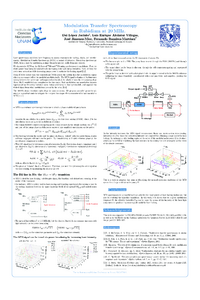
Laser spectroscopy stabilizes laser frequency to atomic resonances for cooling, clocks, and interferometry. Modulation Transfer Spectroscopy (MTS), a variant of Saturated Absorption Spectroscopy (SAS), locks a laser by modulating a single beam for precise, stable frequency control.
We characterize MTS on the D₂ lines of ⁸⁵Rb and ⁸⁷Rb using an electro-optic modulator. First, we study power broadening by symmetrically increasing probe and pump intensities. Next, we keep the probe near saturation while increasing pump power to optimize the locking signal [1,2].
Using 20 MHz rather than the conventional 5 MHz places the system in a fast-modulation regime where atoms cannot follow the modulation adiabatically. The MTS signal is dominated by four-wave mixing between the carrier and well-separated sidebands [1,4], which reduces the zero-crossing slope (lower Hz/V sensitivity) and complicates the line shape. Fast modulation can nonetheless improve rejection of low-frequency technical noise, reduce sensitivity to slow system drift, and separate the desired signal from other modulations present in the setup [3,4].
The 20 MHz choice therefore trades slope for noise immunity. We propose controlled power broadening as a practical route to mitigate the complex line-shape effects encountered in fast-modulation MTS [1,3,4].
# References
- D. J. McCarron, S. A. King, S. L. Cornish, Modulation transfer spectroscopy in atomic rubidium, Meas. Sci. Technol. 19, 105601 (2008).
- H.-R. Noh et al., Modulation transfer spectroscopy for 87Rb atoms: theory and experiment, Opt. Express 19, 23444–23452 (2011).
- T. Preuschoff, M. Schlosser, G. Birkl, Optimization strategies for modulation transfer spectroscopy applied to laser stabilization, Opt. Express 26, 24010–24019 (2018).
- E. Jaatinen, Theoretical determination of maximum signal levels obtainable with modulation transfer spectroscopy, Opt. Commun. 120, 91–97 (1995).
Keywords
modulation transfer spectroscopy
MTS
saturated absorption spectroscopy
laser frequency stabilization
rubidium D2 line
fast modulation
electro-optic modulator
four-wave mixing
power broadening
laser locking
atomic spectroscopy
Poster
dai lopez Poster Template SBrT 2024.pdf
Scattering Dynamic of Quantum Information Behaviors in Laser field with Hydrogen Atom
Atomic and nuclear clocks, space–time variation of the fundamental constants and dark matter