Event submissions
Published
This submission belongs to the session S1. Atomic structure and spectra: Theory and experiment of the event The 1st International Online Conference on Atoms
Published date
27 Jan, 2026
Academic Editor
'%3e%3cpath%20d='M12.6657%2010.9104C12.4185%2010.325%2012.0599%209.79327%2011.6097%209.34482C11.1609%208.89508%2010.6293%208.5365%2010.0442%208.28888C10.0389%208.28626%2010.0337%208.28495%2010.0285%208.28233C10.8446%207.69279%2011.3752%206.73249%2011.3752%205.64904C11.3752%203.8542%209.92103%202.39999%208.1262%202.39999C6.33136%202.39999%204.87715%203.8542%204.87715%205.64904C4.87715%206.73249%205.40774%207.69279%206.22393%208.28364C6.21869%208.28626%206.21345%208.28757%206.20821%208.29019C5.62129%208.5378%205.09463%208.89284%204.64265%209.34613C4.1929%209.79493%203.83432%2010.3266%203.58671%2010.9117C3.34345%2011.4845%203.21226%2012.0987%203.20023%2012.7209C3.19988%2012.7349%203.20233%2012.7488%203.20744%2012.7619C3.21255%2012.7749%203.22022%2012.7867%203.22998%2012.7968C3.23975%2012.8068%203.25142%2012.8147%203.26431%2012.8202C3.2772%2012.8256%203.29105%2012.8284%203.30504%2012.8284H4.09109C4.14874%2012.8284%204.19459%2012.7825%204.1959%2012.7262C4.2221%2011.7148%204.62823%2010.7676%205.34617%2010.0497C6.08899%209.30683%207.0755%208.89808%208.1262%208.89808C9.17689%208.89808%2010.1634%209.30683%2010.9062%2010.0497C11.6242%2010.7676%2012.0303%2011.7148%2012.0565%2012.7262C12.0578%2012.7838%2012.1037%2012.8284%2012.1613%2012.8284H12.9474C12.9613%2012.8284%2012.9752%2012.8256%2012.9881%2012.8202C13.001%2012.8147%2013.0126%2012.8068%2013.0224%2012.7968C13.0322%2012.7867%2013.0398%2012.7749%2013.0449%2012.7619C13.0501%2012.7488%2013.0525%2012.7349%2013.0522%2012.7209C13.0391%2012.0947%2012.9094%2011.4855%2012.6657%2010.9104ZM8.1262%207.9024C7.52486%207.9024%206.9589%207.6679%206.53312%207.24211C6.10733%206.81633%205.87283%206.25037%205.87283%205.64904C5.87283%205.0477%206.10733%204.48174%206.53312%204.05596C6.9589%203.63018%207.52486%203.39567%208.1262%203.39567C8.72753%203.39567%209.29349%203.63018%209.71927%204.05596C10.1451%204.48174%2010.3796%205.0477%2010.3796%205.64904C10.3796%206.25037%2010.1451%206.81633%209.71927%207.24211C9.29349%207.6679%208.72753%207.9024%208.1262%207.9024Z'%20fill='%235D1EE1'/%3e%3c/g%3e%3c/svg%3e) Pascal Quinet
Pascal QuinetCitation
Elmar Träbert, Long 3d-level lifetimes in highly charged ions of the iron-group elements: a nuisance or a feature?, in Proceedings of The 1st International Online Conference on Atoms, 29 January–30 January 2026, MDPI: Basel, Switzerland
Share
Email
Facebook
Twitter
LinkedIn
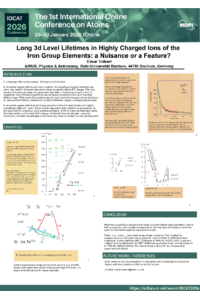
Long 3d-level lifetimes in highly charged ions of the iron-group elements: a nuisance or a feature?

Elmar Träbert 1
1. Department of Physics & Astronomy, AIRUB stands for Astronomy Institute Ruhr University Bochum, Bochum, 44780 , Germany
Abstract
Atomic lifetime measurements (for example, by beam–foil spectroscopic techniques) of prominent lines and levels in highly charged ions of iron-group elements began decades ago with 3s-3p resonance and intercombination transitions and a few 3p-3d transitions, finding lifetimes in the order of 0.1 ns to dozens of nanoseconds for levels with electric dipole (E1) decay channels. The proximity of the 3p- and 3d-level lifetimes causes well-known problems in multi-exponential decay curve analysis. When, later on, the much longer lifetimes (in the millisecond range) of levels with only E1-forbidden decay channels were addressed in ion traps, the cascade problem initially seemed to be absent, and these long-lived levels were considered to be unique. However, proceeding from Na- and Mg-like ions to Al-like ions and "heavier" isoelectronic sequences, slow cascades appeared that could be traced to specific long-lived 3d levels that also have only E1-forbidden decay channels and thus feature level lifetimes in the same millisecond range, causing the cascade problem to re-appear and to worsen with the increasing number of electrons in the n=3 valence shell. A severe complication arises from the fact that these (often multiple) 3d decays have not been observed directly, so no lifetime measurement has been available to test the computational predictions cleanly. There is at least an astrophysical identification of such a transition in (Al-like) Fe XIV, but this is without time resolution.
Keywords
Atomic level lifetimes
E1-forbidden decays
E1 decays
Cascade problems
Poster
ELMAR TRABERT Fe_3d_poster_ET Kopie.pdf
Precision calculation of self-energy correction to Lamb shift: improved methods
Energy Levels and Transition Data of Cs XI