Event submissions
Published
This submission belongs to the session S1. Atomic structure and spectra: Theory and experiment of the event The 1st International Online Conference on Atoms
Published date
27 Jan, 2026
Academic Editor
'%3e%3cpath%20d='M12.6657%2010.9104C12.4185%2010.325%2012.0599%209.79327%2011.6097%209.34482C11.1609%208.89508%2010.6293%208.5365%2010.0442%208.28888C10.0389%208.28626%2010.0337%208.28495%2010.0285%208.28233C10.8446%207.69279%2011.3752%206.73249%2011.3752%205.64904C11.3752%203.8542%209.92103%202.39999%208.1262%202.39999C6.33136%202.39999%204.87715%203.8542%204.87715%205.64904C4.87715%206.73249%205.40774%207.69279%206.22393%208.28364C6.21869%208.28626%206.21345%208.28757%206.20821%208.29019C5.62129%208.5378%205.09463%208.89284%204.64265%209.34613C4.1929%209.79493%203.83432%2010.3266%203.58671%2010.9117C3.34345%2011.4845%203.21226%2012.0987%203.20023%2012.7209C3.19988%2012.7349%203.20233%2012.7488%203.20744%2012.7619C3.21255%2012.7749%203.22022%2012.7867%203.22998%2012.7968C3.23975%2012.8068%203.25142%2012.8147%203.26431%2012.8202C3.2772%2012.8256%203.29105%2012.8284%203.30504%2012.8284H4.09109C4.14874%2012.8284%204.19459%2012.7825%204.1959%2012.7262C4.2221%2011.7148%204.62823%2010.7676%205.34617%2010.0497C6.08899%209.30683%207.0755%208.89808%208.1262%208.89808C9.17689%208.89808%2010.1634%209.30683%2010.9062%2010.0497C11.6242%2010.7676%2012.0303%2011.7148%2012.0565%2012.7262C12.0578%2012.7838%2012.1037%2012.8284%2012.1613%2012.8284H12.9474C12.9613%2012.8284%2012.9752%2012.8256%2012.9881%2012.8202C13.001%2012.8147%2013.0126%2012.8068%2013.0224%2012.7968C13.0322%2012.7867%2013.0398%2012.7749%2013.0449%2012.7619C13.0501%2012.7488%2013.0525%2012.7349%2013.0522%2012.7209C13.0391%2012.0947%2012.9094%2011.4855%2012.6657%2010.9104ZM8.1262%207.9024C7.52486%207.9024%206.9589%207.6679%206.53312%207.24211C6.10733%206.81633%205.87283%206.25037%205.87283%205.64904C5.87283%205.0477%206.10733%204.48174%206.53312%204.05596C6.9589%203.63018%207.52486%203.39567%208.1262%203.39567C8.72753%203.39567%209.29349%203.63018%209.71927%204.05596C10.1451%204.48174%2010.3796%205.0477%2010.3796%205.64904C10.3796%206.25037%2010.1451%206.81633%209.71927%207.24211C9.29349%207.6679%208.72753%207.9024%208.1262%207.9024Z'%20fill='%235D1EE1'/%3e%3c/g%3e%3c/svg%3e) Pascal Quinet
Pascal QuinetCitation
Leonid Skripnikov, Nuclear magnetization distribution effect in molecules and atoms, in Proceedings of The 1st International Online Conference on Atoms, 29 January–30 January 2026, MDPI: Basel, Switzerland
Share
Email
Facebook
Twitter
LinkedIn
Nuclear magnetization distribution effect in molecules and atoms

Leonid Skripnikov 1
1. Petersburg Nuclear Physics Institute named after B.P. Konstantinov, National Research Centre “Kurchatov Institute”, Gatchina 188300, Leningrad Region, Russia
Abstract
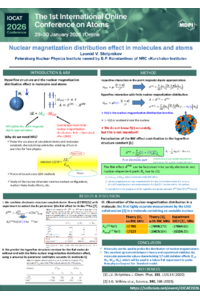
Theoretical predictions of hyperfine splitting in heavy atoms and molecules hold significant importance across various fundamental physical applications. They serve as crucial tests for the accuracy of calculated properties necessary for interpreting experiments aimed at detecting violations of spatial parity and time-reversal symmetries in fundamental interactions using atoms and molecules. Hyperfine splittings in the spectra of highly charged ions offer opportunities to test bound-state quantum electrodynamics. Accurate calculations are essential for determining the magnetic moments of short-lived isotopes.
In many cases, the largest uncertainty in the theoretically predicted value of the hyperfine splitting arises from the nuclear component of the problem, namely from the finite nuclear magnetization distribution known as the Bohr–Weisskopf (BW) effect in atoms. This distribution is not well known in most cases. We developed a model-independent approach to address the BW effect in atoms and molecules.
This method is applied to the radium monofluoride molecule, demonstrating the possibility of separating the contribution of the BW effect to the hyperfine constant of a heavy atom or molecule into a purely electronic-structure part and a universal parameter dependent on the nucleus. This factorization allows for the extraction of the nuclear magnetization distribution from experimental data on the hyperfine structure in an atom or molecule, which can then be used to predict the BW effect in any other compound of the atom under consideration. This method has been experimentally verified. We also theoretically study the hyperfine structure of Po and Ag atoms. By employing the factorization method, we achieve substantially improved values for the nuclear magnetic dipole moments of different isotopes of these atoms.
This proposed formalism enables the deduction of nuclear magnetic dipole moments from hyperfine data for both atoms and molecules at a new level of precision.
Keywords
hyperfine structure
nuclear magnetic dipole moment,
Poster
poster_Skripnikov.pdf
Benchmarks and Improvement of Atomic Energy Level Calculations for Lanthanides with FAC and AS Atomic Codes
Analysis of the perturbative expansion for the energies of few-electron ions