Event submissions
Published
This submission belongs to the session S1. Atomic structure and spectra: Theory and experiment of the event The 1st International Online Conference on Atoms
Published date
27 Jan, 2026
Academic Editor
'%3e%3cpath%20d='M12.6657%2010.9104C12.4185%2010.325%2012.0599%209.79327%2011.6097%209.34482C11.1609%208.89508%2010.6293%208.5365%2010.0442%208.28888C10.0389%208.28626%2010.0337%208.28495%2010.0285%208.28233C10.8446%207.69279%2011.3752%206.73249%2011.3752%205.64904C11.3752%203.8542%209.92103%202.39999%208.1262%202.39999C6.33136%202.39999%204.87715%203.8542%204.87715%205.64904C4.87715%206.73249%205.40774%207.69279%206.22393%208.28364C6.21869%208.28626%206.21345%208.28757%206.20821%208.29019C5.62129%208.5378%205.09463%208.89284%204.64265%209.34613C4.1929%209.79493%203.83432%2010.3266%203.58671%2010.9117C3.34345%2011.4845%203.21226%2012.0987%203.20023%2012.7209C3.19988%2012.7349%203.20233%2012.7488%203.20744%2012.7619C3.21255%2012.7749%203.22022%2012.7867%203.22998%2012.7968C3.23975%2012.8068%203.25142%2012.8147%203.26431%2012.8202C3.2772%2012.8256%203.29105%2012.8284%203.30504%2012.8284H4.09109C4.14874%2012.8284%204.19459%2012.7825%204.1959%2012.7262C4.2221%2011.7148%204.62823%2010.7676%205.34617%2010.0497C6.08899%209.30683%207.0755%208.89808%208.1262%208.89808C9.17689%208.89808%2010.1634%209.30683%2010.9062%2010.0497C11.6242%2010.7676%2012.0303%2011.7148%2012.0565%2012.7262C12.0578%2012.7838%2012.1037%2012.8284%2012.1613%2012.8284H12.9474C12.9613%2012.8284%2012.9752%2012.8256%2012.9881%2012.8202C13.001%2012.8147%2013.0126%2012.8068%2013.0224%2012.7968C13.0322%2012.7867%2013.0398%2012.7749%2013.0449%2012.7619C13.0501%2012.7488%2013.0525%2012.7349%2013.0522%2012.7209C13.0391%2012.0947%2012.9094%2011.4855%2012.6657%2010.9104ZM8.1262%207.9024C7.52486%207.9024%206.9589%207.6679%206.53312%207.24211C6.10733%206.81633%205.87283%206.25037%205.87283%205.64904C5.87283%205.0477%206.10733%204.48174%206.53312%204.05596C6.9589%203.63018%207.52486%203.39567%208.1262%203.39567C8.72753%203.39567%209.29349%203.63018%209.71927%204.05596C10.1451%204.48174%2010.3796%205.0477%2010.3796%205.64904C10.3796%206.25037%2010.1451%206.81633%209.71927%207.24211C9.29349%207.6679%208.72753%207.9024%208.1262%207.9024Z'%20fill='%235D1EE1'/%3e%3c/g%3e%3c/svg%3e) Anil Pradhan
Anil PradhanCitation
Lucas Maison, Patrick Palmeri, Pascal Quinet, Multiplatform computations of M1 and E2 transition probabilities in lanthanide ions for kilonova nebular-phase analysis, in Proceedings of The 1st International Online Conference on Atoms, 29 January–30 January 2026, MDPI: Basel, Switzerland
Share
Email
Facebook
Twitter
LinkedIn
Multiplatform computations of M1 and E2 transition probabilities in lanthanide ions for kilonova nebular-phase analysis
'%3e%3cpath%20d='M12.6647%2010.9104C12.4176%2010.325%2012.0589%209.7933%2011.6088%209.34485C11.16%208.89511%2010.6283%208.53653%2010.0432%208.28891C10.038%208.28629%2010.0327%208.28498%2010.0275%208.28236C10.8437%207.69282%2011.3743%206.73252%2011.3743%205.64907C11.3743%203.85423%209.92005%202.40002%208.12522%202.40002C6.33038%202.40002%204.87618%203.85423%204.87618%205.64907C4.87618%206.73252%205.40677%207.69282%206.22296%208.28367C6.21772%208.28629%206.21248%208.2876%206.20724%208.29022C5.62031%208.53783%205.09365%208.89287%204.64167%209.34616C4.19192%209.79496%203.83334%2010.3266%203.58573%2010.9117C3.34247%2011.4846%203.21128%2012.0987%203.19925%2012.721C3.1989%2012.735%203.20135%2012.7489%203.20646%2012.7619C3.21157%2012.7749%203.21924%2012.7868%203.22901%2012.7968C3.23877%2012.8068%203.25045%2012.8148%203.26334%2012.8202C3.27623%2012.8256%203.29007%2012.8284%203.30406%2012.8284H4.09012C4.14776%2012.8284%204.19362%2012.7825%204.19493%2012.7262C4.22113%2011.7148%204.62726%2010.7676%205.34519%2010.0497C6.08802%209.30686%207.07452%208.89811%208.12522%208.89811C9.17592%208.89811%2010.1624%209.30686%2010.9052%2010.0497C11.6232%2010.7676%2012.0293%2011.7148%2012.0555%2012.7262C12.0568%2012.7839%2012.1027%2012.8284%2012.1603%2012.8284H12.9464C12.9604%2012.8284%2012.9742%2012.8256%2012.9871%2012.8202C13%2012.8148%2013.0117%2012.8068%2013.0214%2012.7968C13.0312%2012.7868%2013.0389%2012.7749%2013.044%2012.7619C13.0491%2012.7489%2013.0515%2012.735%2013.0512%2012.721C13.0381%2012.0947%2012.9084%2011.4856%2012.6647%2010.9104ZM8.12522%207.90243C7.52388%207.90243%206.95792%207.66793%206.53214%207.24215C6.10636%206.81636%205.87185%206.2504%205.87185%205.64907C5.87185%205.04773%206.10636%204.48177%206.53214%204.05599C6.95792%203.63021%207.52388%203.3957%208.12522%203.3957C8.72655%203.3957%209.29252%203.63021%209.7183%204.05599C10.1441%204.48177%2010.3786%205.04773%2010.3786%205.64907C10.3786%206.2504%2010.1441%206.81636%209.7183%207.24215C9.29252%207.66793%208.72655%207.90243%208.12522%207.90243Z'%20fill='%235D1EE1'/%3e%3c/g%3e%3c/svg%3e)
Lucas Maison 1
Patrick Palmeri 1

Pascal Quinet 1,2
1. Atomic Physics and Astrophysics, University of Mons (UMONS), 7000 Mons, Belgium
2. Institute of Physics and Nuclear Astrophysics (IPNAS), University of Liège (ULiège), 4000 Liège, Belgium
Abstract
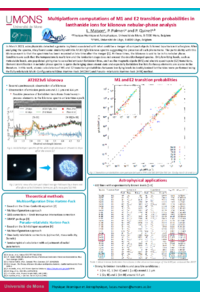
On August 17, 2017, the LIGO/Virgo collaboration detected, for the first time, a gravitational wave signal (GW170817) associated with a neutron star merger. This event marked a milestone in multi-messenger astronomy. The merger ejected a significant amount of hot and radioactive matter into space, where nuclear reactions synthesized elements that were heavier than iron, including lanthanides (Z = 57–71). The radioactive decay of these elements powered a transient electromagnetic phenomenon known as a kilonova.
In the early stages, the kilonova spectrum is dominated by numerous allowed transitions from heavy elements. However, in the later nebular phase, the temperature and density of the ejecta decrease significantly, limiting the ionization stage to at most doubly charged species. Under these conditions, only low-energy levels, such as metastable states, are populated, resulting in forbidden emission lines such as magnetic dipole (M1) and electric quadrupole (E2) transitions. Observations of kilonova AT2017gfo and, more recently, of a similar transient event recorded in March 2023 by the James Webb Space Telescope have revealed infrared spectral features in the late-time spectra that are potentially linked to forbidden transitions of lanthanides and other heavy elements.
To facilitate the analysis of such spectra, new calculations of transition probabilities for M1 and E2 lines between low-lying levels in singly and doubly ionized lanthanide atoms were carried out. The fully relativistic Multi-Configurational Dirac–Hartree–Fock (MCDHF) method, implemented in the GRASP code, was employed to model the atomic structure and compute radiative parameters. Results were compared to those obtained using the pseudo-relativistic Hartree–Fock (HFR) approach to ensure reliability. This work provides a consistent set of atomic data, highlighting the most intense forbidden lines of lanthanides, which are likely to be observed in the infrared spectra of kilonovae during their nebular phase.
Keywords
kilonovae
lanthanides
forbidden transitions
radiative decay rates
nebular phase
atomic data
Poster
IOCAT2026_Lucas_Maison_156042.pdf
Plasma screening effect on the above-threshold ionization of the sodium atom with a two-color laser field
From Atomic Physics to Predictions: AI-Assisted Screening of Heavy-Metal Removal by Metal-Oxide Nanomaterials