Event submissions
Published
This submission belongs to the session S1. Atomic structure and spectra: Theory and experiment of the event The 1st International Online Conference on Atoms
Published date
27 Jan, 2026
Academic Editor
'%3e%3cpath%20d='M12.6657%2010.9104C12.4185%2010.325%2012.0599%209.79327%2011.6097%209.34482C11.1609%208.89508%2010.6293%208.5365%2010.0442%208.28888C10.0389%208.28626%2010.0337%208.28495%2010.0285%208.28233C10.8446%207.69279%2011.3752%206.73249%2011.3752%205.64904C11.3752%203.8542%209.92103%202.39999%208.1262%202.39999C6.33136%202.39999%204.87715%203.8542%204.87715%205.64904C4.87715%206.73249%205.40774%207.69279%206.22393%208.28364C6.21869%208.28626%206.21345%208.28757%206.20821%208.29019C5.62129%208.5378%205.09463%208.89284%204.64265%209.34613C4.1929%209.79493%203.83432%2010.3266%203.58671%2010.9117C3.34345%2011.4845%203.21226%2012.0987%203.20023%2012.7209C3.19988%2012.7349%203.20233%2012.7488%203.20744%2012.7619C3.21255%2012.7749%203.22022%2012.7867%203.22998%2012.7968C3.23975%2012.8068%203.25142%2012.8147%203.26431%2012.8202C3.2772%2012.8256%203.29105%2012.8284%203.30504%2012.8284H4.09109C4.14874%2012.8284%204.19459%2012.7825%204.1959%2012.7262C4.2221%2011.7148%204.62823%2010.7676%205.34617%2010.0497C6.08899%209.30683%207.0755%208.89808%208.1262%208.89808C9.17689%208.89808%2010.1634%209.30683%2010.9062%2010.0497C11.6242%2010.7676%2012.0303%2011.7148%2012.0565%2012.7262C12.0578%2012.7838%2012.1037%2012.8284%2012.1613%2012.8284H12.9474C12.9613%2012.8284%2012.9752%2012.8256%2012.9881%2012.8202C13.001%2012.8147%2013.0126%2012.8068%2013.0224%2012.7968C13.0322%2012.7867%2013.0398%2012.7749%2013.0449%2012.7619C13.0501%2012.7488%2013.0525%2012.7349%2013.0522%2012.7209C13.0391%2012.0947%2012.9094%2011.4855%2012.6657%2010.9104ZM8.1262%207.9024C7.52486%207.9024%206.9589%207.6679%206.53312%207.24211C6.10733%206.81633%205.87283%206.25037%205.87283%205.64904C5.87283%205.0477%206.10733%204.48174%206.53312%204.05596C6.9589%203.63018%207.52486%203.39567%208.1262%203.39567C8.72753%203.39567%209.29349%203.63018%209.71927%204.05596C10.1451%204.48174%2010.3796%205.0477%2010.3796%205.64904C10.3796%206.25037%2010.1451%206.81633%209.71927%207.24211C9.29349%207.6679%208.72753%207.9024%208.1262%207.9024Z'%20fill='%235D1EE1'/%3e%3c/g%3e%3c/svg%3e) Pascal Quinet
Pascal QuinetCitation
Artem Bobylev, Dmitry Solovyev, Timur Zalialiutdinov, Calculations of energies, matrix elements, polarizabilities, and corresponding QED corrections for many-electron monovalent atoms and ions, in Proceedings of The 1st International Online Conference on Atoms, 29 January–30 January 2026, MDPI: Basel, Switzerland
Share
Email
Facebook
Twitter
LinkedIn
Calculations of energies, matrix elements, polarizabilities, and corresponding QED corrections for many-electron monovalent atoms and ions
'%3e%3cpath%20d='M12.6647%2010.9104C12.4176%2010.325%2012.0589%209.7933%2011.6088%209.34485C11.16%208.89511%2010.6283%208.53653%2010.0432%208.28891C10.038%208.28629%2010.0327%208.28498%2010.0275%208.28236C10.8437%207.69282%2011.3743%206.73252%2011.3743%205.64907C11.3743%203.85423%209.92005%202.40002%208.12522%202.40002C6.33038%202.40002%204.87618%203.85423%204.87618%205.64907C4.87618%206.73252%205.40677%207.69282%206.22296%208.28367C6.21772%208.28629%206.21248%208.2876%206.20724%208.29022C5.62031%208.53783%205.09365%208.89287%204.64167%209.34616C4.19192%209.79496%203.83334%2010.3266%203.58573%2010.9117C3.34247%2011.4846%203.21128%2012.0987%203.19925%2012.721C3.1989%2012.735%203.20135%2012.7489%203.20646%2012.7619C3.21157%2012.7749%203.21924%2012.7868%203.22901%2012.7968C3.23877%2012.8068%203.25045%2012.8148%203.26334%2012.8202C3.27623%2012.8256%203.29007%2012.8284%203.30406%2012.8284H4.09012C4.14776%2012.8284%204.19362%2012.7825%204.19493%2012.7262C4.22113%2011.7148%204.62726%2010.7676%205.34519%2010.0497C6.08802%209.30686%207.07452%208.89811%208.12522%208.89811C9.17592%208.89811%2010.1624%209.30686%2010.9052%2010.0497C11.6232%2010.7676%2012.0293%2011.7148%2012.0555%2012.7262C12.0568%2012.7839%2012.1027%2012.8284%2012.1603%2012.8284H12.9464C12.9604%2012.8284%2012.9742%2012.8256%2012.9871%2012.8202C13%2012.8148%2013.0117%2012.8068%2013.0214%2012.7968C13.0312%2012.7868%2013.0389%2012.7749%2013.044%2012.7619C13.0491%2012.7489%2013.0515%2012.735%2013.0512%2012.721C13.0381%2012.0947%2012.9084%2011.4856%2012.6647%2010.9104ZM8.12522%207.90243C7.52388%207.90243%206.95792%207.66793%206.53214%207.24215C6.10636%206.81636%205.87185%206.2504%205.87185%205.64907C5.87185%205.04773%206.10636%204.48177%206.53214%204.05599C6.95792%203.63021%207.52388%203.3957%208.12522%203.3957C8.72655%203.3957%209.29252%203.63021%209.7183%204.05599C10.1441%204.48177%2010.3786%205.04773%2010.3786%205.64907C10.3786%206.2504%2010.1441%206.81636%209.7183%207.24215C9.29252%207.66793%208.72655%207.90243%208.12522%207.90243Z'%20fill='%235D1EE1'/%3e%3c/g%3e%3c/svg%3e)
Artem Bobylev 1,2
Dmitry Solovyev 1,2
Timur Zalialiutdinov 1,2
1. Department of Physics, St. Petersburg State University, Petrodvorets, Oulianovskaya 1, 198504, St. Petersburg, Russia
2. Petersburg Nuclear Physics Institute named by B.P. Konstantinov of National Research Centre ’Kurchatov Institut’, St. Petersburg, Gatchina 188300, Russia
Abstract
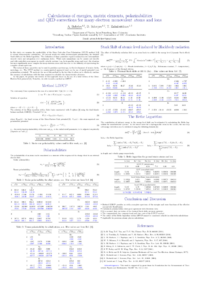
In this study, we examine the applicability of the Dirac–Fock plus Core-Polarization (DFCP) method to atomic characteristics calculations [1]. We present results for static electric-dipole polarizability, the thermal Stark shift and the Bethe logarithm [2]. The evaluation of these quantities requires summation over intermediate discrete states and integration over continuum states. While such summations can be carried out directly and with controlled convergence in exactly solvable systems (e.g., hydrogen-like atoms and ions), the situation becomes significantly more complex for many-electron atoms and ions due to the difficulty of reproducing the complete atomic spectrum.
To solve this problem, there are approximate approaches, including the use of model potentials, which are especially effective for monovalent atoms and ions of the alkaline group. In our work, we employ the DFCP method, which based a local form of the Dirac–Hartree–Fock potential [3] (LDFCP). We solve the radial part of the Dirac equation using a finite basis based on B-splines using the dual kinetic balance (DKB) method [4]. In this framework, the complete spectrum—discrete, continuum, and negative continuum—is replaced by a discrete pseudo-spectrum enabling summation over intermediate states (the so-called «sum-over-states» method). The pseudo-spectrum is constructed so that the lowest positive-energy states accurately reproduce the experimental low-lying bound states of the valence electron. The valence electron is considered in the self-consistent field of a frozen core, while core–valence correlation effects are described using a semi-empirical core-polarization potential.
We have obtained a complete spectrum of the energies and wave functions of the effective one-particle Hamiltonian using the LDFCP method. This allowed us to calculate some properties of atoms.This allowed us to calculate some properties of atoms such as polarizability, the thetmal Stark shift, the Bethe logarithm.
A comparison of the results obtained with the data from the literature calculated by other methods shows a good correspondence.
Keywords
atom
polarizability
semi-empirical potential
Poster
Poster_ArtemBobylev.pdf
Quantum-electrodynamics corrections to the hyperfine splitting via Green's function method
E. A. Samsonova1,*
E. A. Prokhorchuk1,2,**
1 St. Petersburg State University
2ITMO University, Saint Petersburg,
*st129161@student.spbu.ru
**st068889@student.spbu.ru
E. A. Samsonova1,*
E. A. Prokhorchuk1,2,**
1 St. Petersburg State University
2ITMO University, Saint Petersburg,
*st129161@student.spbu.ru
**st068889@student.spbu.ru
STUDY OF THE SCATTERING DYNAMIC OF ELECTRON: YUKAWA POTENTIAL IN PRESENCE OF BICHROMATIC LASER FIELDS