Event submissions
Published
This submission belongs to the session S2. Atomic collisions: Theory and experiment of the event The 1st International Online Conference on Atoms
Published date
27 Jan, 2026
Academic Editor
'%3e%3cpath%20d='M12.6657%2010.9104C12.4185%2010.325%2012.0599%209.79327%2011.6097%209.34482C11.1609%208.89508%2010.6293%208.5365%2010.0442%208.28888C10.0389%208.28626%2010.0337%208.28495%2010.0285%208.28233C10.8446%207.69279%2011.3752%206.73249%2011.3752%205.64904C11.3752%203.8542%209.92103%202.39999%208.1262%202.39999C6.33136%202.39999%204.87715%203.8542%204.87715%205.64904C4.87715%206.73249%205.40774%207.69279%206.22393%208.28364C6.21869%208.28626%206.21345%208.28757%206.20821%208.29019C5.62129%208.5378%205.09463%208.89284%204.64265%209.34613C4.1929%209.79493%203.83432%2010.3266%203.58671%2010.9117C3.34345%2011.4845%203.21226%2012.0987%203.20023%2012.7209C3.19988%2012.7349%203.20233%2012.7488%203.20744%2012.7619C3.21255%2012.7749%203.22022%2012.7867%203.22998%2012.7968C3.23975%2012.8068%203.25142%2012.8147%203.26431%2012.8202C3.2772%2012.8256%203.29105%2012.8284%203.30504%2012.8284H4.09109C4.14874%2012.8284%204.19459%2012.7825%204.1959%2012.7262C4.2221%2011.7148%204.62823%2010.7676%205.34617%2010.0497C6.08899%209.30683%207.0755%208.89808%208.1262%208.89808C9.17689%208.89808%2010.1634%209.30683%2010.9062%2010.0497C11.6242%2010.7676%2012.0303%2011.7148%2012.0565%2012.7262C12.0578%2012.7838%2012.1037%2012.8284%2012.1613%2012.8284H12.9474C12.9613%2012.8284%2012.9752%2012.8256%2012.9881%2012.8202C13.001%2012.8147%2013.0126%2012.8068%2013.0224%2012.7968C13.0322%2012.7867%2013.0398%2012.7749%2013.0449%2012.7619C13.0501%2012.7488%2013.0525%2012.7349%2013.0522%2012.7209C13.0391%2012.0947%2012.9094%2011.4855%2012.6657%2010.9104ZM8.1262%207.9024C7.52486%207.9024%206.9589%207.6679%206.53312%207.24211C6.10733%206.81633%205.87283%206.25037%205.87283%205.64904C5.87283%205.0477%206.10733%204.48174%206.53312%204.05596C6.9589%203.63018%207.52486%203.39567%208.1262%203.39567C8.72753%203.39567%209.29349%203.63018%209.71927%204.05596C10.1451%204.48174%2010.3796%205.0477%2010.3796%205.64904C10.3796%206.25037%2010.1451%206.81633%209.71927%207.24211C9.29349%207.6679%208.72753%207.9024%208.1262%207.9024Z'%20fill='%235D1EE1'/%3e%3c/g%3e%3c/svg%3e) Omar Fojón
Omar FojónCitation
Santosh Kumar Das, Saddam Husain Dhobi, Surendra Hangsarumba, Kishori Yadav, Suresh Prasad Gupta, STUDY OF THE SCATTERING DYNAMIC OF ELECTRON: YUKAWA POTENTIAL IN PRESENCE OF BICHROMATIC LASER FIELDS, in Proceedings of The 1st International Online Conference on Atoms, 29 January–30 January 2026, MDPI: Basel, Switzerland
Share
Email
Facebook
Twitter
LinkedIn
STUDY OF THE SCATTERING DYNAMIC OF ELECTRON: YUKAWA POTENTIAL IN PRESENCE OF BICHROMATIC LASER FIELDS
'%3e%3cpath%20d='M12.6647%2010.9104C12.4176%2010.325%2012.0589%209.7933%2011.6088%209.34485C11.16%208.89511%2010.6283%208.53653%2010.0432%208.28891C10.038%208.28629%2010.0327%208.28498%2010.0275%208.28236C10.8437%207.69282%2011.3743%206.73252%2011.3743%205.64907C11.3743%203.85423%209.92005%202.40002%208.12522%202.40002C6.33038%202.40002%204.87618%203.85423%204.87618%205.64907C4.87618%206.73252%205.40677%207.69282%206.22296%208.28367C6.21772%208.28629%206.21248%208.2876%206.20724%208.29022C5.62031%208.53783%205.09365%208.89287%204.64167%209.34616C4.19192%209.79496%203.83334%2010.3266%203.58573%2010.9117C3.34247%2011.4846%203.21128%2012.0987%203.19925%2012.721C3.1989%2012.735%203.20135%2012.7489%203.20646%2012.7619C3.21157%2012.7749%203.21924%2012.7868%203.22901%2012.7968C3.23877%2012.8068%203.25045%2012.8148%203.26334%2012.8202C3.27623%2012.8256%203.29007%2012.8284%203.30406%2012.8284H4.09012C4.14776%2012.8284%204.19362%2012.7825%204.19493%2012.7262C4.22113%2011.7148%204.62726%2010.7676%205.34519%2010.0497C6.08802%209.30686%207.07452%208.89811%208.12522%208.89811C9.17592%208.89811%2010.1624%209.30686%2010.9052%2010.0497C11.6232%2010.7676%2012.0293%2011.7148%2012.0555%2012.7262C12.0568%2012.7839%2012.1027%2012.8284%2012.1603%2012.8284H12.9464C12.9604%2012.8284%2012.9742%2012.8256%2012.9871%2012.8202C13%2012.8148%2013.0117%2012.8068%2013.0214%2012.7968C13.0312%2012.7868%2013.0389%2012.7749%2013.044%2012.7619C13.0491%2012.7489%2013.0515%2012.735%2013.0512%2012.721C13.0381%2012.0947%2012.9084%2011.4856%2012.6647%2010.9104ZM8.12522%207.90243C7.52388%207.90243%206.95792%207.66793%206.53214%207.24215C6.10636%206.81636%205.87185%206.2504%205.87185%205.64907C5.87185%205.04773%206.10636%204.48177%206.53214%204.05599C6.95792%203.63021%207.52388%203.3957%208.12522%203.3957C8.72655%203.3957%209.29252%203.63021%209.7183%204.05599C10.1441%204.48177%2010.3786%205.04773%2010.3786%205.64907C10.3786%206.2504%2010.1441%206.81636%209.7183%207.24215C9.29252%207.66793%208.72655%207.90243%208.12522%207.90243Z'%20fill='%235D1EE1'/%3e%3c/g%3e%3c/svg%3e)
Santosh Kumar Das 1
Saddam Husain Dhobi 1
Surendra Hangsarumba 1
Kishori Yadav 1
Suresh Prasad Gupta 1
1. Department of Physics, Tribhuvan University, Lalitpur, 44700, Nepal
Abstract
Abstract:
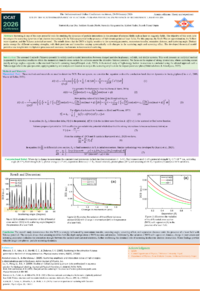
Scattering is one of the most powerful tools for studying the dynamics of particle interactions in the presence of external fields such as laser or magnetic fields. The objective of this work is to investigate the scattering dynamics of an electron interacting with the Yukawa potential in the presence of bichromatic polarized laser fields. For this purpose, the Kroll–Watson approximation, the Volkov wave equation, and the Yukawa potential are used [1-2]. The S-matrix is determined, and, using the Kronecker delta condition, the transition matrix is developed, which is directly related to the differential cross-section (DCS) for different polarizations. The transition matrix, along with the initial and final momentum of the electron, is used to analyze the scattering dynamics by computing the developed equations. The result shows that the DCS is highly sensitive to the screening parameter, momentum transfer, separation distance, and scattering angle. Distinct peaks emerge for different screening strengths, with their positions and intensities varying systematically with changes in the scattering angle and screening effect. When the change in momentum is minimum, the high and low peaks of the DCS are most pronounced; conversely, they decrease as the momentum change increases. The DCS attains its maximum value when the screening parameter is minimal, and this behavior is similarly observed in the variation of DCS with respect to separation and screening parameters. The developed theoretical model provides new insights into multiphoton processes and resonance mechanisms in laser-assisted scattering.
[1]Liu, P., Wang, Q., & Li, X. (2009). Studies on CdSe/L-cysteine quantum dots synthesized in aqueous solution for biological labeling. Journal of Physical Chemistry C, 113(18),7670–7676.
[2]Maurer, J., and Keller, U. (2021). Ionization inintense laser fields beyond the electric dipoleapproximation: concepts, methods, achieVementsand future directions. Journal of Physics B: Atomic,Molecular and Optical Physics, 54(9), 40-45.
Keywords
Yukawa potential
bichromatic polarized laser fields
Differential cross section
Kroll–Watson approximation
s-matrix
Poster
Santosh MDPI.pdf
Calculations of energies, matrix elements, polarizabilities, and corresponding QED corrections for many-electron monovalent atoms and ions
Interelectronic interaction effects in quadratic Zeeman splitting