Event submissions
Published
This submission belongs to the session S2. Atomic collisions: Theory and experiment of the event The 1st International Online Conference on Atoms
Published date
27 Jan, 2026
Academic Editor
'%3e%3cpath%20d='M12.6657%2010.9104C12.4185%2010.325%2012.0599%209.79327%2011.6097%209.34482C11.1609%208.89508%2010.6293%208.5365%2010.0442%208.28888C10.0389%208.28626%2010.0337%208.28495%2010.0285%208.28233C10.8446%207.69279%2011.3752%206.73249%2011.3752%205.64904C11.3752%203.8542%209.92103%202.39999%208.1262%202.39999C6.33136%202.39999%204.87715%203.8542%204.87715%205.64904C4.87715%206.73249%205.40774%207.69279%206.22393%208.28364C6.21869%208.28626%206.21345%208.28757%206.20821%208.29019C5.62129%208.5378%205.09463%208.89284%204.64265%209.34613C4.1929%209.79493%203.83432%2010.3266%203.58671%2010.9117C3.34345%2011.4845%203.21226%2012.0987%203.20023%2012.7209C3.19988%2012.7349%203.20233%2012.7488%203.20744%2012.7619C3.21255%2012.7749%203.22022%2012.7867%203.22998%2012.7968C3.23975%2012.8068%203.25142%2012.8147%203.26431%2012.8202C3.2772%2012.8256%203.29105%2012.8284%203.30504%2012.8284H4.09109C4.14874%2012.8284%204.19459%2012.7825%204.1959%2012.7262C4.2221%2011.7148%204.62823%2010.7676%205.34617%2010.0497C6.08899%209.30683%207.0755%208.89808%208.1262%208.89808C9.17689%208.89808%2010.1634%209.30683%2010.9062%2010.0497C11.6242%2010.7676%2012.0303%2011.7148%2012.0565%2012.7262C12.0578%2012.7838%2012.1037%2012.8284%2012.1613%2012.8284H12.9474C12.9613%2012.8284%2012.9752%2012.8256%2012.9881%2012.8202C13.001%2012.8147%2013.0126%2012.8068%2013.0224%2012.7968C13.0322%2012.7867%2013.0398%2012.7749%2013.0449%2012.7619C13.0501%2012.7488%2013.0525%2012.7349%2013.0522%2012.7209C13.0391%2012.0947%2012.9094%2011.4855%2012.6657%2010.9104ZM8.1262%207.9024C7.52486%207.9024%206.9589%207.6679%206.53312%207.24211C6.10733%206.81633%205.87283%206.25037%205.87283%205.64904C5.87283%205.0477%206.10733%204.48174%206.53312%204.05596C6.9589%203.63018%207.52486%203.39567%208.1262%203.39567C8.72753%203.39567%209.29349%203.63018%209.71927%204.05596C10.1451%204.48174%2010.3796%205.0477%2010.3796%205.64904C10.3796%206.25037%2010.1451%206.81633%209.71927%207.24211C9.29349%207.6679%208.72753%207.9024%208.1262%207.9024Z'%20fill='%235D1EE1'/%3e%3c/g%3e%3c/svg%3e) Omar Fojón
Omar FojónCitation
VERÓNICA BELÉN TESSARO, BENOIT GERVAIS, MICHAEL BEUVE, MARIEL ELISA GALASSI, REFERENCE DOSIMETRY IN HADRONTHERAPY: MONTE CARLO CALCULATION OF STOPPING POWER AND W-VALUES, in Proceedings of The 1st International Online Conference on Atoms, 29 January–30 January 2026, MDPI: Basel, Switzerland
Share
Email
Facebook
Twitter
LinkedIn
REFERENCE DOSIMETRY IN HADRONTHERAPY: MONTE CARLO CALCULATION OF STOPPING POWER AND W-VALUES
'%3e%3cpath%20d='M12.6647%2010.9104C12.4176%2010.325%2012.0589%209.7933%2011.6088%209.34485C11.16%208.89511%2010.6283%208.53653%2010.0432%208.28891C10.038%208.28629%2010.0327%208.28498%2010.0275%208.28236C10.8437%207.69282%2011.3743%206.73252%2011.3743%205.64907C11.3743%203.85423%209.92005%202.40002%208.12522%202.40002C6.33038%202.40002%204.87618%203.85423%204.87618%205.64907C4.87618%206.73252%205.40677%207.69282%206.22296%208.28367C6.21772%208.28629%206.21248%208.2876%206.20724%208.29022C5.62031%208.53783%205.09365%208.89287%204.64167%209.34616C4.19192%209.79496%203.83334%2010.3266%203.58573%2010.9117C3.34247%2011.4846%203.21128%2012.0987%203.19925%2012.721C3.1989%2012.735%203.20135%2012.7489%203.20646%2012.7619C3.21157%2012.7749%203.21924%2012.7868%203.22901%2012.7968C3.23877%2012.8068%203.25045%2012.8148%203.26334%2012.8202C3.27623%2012.8256%203.29007%2012.8284%203.30406%2012.8284H4.09012C4.14776%2012.8284%204.19362%2012.7825%204.19493%2012.7262C4.22113%2011.7148%204.62726%2010.7676%205.34519%2010.0497C6.08802%209.30686%207.07452%208.89811%208.12522%208.89811C9.17592%208.89811%2010.1624%209.30686%2010.9052%2010.0497C11.6232%2010.7676%2012.0293%2011.7148%2012.0555%2012.7262C12.0568%2012.7839%2012.1027%2012.8284%2012.1603%2012.8284H12.9464C12.9604%2012.8284%2012.9742%2012.8256%2012.9871%2012.8202C13%2012.8148%2013.0117%2012.8068%2013.0214%2012.7968C13.0312%2012.7868%2013.0389%2012.7749%2013.044%2012.7619C13.0491%2012.7489%2013.0515%2012.735%2013.0512%2012.721C13.0381%2012.0947%2012.9084%2011.4856%2012.6647%2010.9104ZM8.12522%207.90243C7.52388%207.90243%206.95792%207.66793%206.53214%207.24215C6.10636%206.81636%205.87185%206.2504%205.87185%205.64907C5.87185%205.04773%206.10636%204.48177%206.53214%204.05599C6.95792%203.63021%207.52388%203.3957%208.12522%203.3957C8.72655%203.3957%209.29252%203.63021%209.7183%204.05599C10.1441%204.48177%2010.3786%205.04773%2010.3786%205.64907C10.3786%206.2504%2010.1441%206.81636%209.7183%207.24215C9.29252%207.66793%208.72655%207.90243%208.12522%207.90243Z'%20fill='%235D1EE1'/%3e%3c/g%3e%3c/svg%3e)
VERÓNICA BELÉN TESSARO 1
BENOIT GERVAIS 2
MICHAEL BEUVE 3

MARIEL ELISA GALASSI 1
1. School of Basic Education, Department of Physics and Chemistry, Faculty of Exact Sciences, Engineering and Surveying – Biomedical Physics Group, National University of Rosario; Rosario Physics Institute (IFIR–CONICET), Rosario S2000, Argentina
2. Centre for Research on Ions, Materials and Photonics (CIMAP), UMR 6252, CIRIL–GANIL; CEA (French Alternative Energies and Atomic Energy Commission), CNRS (National Centre for Scientific Research), ENSICAEN (National Graduate School of Engineering of Caen)
3. Institute of Physics of the Two Infinities of Lyon (IP2I), CNRS/IN2P3 (National Institute of Nuclear and Particle Physics), Claude Bernard University Lyon 1, Villeurbanne 69100, France
Abstract
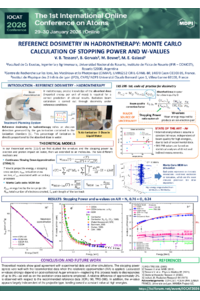
In hadrontherapy, reference dosimetry relies on air-filled ionization chambers [1]. Converting chamber readings to absorbed doses in water requires knowledge of the stopping power and the W-value in air (Wₐ), defined as the mean energy needed to produce an electron–ion pair. Experimental data for Wₐ for fast ions are limited, while theoretical calculations are highly demanding, as they must account for ion pairs generated by both the primary ion and all secondary electrons. Therefore, international protocols recommend a constant W-value, independent of beam quality, which represents a major source of uncertainty. This study aims to calculate these parameters for ion interactions in air to reduce uncertainties in reference dosimetry.
Calculations were performed with the MDM-Ion Monte Carlo code, extended to the studied media and ion projectiles [2,3,4], and with an analytical model based on the Continuous Slowing Down Approximation [5]. The adopted cross sections include relativistic corrections for projectile kinetic energy and consider the contribution from Auger electron emission.
The stopping power results obtained with the relativistic approximation show excellent agreement with the reference data reported in ICRU90. For the w-values, a good consistency is observed with other theoretical models and recommended data when post-collisional effects are taken into account. Moreover, this parameter exhibits a strong sensitivity to the choice of excitation cross sections employed in the calculations.
Stopping power is strongly influenced by relativistic corrections. In contrast, the w-values are mainly affected by the selection of excitation cross sections and post-collision effects, while remaining largely independent of the projectile type, approaching a constant value at high energies.
[1] IAEA TRS-398. (2000) http://www-naweb.iaea.org/nahu/DMRP/documents/CoP_V12_2006-06-05.pdf
[2] Tessaro (2019), NIMB doi:10.1016/j.nimb.2018.11.031.
[3] Tessaro (2021), Physica Medica, doi:10.1016/j.ejmp.2021.06.006.
[4] Tessaro (2022) Cotutelle Phd thesis: Universidad Nacional de Rosario (Argentina) and Universidad de Lyon 1 (Francia).
[5] Inokuti (1975), Radiation Research 64(1):6–22.
Keywords
MONTE CARLO SIMULATION - HADRONTHERAPY - REFERENCE DOSIMETRY
Poster
IOCAT2026_POSTER_TESSARO.pdf
Boson-mediated interelectronic interaction: spectral sensitivity of few-electron ions
Single-centre description of the electron impact ionization of molecules: H2O and C4H8O