Event submissions
Published
This submission belongs to the session S1. Atomic structure and spectra: Theory and experiment of the event The 1st International Online Conference on Atoms
Published date
27 Jan, 2026
Academic Editor
'%3e%3cpath%20d='M12.6657%2010.9104C12.4185%2010.325%2012.0599%209.79327%2011.6097%209.34482C11.1609%208.89508%2010.6293%208.5365%2010.0442%208.28888C10.0389%208.28626%2010.0337%208.28495%2010.0285%208.28233C10.8446%207.69279%2011.3752%206.73249%2011.3752%205.64904C11.3752%203.8542%209.92103%202.39999%208.1262%202.39999C6.33136%202.39999%204.87715%203.8542%204.87715%205.64904C4.87715%206.73249%205.40774%207.69279%206.22393%208.28364C6.21869%208.28626%206.21345%208.28757%206.20821%208.29019C5.62129%208.5378%205.09463%208.89284%204.64265%209.34613C4.1929%209.79493%203.83432%2010.3266%203.58671%2010.9117C3.34345%2011.4845%203.21226%2012.0987%203.20023%2012.7209C3.19988%2012.7349%203.20233%2012.7488%203.20744%2012.7619C3.21255%2012.7749%203.22022%2012.7867%203.22998%2012.7968C3.23975%2012.8068%203.25142%2012.8147%203.26431%2012.8202C3.2772%2012.8256%203.29105%2012.8284%203.30504%2012.8284H4.09109C4.14874%2012.8284%204.19459%2012.7825%204.1959%2012.7262C4.2221%2011.7148%204.62823%2010.7676%205.34617%2010.0497C6.08899%209.30683%207.0755%208.89808%208.1262%208.89808C9.17689%208.89808%2010.1634%209.30683%2010.9062%2010.0497C11.6242%2010.7676%2012.0303%2011.7148%2012.0565%2012.7262C12.0578%2012.7838%2012.1037%2012.8284%2012.1613%2012.8284H12.9474C12.9613%2012.8284%2012.9752%2012.8256%2012.9881%2012.8202C13.001%2012.8147%2013.0126%2012.8068%2013.0224%2012.7968C13.0322%2012.7867%2013.0398%2012.7749%2013.0449%2012.7619C13.0501%2012.7488%2013.0525%2012.7349%2013.0522%2012.7209C13.0391%2012.0947%2012.9094%2011.4855%2012.6657%2010.9104ZM8.1262%207.9024C7.52486%207.9024%206.9589%207.6679%206.53312%207.24211C6.10733%206.81633%205.87283%206.25037%205.87283%205.64904C5.87283%205.0477%206.10733%204.48174%206.53312%204.05596C6.9589%203.63018%207.52486%203.39567%208.1262%203.39567C8.72753%203.39567%209.29349%203.63018%209.71927%204.05596C10.1451%204.48174%2010.3796%205.0477%2010.3796%205.64904C10.3796%206.25037%2010.1451%206.81633%209.71927%207.24211C9.29349%207.6679%208.72753%207.9024%208.1262%207.9024Z'%20fill='%235D1EE1'/%3e%3c/g%3e%3c/svg%3e) Omar Fojón
Omar FojónCitation
Martín Barlari, Diego G. Arbó, María Silvia Gravielle, Darío M. Mitnik, Elimination of Spurious Oscillations in Photoemission Spectra via a Scattering Projection Method, in Proceedings of The 1st International Online Conference on Atoms, 29 January–30 January 2026, MDPI: Basel, Switzerland
Share
Email
Facebook
Twitter
LinkedIn
Elimination of Spurious Oscillations in Photoemission Spectra via a Scattering Projection Method
'%3e%3cpath%20d='M12.6647%2010.9104C12.4176%2010.325%2012.0589%209.7933%2011.6088%209.34485C11.16%208.89511%2010.6283%208.53653%2010.0432%208.28891C10.038%208.28629%2010.0327%208.28498%2010.0275%208.28236C10.8437%207.69282%2011.3743%206.73252%2011.3743%205.64907C11.3743%203.85423%209.92005%202.40002%208.12522%202.40002C6.33038%202.40002%204.87618%203.85423%204.87618%205.64907C4.87618%206.73252%205.40677%207.69282%206.22296%208.28367C6.21772%208.28629%206.21248%208.2876%206.20724%208.29022C5.62031%208.53783%205.09365%208.89287%204.64167%209.34616C4.19192%209.79496%203.83334%2010.3266%203.58573%2010.9117C3.34247%2011.4846%203.21128%2012.0987%203.19925%2012.721C3.1989%2012.735%203.20135%2012.7489%203.20646%2012.7619C3.21157%2012.7749%203.21924%2012.7868%203.22901%2012.7968C3.23877%2012.8068%203.25045%2012.8148%203.26334%2012.8202C3.27623%2012.8256%203.29007%2012.8284%203.30406%2012.8284H4.09012C4.14776%2012.8284%204.19362%2012.7825%204.19493%2012.7262C4.22113%2011.7148%204.62726%2010.7676%205.34519%2010.0497C6.08802%209.30686%207.07452%208.89811%208.12522%208.89811C9.17592%208.89811%2010.1624%209.30686%2010.9052%2010.0497C11.6232%2010.7676%2012.0293%2011.7148%2012.0555%2012.7262C12.0568%2012.7839%2012.1027%2012.8284%2012.1603%2012.8284H12.9464C12.9604%2012.8284%2012.9742%2012.8256%2012.9871%2012.8202C13%2012.8148%2013.0117%2012.8068%2013.0214%2012.7968C13.0312%2012.7868%2013.0389%2012.7749%2013.044%2012.7619C13.0491%2012.7489%2013.0515%2012.735%2013.0512%2012.721C13.0381%2012.0947%2012.9084%2011.4856%2012.6647%2010.9104ZM8.12522%207.90243C7.52388%207.90243%206.95792%207.66793%206.53214%207.24215C6.10636%206.81636%205.87185%206.2504%205.87185%205.64907C5.87185%205.04773%206.10636%204.48177%206.53214%204.05599C6.95792%203.63021%207.52388%203.3957%208.12522%203.3957C8.72655%203.3957%209.29252%203.63021%209.7183%204.05599C10.1441%204.48177%2010.3786%205.04773%2010.3786%205.64907C10.3786%206.2504%2010.1441%206.81636%209.7183%207.24215C9.29252%207.66793%208.72655%207.90243%208.12522%207.90243Z'%20fill='%235D1EE1'/%3e%3c/g%3e%3c/svg%3e)
Martín Barlari 1,2

Diego G. Arbó 1,2,3
María Silvia Gravielle 1
Darío M. Mitnik 1
1. Institute for Astronomy and Space Physics (IAFE, UBA–CONICET), Ciudad Universitaria, Buenos Aires C1428GA, Argentina
2. Department of Physics, Faculty of Exact and Natural Sciences, University of Buenos Aires, Ciudad Universitaria, Buenos Aires C1428EGA, Argentina
3. Common Basic Cycle (Ciclo Básico Común), University of Buenos Aires, Buenos Aires C1053ABH, Argentina
Abstract
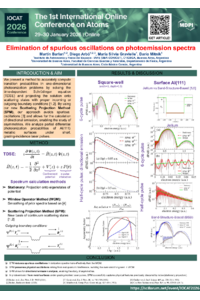
Introduction: The theoretical analysis of ultrafast laser–matter interactions requires accurate methods for calculating time-dependent photoionization spectra. A common approach involves solving the time-dependent Schrödinger equation (TDSE) and projecting the final wave function onto the stationary continuum states of the unperturbed Hamiltonian. However, this projection often introduces large, unphysical oscillations into the energy spectrum, which are typically smoothed using convolution techniques like the window-operator method (WOM), a process that can inadvertently suppress genuine physical features.
Methods: We introduce a novel Scattering Projection Method (SPM) for one-dimensional ionization processes [1]. Instead of using stationary eigenstates, the SPM projects the time-evolved wave function onto a basis of scattering states with appropriate incoming or outgoing boundary conditions. We compare the SPM against the WOM for several systems: a simple square well, a jellium model of a metal surface, and a realistic band-structure-based potential modeling a crystalline aluminum surface.
Results: The SPM effectively eliminates the spurious oscillations that plague the standard projection method, yielding a smooth energy spectrum. Crucially, unlike the WOM, the SPM preserves fine physical structures such as Ramsauer–Townsend resonances, which are smeared out by window averaging. The method also naturally enables the calculation of directional emission, revealing asymmetries in photoelectron spectra driven by ultrashort and half-cycle pulses.
Conclusions: The Scattering Projection Method provides a superior alternative for extracting photoemission spectra from numerical TDSE solutions. It removes spurious numerical artifacts more effectively while faithfully preserving physically relevant spectral details. The SPM is particularly useful for studying systems where quantum interference effects or emission directionality are of interest, offering a robust tool for the analysis of ultrafast ionization dynamics in atoms and solid surfaces.
References:
[1] Barlari et al., Eur. Phys. J. D. 79, 93 (2025).
Keywords
attosecond pulses
photoionization spectra
surface
spurious oscillations
scattering projection method
Poster
BARLARI_poster_IOCAT_2026.pdf
Electron–H2+ Scattering Dynamics in Self-Generated Laser and Thermal Fields for Performance Analysis of PEMFCs
Artificial Intelligence in Atomic and Space Radiation Modeling: Implications for Astronaut Health and Biomedical Risk Prediction