Event submissions
Published
This submission belongs to the session S1. Atomic structure and spectra: Theory and experiment of the event The 1st International Online Conference on Atoms
Published date
27 Jan, 2026
Academic Editor
'%3e%3cpath%20d='M12.6657%2010.9104C12.4185%2010.325%2012.0599%209.79327%2011.6097%209.34482C11.1609%208.89508%2010.6293%208.5365%2010.0442%208.28888C10.0389%208.28626%2010.0337%208.28495%2010.0285%208.28233C10.8446%207.69279%2011.3752%206.73249%2011.3752%205.64904C11.3752%203.8542%209.92103%202.39999%208.1262%202.39999C6.33136%202.39999%204.87715%203.8542%204.87715%205.64904C4.87715%206.73249%205.40774%207.69279%206.22393%208.28364C6.21869%208.28626%206.21345%208.28757%206.20821%208.29019C5.62129%208.5378%205.09463%208.89284%204.64265%209.34613C4.1929%209.79493%203.83432%2010.3266%203.58671%2010.9117C3.34345%2011.4845%203.21226%2012.0987%203.20023%2012.7209C3.19988%2012.7349%203.20233%2012.7488%203.20744%2012.7619C3.21255%2012.7749%203.22022%2012.7867%203.22998%2012.7968C3.23975%2012.8068%203.25142%2012.8147%203.26431%2012.8202C3.2772%2012.8256%203.29105%2012.8284%203.30504%2012.8284H4.09109C4.14874%2012.8284%204.19459%2012.7825%204.1959%2012.7262C4.2221%2011.7148%204.62823%2010.7676%205.34617%2010.0497C6.08899%209.30683%207.0755%208.89808%208.1262%208.89808C9.17689%208.89808%2010.1634%209.30683%2010.9062%2010.0497C11.6242%2010.7676%2012.0303%2011.7148%2012.0565%2012.7262C12.0578%2012.7838%2012.1037%2012.8284%2012.1613%2012.8284H12.9474C12.9613%2012.8284%2012.9752%2012.8256%2012.9881%2012.8202C13.001%2012.8147%2013.0126%2012.8068%2013.0224%2012.7968C13.0322%2012.7867%2013.0398%2012.7749%2013.0449%2012.7619C13.0501%2012.7488%2013.0525%2012.7349%2013.0522%2012.7209C13.0391%2012.0947%2012.9094%2011.4855%2012.6657%2010.9104ZM8.1262%207.9024C7.52486%207.9024%206.9589%207.6679%206.53312%207.24211C6.10733%206.81633%205.87283%206.25037%205.87283%205.64904C5.87283%205.0477%206.10733%204.48174%206.53312%204.05596C6.9589%203.63018%207.52486%203.39567%208.1262%203.39567C8.72753%203.39567%209.29349%203.63018%209.71927%204.05596C10.1451%204.48174%2010.3796%205.0477%2010.3796%205.64904C10.3796%206.25037%2010.1451%206.81633%209.71927%207.24211C9.29349%207.6679%208.72753%207.9024%208.1262%207.9024Z'%20fill='%235D1EE1'/%3e%3c/g%3e%3c/svg%3e) Pascal Quinet
Pascal QuinetCitation
Anjan Sadhukhan, Grzegorz Pestka, Rafał Podeszwa, Henryk A. Witek, Quantum Three-Body System: A Century-Old Problem Revisited, in Proceedings of The 1st International Online Conference on Atoms, 29 January–30 January 2026, MDPI: Basel, Switzerland
Share
Email
Facebook
Twitter
LinkedIn
Quantum Three-Body System: A Century-Old Problem Revisited
'%3e%3cpath%20d='M12.6647%2010.9104C12.4176%2010.325%2012.0589%209.7933%2011.6088%209.34485C11.16%208.89511%2010.6283%208.53653%2010.0432%208.28891C10.038%208.28629%2010.0327%208.28498%2010.0275%208.28236C10.8437%207.69282%2011.3743%206.73252%2011.3743%205.64907C11.3743%203.85423%209.92005%202.40002%208.12522%202.40002C6.33038%202.40002%204.87618%203.85423%204.87618%205.64907C4.87618%206.73252%205.40677%207.69282%206.22296%208.28367C6.21772%208.28629%206.21248%208.2876%206.20724%208.29022C5.62031%208.53783%205.09365%208.89287%204.64167%209.34616C4.19192%209.79496%203.83334%2010.3266%203.58573%2010.9117C3.34247%2011.4846%203.21128%2012.0987%203.19925%2012.721C3.1989%2012.735%203.20135%2012.7489%203.20646%2012.7619C3.21157%2012.7749%203.21924%2012.7868%203.22901%2012.7968C3.23877%2012.8068%203.25045%2012.8148%203.26334%2012.8202C3.27623%2012.8256%203.29007%2012.8284%203.30406%2012.8284H4.09012C4.14776%2012.8284%204.19362%2012.7825%204.19493%2012.7262C4.22113%2011.7148%204.62726%2010.7676%205.34519%2010.0497C6.08802%209.30686%207.07452%208.89811%208.12522%208.89811C9.17592%208.89811%2010.1624%209.30686%2010.9052%2010.0497C11.6232%2010.7676%2012.0293%2011.7148%2012.0555%2012.7262C12.0568%2012.7839%2012.1027%2012.8284%2012.1603%2012.8284H12.9464C12.9604%2012.8284%2012.9742%2012.8256%2012.9871%2012.8202C13%2012.8148%2013.0117%2012.8068%2013.0214%2012.7968C13.0312%2012.7868%2013.0389%2012.7749%2013.044%2012.7619C13.0491%2012.7489%2013.0515%2012.735%2013.0512%2012.721C13.0381%2012.0947%2012.9084%2011.4856%2012.6647%2010.9104ZM8.12522%207.90243C7.52388%207.90243%206.95792%207.66793%206.53214%207.24215C6.10636%206.81636%205.87185%206.2504%205.87185%205.64907C5.87185%205.04773%206.10636%204.48177%206.53214%204.05599C6.95792%203.63021%207.52388%203.3957%208.12522%203.3957C8.72655%203.3957%209.29252%203.63021%209.7183%204.05599C10.1441%204.48177%2010.3786%205.04773%2010.3786%205.64907C10.3786%206.2504%2010.1441%206.81636%209.7183%207.24215C9.29252%207.66793%208.72655%207.90243%208.12522%207.90243Z'%20fill='%235D1EE1'/%3e%3c/g%3e%3c/svg%3e)
Anjan Sadhukhan 1
Grzegorz Pestka 2
Rafał Podeszwa 3
Henryk A. Witek 1
1. Department of Applied Chemistry, National Yang Ming Chiao Tung University, Hsinchu City 30010, Taiwan (ROC)
2. Faculty of Engineering and Technology, State Academy of Applied Sciences in Włocławek, Włocławek 87-800, Poland
3. Institute of Chemistry, University of Silesia, Szkolna 9, 40-006 Katowice, Poland
Abstract
Introduction
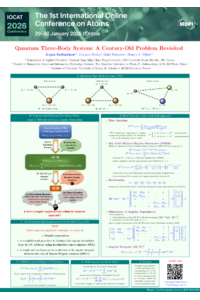
The non-relativistic quantum three-body problem, despite its century-long history, continues to challenge even experienced theorists due to the intricate coupling between angular and radial degrees of freedom. A systematic and pedagogically transparent route for eliminating angular dependence from the three-body Schrodinger equation (SE) is presented, following the spirit of the exposition by Bhatia and Temkin [1,2]. This leads us to the Reduced Schrodinger Equation (RSE)—a matrix-operator formulation that fully retains the generality of arbitrary particle masses, charges, total angular momentum (L), and parity.
Methods
The derivation beginning with the elimination of center-of-mass motion, followed by an analysis of the rotational invariance of the Hamiltonian. The angular basis is constructed from solid minimal bipolar harmonics (MBHs), providing a natural way to preserve the individual partial angular momenta of the constituent particles. The resulting RSE offers immediate insight into the coupling between different partial waves. The variational counterpart is derived, enabling accurate computation of bound-state energies and wave functions. The angular integrals are evaluated through a novel technique that expresses MBHs as linear combinations of Wigner D-functions.
Results
Numerical validation is provided for the low-lying singlet and triplet states of the helium atom—both of natural parity (for L<= 7) and unnatural parity (for L<=4). Explicitly correlated multi-exponent Hylleraas-type bases are employed within the framework of the Rayleigh–Ritz variational principle.
Conclusion
This work aims to unify and clarify results that have long been scattered across the literature, offering a self-contained and conceptually cohesive framework. The formalism not only simplifies the angular reduction process for three-body systems but also provides a transparent foundation for extending such treatments to many-body quantum systems.
References
[1] A. K. Bhatia and A. Temkin. Rev. Mod. Phys., 36:1050–1064 (1964).
[2] A. K. Bhatia and A. Temkin. Phys. Rev., 137:A1335–A1343, (1965).
Keywords
Three-body problem
Bipolar harmonics
Angular momentum coupling
Variational methods.
Poster
Anjan Sadhukhan. IOCAT_2026_Poster.pdf
Photoionization And Resonant Ionization Data For K-shell in Highly Charged Iron Ions
Spherical image states for one- and two-electron atoms