Event submissions
Published
This submission belongs to the session S1. Atomic structure and spectra: Theory and experiment of the event The 1st International Online Conference on Atoms
Published date
27 Jan, 2026
Academic Editor
'%3e%3cpath%20d='M12.6657%2010.9104C12.4185%2010.325%2012.0599%209.79327%2011.6097%209.34482C11.1609%208.89508%2010.6293%208.5365%2010.0442%208.28888C10.0389%208.28626%2010.0337%208.28495%2010.0285%208.28233C10.8446%207.69279%2011.3752%206.73249%2011.3752%205.64904C11.3752%203.8542%209.92103%202.39999%208.1262%202.39999C6.33136%202.39999%204.87715%203.8542%204.87715%205.64904C4.87715%206.73249%205.40774%207.69279%206.22393%208.28364C6.21869%208.28626%206.21345%208.28757%206.20821%208.29019C5.62129%208.5378%205.09463%208.89284%204.64265%209.34613C4.1929%209.79493%203.83432%2010.3266%203.58671%2010.9117C3.34345%2011.4845%203.21226%2012.0987%203.20023%2012.7209C3.19988%2012.7349%203.20233%2012.7488%203.20744%2012.7619C3.21255%2012.7749%203.22022%2012.7867%203.22998%2012.7968C3.23975%2012.8068%203.25142%2012.8147%203.26431%2012.8202C3.2772%2012.8256%203.29105%2012.8284%203.30504%2012.8284H4.09109C4.14874%2012.8284%204.19459%2012.7825%204.1959%2012.7262C4.2221%2011.7148%204.62823%2010.7676%205.34617%2010.0497C6.08899%209.30683%207.0755%208.89808%208.1262%208.89808C9.17689%208.89808%2010.1634%209.30683%2010.9062%2010.0497C11.6242%2010.7676%2012.0303%2011.7148%2012.0565%2012.7262C12.0578%2012.7838%2012.1037%2012.8284%2012.1613%2012.8284H12.9474C12.9613%2012.8284%2012.9752%2012.8256%2012.9881%2012.8202C13.001%2012.8147%2013.0126%2012.8068%2013.0224%2012.7968C13.0322%2012.7867%2013.0398%2012.7749%2013.0449%2012.7619C13.0501%2012.7488%2013.0525%2012.7349%2013.0522%2012.7209C13.0391%2012.0947%2012.9094%2011.4855%2012.6657%2010.9104ZM8.1262%207.9024C7.52486%207.9024%206.9589%207.6679%206.53312%207.24211C6.10733%206.81633%205.87283%206.25037%205.87283%205.64904C5.87283%205.0477%206.10733%204.48174%206.53312%204.05596C6.9589%203.63018%207.52486%203.39567%208.1262%203.39567C8.72753%203.39567%209.29349%203.63018%209.71927%204.05596C10.1451%204.48174%2010.3796%205.0477%2010.3796%205.64904C10.3796%206.25037%2010.1451%206.81633%209.71927%207.24211C9.29349%207.6679%208.72753%207.9024%208.1262%207.9024Z'%20fill='%235D1EE1'/%3e%3c/g%3e%3c/svg%3e) Pascal Quinet
Pascal QuinetCitation
Shikha Rathi, Ben Ohayon, Precision X-ray Spectroscopy with Exotic Atoms to Probe QED and Nuclear Structure, in Proceedings of The 1st International Online Conference on Atoms, 29 January–30 January 2026, MDPI: Basel, Switzerland
Share
Email
Facebook
Twitter
LinkedIn
Precision X-ray Spectroscopy with Exotic Atoms to Probe QED and Nuclear Structure
'%3e%3cpath%20d='M12.6647%2010.9104C12.4176%2010.325%2012.0589%209.7933%2011.6088%209.34485C11.16%208.89511%2010.6283%208.53653%2010.0432%208.28891C10.038%208.28629%2010.0327%208.28498%2010.0275%208.28236C10.8437%207.69282%2011.3743%206.73252%2011.3743%205.64907C11.3743%203.85423%209.92005%202.40002%208.12522%202.40002C6.33038%202.40002%204.87618%203.85423%204.87618%205.64907C4.87618%206.73252%205.40677%207.69282%206.22296%208.28367C6.21772%208.28629%206.21248%208.2876%206.20724%208.29022C5.62031%208.53783%205.09365%208.89287%204.64167%209.34616C4.19192%209.79496%203.83334%2010.3266%203.58573%2010.9117C3.34247%2011.4846%203.21128%2012.0987%203.19925%2012.721C3.1989%2012.735%203.20135%2012.7489%203.20646%2012.7619C3.21157%2012.7749%203.21924%2012.7868%203.22901%2012.7968C3.23877%2012.8068%203.25045%2012.8148%203.26334%2012.8202C3.27623%2012.8256%203.29007%2012.8284%203.30406%2012.8284H4.09012C4.14776%2012.8284%204.19362%2012.7825%204.19493%2012.7262C4.22113%2011.7148%204.62726%2010.7676%205.34519%2010.0497C6.08802%209.30686%207.07452%208.89811%208.12522%208.89811C9.17592%208.89811%2010.1624%209.30686%2010.9052%2010.0497C11.6232%2010.7676%2012.0293%2011.7148%2012.0555%2012.7262C12.0568%2012.7839%2012.1027%2012.8284%2012.1603%2012.8284H12.9464C12.9604%2012.8284%2012.9742%2012.8256%2012.9871%2012.8202C13%2012.8148%2013.0117%2012.8068%2013.0214%2012.7968C13.0312%2012.7868%2013.0389%2012.7749%2013.044%2012.7619C13.0491%2012.7489%2013.0515%2012.735%2013.0512%2012.721C13.0381%2012.0947%2012.9084%2011.4856%2012.6647%2010.9104ZM8.12522%207.90243C7.52388%207.90243%206.95792%207.66793%206.53214%207.24215C6.10636%206.81636%205.87185%206.2504%205.87185%205.64907C5.87185%205.04773%206.10636%204.48177%206.53214%204.05599C6.95792%203.63021%207.52388%203.3957%208.12522%203.3957C8.72655%203.3957%209.29252%203.63021%209.7183%204.05599C10.1441%204.48177%2010.3786%205.04773%2010.3786%205.64907C10.3786%206.2504%2010.1441%206.81636%209.7183%207.24215C9.29252%207.66793%208.72655%207.90243%208.12522%207.90243Z'%20fill='%235D1EE1'/%3e%3c/g%3e%3c/svg%3e)
Shikha Rathi 1,2
Ben Ohayon 3
1. The Helen Diller Quantum Center, Department of Physics, Technion – Israel Institute of Technology, Haifa 32000, Israel
2. Kastler–Brossel Laboratory (LKB), Sorbonne University, CNRS, École Normale Supérieure (ENS-PSL), Collège de France, Case 74, 4 Place Jussieu, 75005 Paris, France
3. Faculty of Physics, Technion – Israel Institute of Technology, Haifa 32000, Israel
Abstract
Exotic atoms, in which electrons are replaced by a heavier negatively charged particle, provide a unique and sensitive laboratory for exploring the frontiers of fundamental physics. Because of the presence of heavier bound particles, such as a muon or antiproton, their electromagnetic interactions with the nucleus are significantly enhanced (due to the inverse dependence on the Bohr radius), allowing precision spectroscopy to probe effects beyond the reach of ordinary atoms. A key technological advancement enabling such measurements is the use of the novel cryogenic microcalorimeters. These detectors offer a great combination of energy resolution and detection efficiency, overcoming limitations of conventional semiconductors and crystal detectors and thus opening new paths for precision X-ray spectroscopy measurement.
In this context, I will present two complementary experimental initiatives, \textbf{QUARTET} and \textbf{PAX}. The QUARTET experiment, conducted at PSI, focuses on X-ray spectroscopy of muonic atoms to determine the nuclear charge radii of light elements (Z = 3–10), achieving an order of magnitude improvement in accuracy over previous results. In parallel, the newly launched PAX experiment aims to test strong-field bound-state quantum electrodynamics (QED) by measuring high-circular Rydberg transition energies in antiprotonic atoms (9 < Z < 83). These circular states are minimally affected by nuclear structure, allowing precise measurements that isolate higher-order QED effects.
Keywords
Atomic Spectrocopy
atomic parameters
precision spectrocopy
QED
nuclear radius
Poster
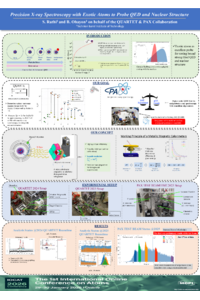
Shikha Rathi Shikha_poster FINAL.pdf
Time-Dependent Multiphoton Theory of Phase Delays
Nondipole laser-assisted photoinonization: the streaking regime