Event submissions
Published
This submission belongs to the session S2. Atomic collisions: Theory and experiment of the event The 1st International Online Conference on Atoms
Published date
27 Jan, 2026
Academic Editor
'%3e%3cpath%20d='M12.6657%2010.9104C12.4185%2010.325%2012.0599%209.79327%2011.6097%209.34482C11.1609%208.89508%2010.6293%208.5365%2010.0442%208.28888C10.0389%208.28626%2010.0337%208.28495%2010.0285%208.28233C10.8446%207.69279%2011.3752%206.73249%2011.3752%205.64904C11.3752%203.8542%209.92103%202.39999%208.1262%202.39999C6.33136%202.39999%204.87715%203.8542%204.87715%205.64904C4.87715%206.73249%205.40774%207.69279%206.22393%208.28364C6.21869%208.28626%206.21345%208.28757%206.20821%208.29019C5.62129%208.5378%205.09463%208.89284%204.64265%209.34613C4.1929%209.79493%203.83432%2010.3266%203.58671%2010.9117C3.34345%2011.4845%203.21226%2012.0987%203.20023%2012.7209C3.19988%2012.7349%203.20233%2012.7488%203.20744%2012.7619C3.21255%2012.7749%203.22022%2012.7867%203.22998%2012.7968C3.23975%2012.8068%203.25142%2012.8147%203.26431%2012.8202C3.2772%2012.8256%203.29105%2012.8284%203.30504%2012.8284H4.09109C4.14874%2012.8284%204.19459%2012.7825%204.1959%2012.7262C4.2221%2011.7148%204.62823%2010.7676%205.34617%2010.0497C6.08899%209.30683%207.0755%208.89808%208.1262%208.89808C9.17689%208.89808%2010.1634%209.30683%2010.9062%2010.0497C11.6242%2010.7676%2012.0303%2011.7148%2012.0565%2012.7262C12.0578%2012.7838%2012.1037%2012.8284%2012.1613%2012.8284H12.9474C12.9613%2012.8284%2012.9752%2012.8256%2012.9881%2012.8202C13.001%2012.8147%2013.0126%2012.8068%2013.0224%2012.7968C13.0322%2012.7867%2013.0398%2012.7749%2013.0449%2012.7619C13.0501%2012.7488%2013.0525%2012.7349%2013.0522%2012.7209C13.0391%2012.0947%2012.9094%2011.4855%2012.6657%2010.9104ZM8.1262%207.9024C7.52486%207.9024%206.9589%207.6679%206.53312%207.24211C6.10733%206.81633%205.87283%206.25037%205.87283%205.64904C5.87283%205.0477%206.10733%204.48174%206.53312%204.05596C6.9589%203.63018%207.52486%203.39567%208.1262%203.39567C8.72753%203.39567%209.29349%203.63018%209.71927%204.05596C10.1451%204.48174%2010.3796%205.0477%2010.3796%205.64904C10.3796%206.25037%2010.1451%206.81633%209.71927%207.24211C9.29349%207.6679%208.72753%207.9024%208.1262%207.9024Z'%20fill='%235D1EE1'/%3e%3c/g%3e%3c/svg%3e) Omar Fojón
Omar FojónCitation
Renata Della Picca, Juan Martin Randazzo, Sebastian David Lopez, Marcelo Fabian Ciappina, Diego Arbo, Nondipole laser-assisted photoinonization: the streaking regime, in Proceedings of The 1st International Online Conference on Atoms, 29 January–30 January 2026, MDPI: Basel, Switzerland
Share
Email
Facebook
Twitter
LinkedIn
Nondipole laser-assisted photoinonization: the streaking regime
'%3e%3cpath%20d='M12.6647%2010.9104C12.4176%2010.325%2012.0589%209.7933%2011.6088%209.34485C11.16%208.89511%2010.6283%208.53653%2010.0432%208.28891C10.038%208.28629%2010.0327%208.28498%2010.0275%208.28236C10.8437%207.69282%2011.3743%206.73252%2011.3743%205.64907C11.3743%203.85423%209.92005%202.40002%208.12522%202.40002C6.33038%202.40002%204.87618%203.85423%204.87618%205.64907C4.87618%206.73252%205.40677%207.69282%206.22296%208.28367C6.21772%208.28629%206.21248%208.2876%206.20724%208.29022C5.62031%208.53783%205.09365%208.89287%204.64167%209.34616C4.19192%209.79496%203.83334%2010.3266%203.58573%2010.9117C3.34247%2011.4846%203.21128%2012.0987%203.19925%2012.721C3.1989%2012.735%203.20135%2012.7489%203.20646%2012.7619C3.21157%2012.7749%203.21924%2012.7868%203.22901%2012.7968C3.23877%2012.8068%203.25045%2012.8148%203.26334%2012.8202C3.27623%2012.8256%203.29007%2012.8284%203.30406%2012.8284H4.09012C4.14776%2012.8284%204.19362%2012.7825%204.19493%2012.7262C4.22113%2011.7148%204.62726%2010.7676%205.34519%2010.0497C6.08802%209.30686%207.07452%208.89811%208.12522%208.89811C9.17592%208.89811%2010.1624%209.30686%2010.9052%2010.0497C11.6232%2010.7676%2012.0293%2011.7148%2012.0555%2012.7262C12.0568%2012.7839%2012.1027%2012.8284%2012.1603%2012.8284H12.9464C12.9604%2012.8284%2012.9742%2012.8256%2012.9871%2012.8202C13%2012.8148%2013.0117%2012.8068%2013.0214%2012.7968C13.0312%2012.7868%2013.0389%2012.7749%2013.044%2012.7619C13.0491%2012.7489%2013.0515%2012.735%2013.0512%2012.721C13.0381%2012.0947%2012.9084%2011.4856%2012.6647%2010.9104ZM8.12522%207.90243C7.52388%207.90243%206.95792%207.66793%206.53214%207.24215C6.10636%206.81636%205.87185%206.2504%205.87185%205.64907C5.87185%205.04773%206.10636%204.48177%206.53214%204.05599C6.95792%203.63021%207.52388%203.3957%208.12522%203.3957C8.72655%203.3957%209.29252%203.63021%209.7183%204.05599C10.1441%204.48177%2010.3786%205.04773%2010.3786%205.64907C10.3786%206.2504%2010.1441%206.81636%209.7183%207.24215C9.29252%207.66793%208.72655%207.90243%208.12522%207.90243Z'%20fill='%235D1EE1'/%3e%3c/g%3e%3c/svg%3e)
Renata Della Picca 1
Juan Martin Randazzo 2
Sebastian David Lopez 3

Marcelo Fabian Ciappina 4

Diego Arbo 5
1. National Scientific and Technical Research Council (CONICET) and Bariloche Atomic Center (CAB), San Carlos de Bariloche 8400, Río Negro, Argentina
2. Bariloche Atomic Center (CAB), National Atomic Energy Commission (CNEA), CONICET and Balseiro Institute, National University of Cuyo (UNCuyo), San Carlos de Bariloche 8400, Río Negro, Argentina
3. Institute for Research in Non-Conventional Energy (INENCO), National University of Salta (UNSa) and CONICET, Salta 4400, Argentina
4. Department of Physics, Guangdong Technion–Israel Institute of Technology; Guangdong Provincial Key Laboratory of Materials and Technologies for Energy Conversion, Shantou 515063, China
5. Institute for Astronomy and Space Physics (IAFE), University of Buenos Aires (UBA) and CONICET, Buenos Aires C1428GA, Argentina
Abstract
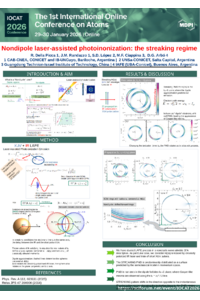
When atoms and molecules are exposed to an extreme ultraviolet (XUV) pulse and infrared (IR) laser field that overlap in space and time, the so-called laser-assisted photoionization emission (LAPE) processes take place. Depending on whether the XUV pulse duration is shorter, or longer, than one IR optical cycle (T = 2π/ωIR, where ωIR is the frequency of the IR laser), two different scenarios arise: the sideband or the streaking regime respectively. The photoelecton momentum distribution (PMD) can be recorded for different delays between the pulses, so the photoionization dynamics becomes accessible with attosecond resolution.
In recent years, there has been increasing interest in exploring strong laser–matter in-
teractions beyond the widely used electric dipole approximation [1]. However, the streaking scenario remains unexplored. In this work, we introduce a theoretical model to describe the streaking regime within the strong field approximation including first-order nondipole corrections [2, 3]. In order to study a specific case, we have focused on XUV ionization of a 1s-state hydrogen atom assisted by a ellipctically polarized IR laser.
We will systematically explore the PMD for different delays and making use of the semiclassical model (SCM) to gain an overall understanding of PMD structures, we will analyze the PMD as in the attoclock process [4].
[1] J Maurer and U Keller 2021 J. Phys. B 54 094001
[2] C J Joachain, N J Kylstra, and R M Potvliege 2012 Atoms in Intense Laser Fields, Cambridge University Press.
[3] R Della Picca et al. 2023 Phys. Rev. A 107 053104
[4] R Della Picca et al. 2025 Phys. Rev. A 112 023111
Keywords
LASER-ASSISTED PHOTOIONIZATION
NONDIPOLE
STREAKING
Poster
Renata Della Picca PosterIOCAT26_DELLAPICCA.pdf
Precision X-ray Spectroscopy with Exotic Atoms to Probe QED and Nuclear Structure
Strong field photoionization: Analysis of overlapping ATI and LAPE structures