Event submissions
Published
This submission belongs to the session S2. Atomic collisions: Theory and experiment of the event The 1st International Online Conference on Atoms
Published date
27 Jan, 2026
Academic Editor
'%3e%3cpath%20d='M12.6657%2010.9104C12.4185%2010.325%2012.0599%209.79327%2011.6097%209.34482C11.1609%208.89508%2010.6293%208.5365%2010.0442%208.28888C10.0389%208.28626%2010.0337%208.28495%2010.0285%208.28233C10.8446%207.69279%2011.3752%206.73249%2011.3752%205.64904C11.3752%203.8542%209.92103%202.39999%208.1262%202.39999C6.33136%202.39999%204.87715%203.8542%204.87715%205.64904C4.87715%206.73249%205.40774%207.69279%206.22393%208.28364C6.21869%208.28626%206.21345%208.28757%206.20821%208.29019C5.62129%208.5378%205.09463%208.89284%204.64265%209.34613C4.1929%209.79493%203.83432%2010.3266%203.58671%2010.9117C3.34345%2011.4845%203.21226%2012.0987%203.20023%2012.7209C3.19988%2012.7349%203.20233%2012.7488%203.20744%2012.7619C3.21255%2012.7749%203.22022%2012.7867%203.22998%2012.7968C3.23975%2012.8068%203.25142%2012.8147%203.26431%2012.8202C3.2772%2012.8256%203.29105%2012.8284%203.30504%2012.8284H4.09109C4.14874%2012.8284%204.19459%2012.7825%204.1959%2012.7262C4.2221%2011.7148%204.62823%2010.7676%205.34617%2010.0497C6.08899%209.30683%207.0755%208.89808%208.1262%208.89808C9.17689%208.89808%2010.1634%209.30683%2010.9062%2010.0497C11.6242%2010.7676%2012.0303%2011.7148%2012.0565%2012.7262C12.0578%2012.7838%2012.1037%2012.8284%2012.1613%2012.8284H12.9474C12.9613%2012.8284%2012.9752%2012.8256%2012.9881%2012.8202C13.001%2012.8147%2013.0126%2012.8068%2013.0224%2012.7968C13.0322%2012.7867%2013.0398%2012.7749%2013.0449%2012.7619C13.0501%2012.7488%2013.0525%2012.7349%2013.0522%2012.7209C13.0391%2012.0947%2012.9094%2011.4855%2012.6657%2010.9104ZM8.1262%207.9024C7.52486%207.9024%206.9589%207.6679%206.53312%207.24211C6.10733%206.81633%205.87283%206.25037%205.87283%205.64904C5.87283%205.0477%206.10733%204.48174%206.53312%204.05596C6.9589%203.63018%207.52486%203.39567%208.1262%203.39567C8.72753%203.39567%209.29349%203.63018%209.71927%204.05596C10.1451%204.48174%2010.3796%205.0477%2010.3796%205.64904C10.3796%206.25037%2010.1451%206.81633%209.71927%207.24211C9.29349%207.6679%208.72753%207.9024%208.1262%207.9024Z'%20fill='%235D1EE1'/%3e%3c/g%3e%3c/svg%3e) Omar Fojón
Omar FojónCitation
Luís Leitão, Ricardo Silva, Andreas Flors, Tomás Campante, Daniel Garcia, José Pires Marques, Jorge Sampaio, Systematic calculations of Electron-Impact Excitation of Lanthanides for Collision-Radiative Modelling, in Proceedings of The 1st International Online Conference on Atoms, 29 January–30 January 2026, MDPI: Basel, Switzerland
Share
Email
Facebook
Twitter
LinkedIn
Systematic calculations of Electron-Impact Excitation of Lanthanides for Collision-Radiative Modelling
'%3e%3cpath%20d='M12.6647%2010.9104C12.4176%2010.325%2012.0589%209.7933%2011.6088%209.34485C11.16%208.89511%2010.6283%208.53653%2010.0432%208.28891C10.038%208.28629%2010.0327%208.28498%2010.0275%208.28236C10.8437%207.69282%2011.3743%206.73252%2011.3743%205.64907C11.3743%203.85423%209.92005%202.40002%208.12522%202.40002C6.33038%202.40002%204.87618%203.85423%204.87618%205.64907C4.87618%206.73252%205.40677%207.69282%206.22296%208.28367C6.21772%208.28629%206.21248%208.2876%206.20724%208.29022C5.62031%208.53783%205.09365%208.89287%204.64167%209.34616C4.19192%209.79496%203.83334%2010.3266%203.58573%2010.9117C3.34247%2011.4846%203.21128%2012.0987%203.19925%2012.721C3.1989%2012.735%203.20135%2012.7489%203.20646%2012.7619C3.21157%2012.7749%203.21924%2012.7868%203.22901%2012.7968C3.23877%2012.8068%203.25045%2012.8148%203.26334%2012.8202C3.27623%2012.8256%203.29007%2012.8284%203.30406%2012.8284H4.09012C4.14776%2012.8284%204.19362%2012.7825%204.19493%2012.7262C4.22113%2011.7148%204.62726%2010.7676%205.34519%2010.0497C6.08802%209.30686%207.07452%208.89811%208.12522%208.89811C9.17592%208.89811%2010.1624%209.30686%2010.9052%2010.0497C11.6232%2010.7676%2012.0293%2011.7148%2012.0555%2012.7262C12.0568%2012.7839%2012.1027%2012.8284%2012.1603%2012.8284H12.9464C12.9604%2012.8284%2012.9742%2012.8256%2012.9871%2012.8202C13%2012.8148%2013.0117%2012.8068%2013.0214%2012.7968C13.0312%2012.7868%2013.0389%2012.7749%2013.044%2012.7619C13.0491%2012.7489%2013.0515%2012.735%2013.0512%2012.721C13.0381%2012.0947%2012.9084%2011.4856%2012.6647%2010.9104ZM8.12522%207.90243C7.52388%207.90243%206.95792%207.66793%206.53214%207.24215C6.10636%206.81636%205.87185%206.2504%205.87185%205.64907C5.87185%205.04773%206.10636%204.48177%206.53214%204.05599C6.95792%203.63021%207.52388%203.3957%208.12522%203.3957C8.72655%203.3957%209.29252%203.63021%209.7183%204.05599C10.1441%204.48177%2010.3786%205.04773%2010.3786%205.64907C10.3786%206.2504%2010.1441%206.81636%209.7183%207.24215C9.29252%207.66793%208.72655%207.90243%208.12522%207.90243Z'%20fill='%235D1EE1'/%3e%3c/g%3e%3c/svg%3e)
Luís Leitão 1,2
Ricardo Silva 1,2
Andreas Flors 3

Tomás Campante 1,2
Daniel Garcia 1,2
José Pires Marques 1,2

Jorge Sampaio 1,2
1. Laboratory of Instrumentation and Experimental Particle Physics (LIP), Av. Prof. Gama Pinto 2, 1649-003 Lisbon, Portugal
2. Faculty of Sciences, University of Lisbon, Rua Ernesto de Vasconcelos, Building C8, 1749-016 Lisbon, Portugal
3. GSI Helmholtz Centre for Heavy Ion Research, Planckstraße 1, 64291 Darmstadt, Germany
Abstract
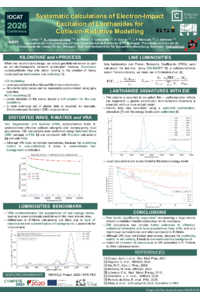
The expanding ejecta of binary neutron star mergers (NSMs) have been proven to be the ideal site for the production of lanthanides via rapid neutron capture (r-process) nucleosynthesis. However, identifying specific atomic absorption and emission features in kilonova spectra and linking them with individual elements remains significant challenges [1,2].
One of the primary obstacles is the lack of comprehensive collisional atomic data for modelling the late nebular epochs (> 4 days post-merger). While it is a reasonable approximation to assume that the ejecta is in local thermodynamic equilibrium (LTE) and that atomic absorption processes dominate in the early hours (< 1 day after the NSM), it is not possible to assume LTE for nebular epochs. During these late stages, relevant processes include photoionization, ionization, excitation by electron impact, and electronic recombination [3].
In this work, we address this gap by benchmarking electron-impact excitation collision strengths and line emissivities for Au and Pt against the existing literature [4,5], using the Flexible Atomic Code’s distorted-wave (DW) method [6]. Owing to its lower computational cost, the DW approach enables systematic calculations across the lanthanides, for which we report the results. We also present luminosity predictions derived from our atomic data [7]. Together, these calculations refine non-LTE spectral models, improving the interpretation of kilonova spectra and the tracing of heavy-element production.
[1] Nanae Domoto et al 2022 ApJ 939 8
[2] A Flörs et al 2023 MNRAS, Volume 524, Issue 2
[3] Quentin Pognan et al 2022 MNRAS Volume 513, Issue 4
[4] Michael McCann et al 2022, MRNAS 509(4):4723
[5] S. J. Bromley et al, 2023, ApJ 268 22
[6] M. F. Gu, “The Flexible Atomic Code,” J Phys 86(5):675 (2008)
[7] M McCann et al, 2025, MNRAS, Volume 538, Issue 1
Keywords
Electron-impact excitation
distorted-wave
kilonova
Poster
IOCAT_LuisLeitao.pdf
Atomic Structure and Relativistic Transition Modeling of Na-like Cs for Plasma Applications
Study of the hyperfine structure of Ba-like elements: an MCDHF approach for modeling the first excited levels