Event submissions
Published
This submission belongs to the session S3. Strategic Management of the event The 1st International Online Conference on Administrative Sciences
Published date
30 Jan, 2026
Academic Editor
'%3e%3cpath%20d='M12.6657%2010.9104C12.4185%2010.325%2012.0599%209.79327%2011.6097%209.34482C11.1609%208.89508%2010.6293%208.5365%2010.0442%208.28888C10.0389%208.28626%2010.0337%208.28495%2010.0285%208.28233C10.8446%207.69279%2011.3752%206.73249%2011.3752%205.64904C11.3752%203.8542%209.92103%202.39999%208.1262%202.39999C6.33136%202.39999%204.87715%203.8542%204.87715%205.64904C4.87715%206.73249%205.40774%207.69279%206.22393%208.28364C6.21869%208.28626%206.21345%208.28757%206.20821%208.29019C5.62129%208.5378%205.09463%208.89284%204.64265%209.34613C4.1929%209.79493%203.83432%2010.3266%203.58671%2010.9117C3.34345%2011.4845%203.21226%2012.0987%203.20023%2012.7209C3.19988%2012.7349%203.20233%2012.7488%203.20744%2012.7619C3.21255%2012.7749%203.22022%2012.7867%203.22998%2012.7968C3.23975%2012.8068%203.25142%2012.8147%203.26431%2012.8202C3.2772%2012.8256%203.29105%2012.8284%203.30504%2012.8284H4.09109C4.14874%2012.8284%204.19459%2012.7825%204.1959%2012.7262C4.2221%2011.7148%204.62823%2010.7676%205.34617%2010.0497C6.08899%209.30683%207.0755%208.89808%208.1262%208.89808C9.17689%208.89808%2010.1634%209.30683%2010.9062%2010.0497C11.6242%2010.7676%2012.0303%2011.7148%2012.0565%2012.7262C12.0578%2012.7838%2012.1037%2012.8284%2012.1613%2012.8284H12.9474C12.9613%2012.8284%2012.9752%2012.8256%2012.9881%2012.8202C13.001%2012.8147%2013.0126%2012.8068%2013.0224%2012.7968C13.0322%2012.7867%2013.0398%2012.7749%2013.0449%2012.7619C13.0501%2012.7488%2013.0525%2012.7349%2013.0522%2012.7209C13.0391%2012.0947%2012.9094%2011.4855%2012.6657%2010.9104ZM8.1262%207.9024C7.52486%207.9024%206.9589%207.6679%206.53312%207.24211C6.10733%206.81633%205.87283%206.25037%205.87283%205.64904C5.87283%205.0477%206.10733%204.48174%206.53312%204.05596C6.9589%203.63018%207.52486%203.39567%208.1262%203.39567C8.72753%203.39567%209.29349%203.63018%209.71927%204.05596C10.1451%204.48174%2010.3796%205.0477%2010.3796%205.64904C10.3796%206.25037%2010.1451%206.81633%209.71927%207.24211C9.29349%207.6679%208.72753%207.9024%208.1262%207.9024Z'%20fill='%235D1EE1'/%3e%3c/g%3e%3c/svg%3e) Isabel-María García‐Sánchez
Isabel-María García‐SánchezCitation
Paula Cristina de Almeida Marques, Strategic Governance and Crisis Readiness: A Longitudinal Assessment of AI and Balanced Scorecard Integration in Healthcare Institutions, in Proceedings of The 1st International Online Conference on Administrative Sciences, 4 February–5 February 2026, MDPI: Basel, Switzerland
Share
Email
Facebook
Twitter
LinkedIn
Strategic Governance and Crisis Readiness: A Longitudinal Assessment of AI and Balanced Scorecard Integration in Healthcare Institutions
'%3e%3cpath%20d='M12.6647%2010.9104C12.4176%2010.325%2012.0589%209.7933%2011.6088%209.34485C11.16%208.89511%2010.6283%208.53653%2010.0432%208.28891C10.038%208.28629%2010.0327%208.28498%2010.0275%208.28236C10.8437%207.69282%2011.3743%206.73252%2011.3743%205.64907C11.3743%203.85423%209.92005%202.40002%208.12522%202.40002C6.33038%202.40002%204.87618%203.85423%204.87618%205.64907C4.87618%206.73252%205.40677%207.69282%206.22296%208.28367C6.21772%208.28629%206.21248%208.2876%206.20724%208.29022C5.62031%208.53783%205.09365%208.89287%204.64167%209.34616C4.19192%209.79496%203.83334%2010.3266%203.58573%2010.9117C3.34247%2011.4846%203.21128%2012.0987%203.19925%2012.721C3.1989%2012.735%203.20135%2012.7489%203.20646%2012.7619C3.21157%2012.7749%203.21924%2012.7868%203.22901%2012.7968C3.23877%2012.8068%203.25045%2012.8148%203.26334%2012.8202C3.27623%2012.8256%203.29007%2012.8284%203.30406%2012.8284H4.09012C4.14776%2012.8284%204.19362%2012.7825%204.19493%2012.7262C4.22113%2011.7148%204.62726%2010.7676%205.34519%2010.0497C6.08802%209.30686%207.07452%208.89811%208.12522%208.89811C9.17592%208.89811%2010.1624%209.30686%2010.9052%2010.0497C11.6232%2010.7676%2012.0293%2011.7148%2012.0555%2012.7262C12.0568%2012.7839%2012.1027%2012.8284%2012.1603%2012.8284H12.9464C12.9604%2012.8284%2012.9742%2012.8256%2012.9871%2012.8202C13%2012.8148%2013.0117%2012.8068%2013.0214%2012.7968C13.0312%2012.7868%2013.0389%2012.7749%2013.044%2012.7619C13.0491%2012.7489%2013.0515%2012.735%2013.0512%2012.721C13.0381%2012.0947%2012.9084%2011.4856%2012.6647%2010.9104ZM8.12522%207.90243C7.52388%207.90243%206.95792%207.66793%206.53214%207.24215C6.10636%206.81636%205.87185%206.2504%205.87185%205.64907C5.87185%205.04773%206.10636%204.48177%206.53214%204.05599C6.95792%203.63021%207.52388%203.3957%208.12522%203.3957C8.72655%203.3957%209.29252%203.63021%209.7183%204.05599C10.1441%204.48177%2010.3786%205.04773%2010.3786%205.64907C10.3786%206.2504%2010.1441%206.81636%209.7183%207.24215C9.29252%207.66793%208.72655%207.90243%208.12522%207.90243Z'%20fill='%235D1EE1'/%3e%3c/g%3e%3c/svg%3e)
Paula Cristina de Almeida Marques 1
1. Department of Economics and Management, University of the Azores, Ponta Delgada, 9500-321, Portugal
Abstract
Introduction:
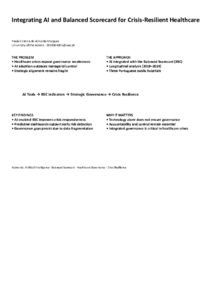
In the wake of increasing health crises and systemic challenges, hospitals must enhance their strategic governance and crisis readiness. This study investigates how the integration of Artificial Intelligence (AI) with the Balanced Scorecard (BSC) framework can contribute to the long-term resilience and performance of healthcare institutions. The research focuses on strategic alignment, sustainability goals, and digital transformation as central pillars of hospital governance.
Methods:
A longitudinal multiple-case study was conducted across three Portuguese public hospitals between 2019 and 2024. Data were collected through semi-structured interviews with top management and analysis of institutional strategic plans, key performance indicators, and AI integration initiatives. The BSC was adapted to incorporate ESG metrics and predictive analytics capabilities powered by AI tools.
Results:
Findings reveal that hospitals leveraging AI-enhanced BSC systems demonstrate improved strategic responsiveness, transparency in performance monitoring, and proactive decision-making. AI contributed to identifying patterns in patient care demand, resource allocation efficiency, and risk anticipation. However, challenges related to data governance, digital competencies, and institutional resistance were also identified.
Conclusions:
Integrating AI into BSC frameworks fosters a more resilient and adaptive governance model in the healthcare sector. This approach supports strategic decision-making in crisis contexts, aligning institutional objectives with sustainability, efficiency, and public value creation. Future research should explore scalable digital strategies and cross-sectoral applicability in public administration.
Keywords
Artificial Intelligence
Balanced Scorecard
Crisis Governance
Healthcare Management
Public Administration
Digital Transformation
Strategic Decision-Making
Poster
IOCAS2026_Poster_FINALISSIMO_Paula_Marques.pdf
Nano-Vision: Startups as Catalytic Architectures for Scientific Frontier Expansion
When Perfect Isn’t Good Enough: Designing for Imperfection in Resilient System Leadership