Event submissions
Published
This submission belongs to the session S4. Infection Biology of the event The 1st International Online Conference on Biology
Published date
05 Feb, 2026
Academic Editor
'%3e%3cpath%20d='M12.6657%2010.9104C12.4185%2010.325%2012.0599%209.79327%2011.6097%209.34482C11.1609%208.89508%2010.6293%208.5365%2010.0442%208.28888C10.0389%208.28626%2010.0337%208.28495%2010.0285%208.28233C10.8446%207.69279%2011.3752%206.73249%2011.3752%205.64904C11.3752%203.8542%209.92103%202.39999%208.1262%202.39999C6.33136%202.39999%204.87715%203.8542%204.87715%205.64904C4.87715%206.73249%205.40774%207.69279%206.22393%208.28364C6.21869%208.28626%206.21345%208.28757%206.20821%208.29019C5.62129%208.5378%205.09463%208.89284%204.64265%209.34613C4.1929%209.79493%203.83432%2010.3266%203.58671%2010.9117C3.34345%2011.4845%203.21226%2012.0987%203.20023%2012.7209C3.19988%2012.7349%203.20233%2012.7488%203.20744%2012.7619C3.21255%2012.7749%203.22022%2012.7867%203.22998%2012.7968C3.23975%2012.8068%203.25142%2012.8147%203.26431%2012.8202C3.2772%2012.8256%203.29105%2012.8284%203.30504%2012.8284H4.09109C4.14874%2012.8284%204.19459%2012.7825%204.1959%2012.7262C4.2221%2011.7148%204.62823%2010.7676%205.34617%2010.0497C6.08899%209.30683%207.0755%208.89808%208.1262%208.89808C9.17689%208.89808%2010.1634%209.30683%2010.9062%2010.0497C11.6242%2010.7676%2012.0303%2011.7148%2012.0565%2012.7262C12.0578%2012.7838%2012.1037%2012.8284%2012.1613%2012.8284H12.9474C12.9613%2012.8284%2012.9752%2012.8256%2012.9881%2012.8202C13.001%2012.8147%2013.0126%2012.8068%2013.0224%2012.7968C13.0322%2012.7867%2013.0398%2012.7749%2013.0449%2012.7619C13.0501%2012.7488%2013.0525%2012.7349%2013.0522%2012.7209C13.0391%2012.0947%2012.9094%2011.4855%2012.6657%2010.9104ZM8.1262%207.9024C7.52486%207.9024%206.9589%207.6679%206.53312%207.24211C6.10733%206.81633%205.87283%206.25037%205.87283%205.64904C5.87283%205.0477%206.10733%204.48174%206.53312%204.05596C6.9589%203.63018%207.52486%203.39567%208.1262%203.39567C8.72753%203.39567%209.29349%203.63018%209.71927%204.05596C10.1451%204.48174%2010.3796%205.0477%2010.3796%205.64904C10.3796%206.25037%2010.1451%206.81633%209.71927%207.24211C9.29349%207.6679%208.72753%207.9024%208.1262%207.9024Z'%20fill='%235D1EE1'/%3e%3c/g%3e%3c/svg%3e) Oswaldo Palenzuela
Oswaldo PalenzuelaCitation
Tenhinene Izerghouf, Nassima Sadoun, Donia Mechoub, Amine Msela, Nacima Meguenni, Evolution of Antimicrobial Resistance and Virulence in Avian Pathogenic Escherichia coli: A Dual Threat to Animal and Human Health, in Proceedings of The 1st International Online Conference on Biology, 10 February–12 February 2026, MDPI: Basel, Switzerland
Share
Email
Facebook
Twitter
LinkedIn
Evolution of Antimicrobial Resistance and Virulence in Avian Pathogenic Escherichia coli: A Dual Threat to Animal and Human Health
'%3e%3cpath%20d='M12.6647%2010.9104C12.4176%2010.325%2012.0589%209.7933%2011.6088%209.34485C11.16%208.89511%2010.6283%208.53653%2010.0432%208.28891C10.038%208.28629%2010.0327%208.28498%2010.0275%208.28236C10.8437%207.69282%2011.3743%206.73252%2011.3743%205.64907C11.3743%203.85423%209.92005%202.40002%208.12522%202.40002C6.33038%202.40002%204.87618%203.85423%204.87618%205.64907C4.87618%206.73252%205.40677%207.69282%206.22296%208.28367C6.21772%208.28629%206.21248%208.2876%206.20724%208.29022C5.62031%208.53783%205.09365%208.89287%204.64167%209.34616C4.19192%209.79496%203.83334%2010.3266%203.58573%2010.9117C3.34247%2011.4846%203.21128%2012.0987%203.19925%2012.721C3.1989%2012.735%203.20135%2012.7489%203.20646%2012.7619C3.21157%2012.7749%203.21924%2012.7868%203.22901%2012.7968C3.23877%2012.8068%203.25045%2012.8148%203.26334%2012.8202C3.27623%2012.8256%203.29007%2012.8284%203.30406%2012.8284H4.09012C4.14776%2012.8284%204.19362%2012.7825%204.19493%2012.7262C4.22113%2011.7148%204.62726%2010.7676%205.34519%2010.0497C6.08802%209.30686%207.07452%208.89811%208.12522%208.89811C9.17592%208.89811%2010.1624%209.30686%2010.9052%2010.0497C11.6232%2010.7676%2012.0293%2011.7148%2012.0555%2012.7262C12.0568%2012.7839%2012.1027%2012.8284%2012.1603%2012.8284H12.9464C12.9604%2012.8284%2012.9742%2012.8256%2012.9871%2012.8202C13%2012.8148%2013.0117%2012.8068%2013.0214%2012.7968C13.0312%2012.7868%2013.0389%2012.7749%2013.044%2012.7619C13.0491%2012.7489%2013.0515%2012.735%2013.0512%2012.721C13.0381%2012.0947%2012.9084%2011.4856%2012.6647%2010.9104ZM8.12522%207.90243C7.52388%207.90243%206.95792%207.66793%206.53214%207.24215C6.10636%206.81636%205.87185%206.2504%205.87185%205.64907C5.87185%205.04773%206.10636%204.48177%206.53214%204.05599C6.95792%203.63021%207.52388%203.3957%208.12522%203.3957C8.72655%203.3957%209.29252%203.63021%209.7183%204.05599C10.1441%204.48177%2010.3786%205.04773%2010.3786%205.64907C10.3786%206.2504%2010.1441%206.81636%209.7183%207.24215C9.29252%207.66793%208.72655%207.90243%208.12522%207.90243Z'%20fill='%235D1EE1'/%3e%3c/g%3e%3c/svg%3e)
Tenhinene Izerghouf 1
Nassima Sadoun 1
Donia Mechoub 1
Amine Msela 1
Nacima Meguenni 1
1. Laboratory of Analytical Biochemistry and Biotechnology (LABAB), Mouloud Mammeri University of Tizi Ouzou, Tizi Ouzou. 15000. Algeria.
Abstract
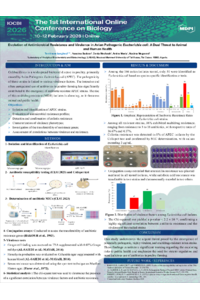
Avian colibacillosis, a pervasive bacterial infection in poultry, is caused by avian pathogenic Escherichia coli (APEC). The pathogenicity of these strains is primarily associated with specific virulence factors such as serum resistance and α-hemolysin production. The uncontrolled and excessive use of antibiotics in poultry production has greatly contributed to the emergence of resistant and even multidrug-resistant (MDR) APEC strains.
In the present study, fifty APEC isolates were characterized for their virulence and antimicrobial resistance traits. Almost all isolates exhibited serum resistance and produced α-hemolysin, while 42% were Congo red positive, indicating the presence of virulence-associated phenotypes. Antimicrobial susceptibility testing revealed alarming resistance rates: 86% to tetracycline, 76% to nalidixic acid, and 60% to amoxicillin. Conversely, tobramycin and imipenem remained largely effective against most isolates.
However, colistin resistance was detected in 8% of the isolates using the Colispot test. This resistance was further confirmed by minimum inhibitory concentration (MIC) assays in liquid medium, which showed MIC values exceeding 2 µg/mL, confirming true colistin resistance according to EUCAST criteria.
Conjugation experiments demonstrated the plasmid-borne nature of amoxicillin resistance in all tested isolates. Nalidixic acid resistance was found to be transferable in two strains, while chromosomally encoded in another two.
Statistical analysis using the chi-square test revealed a significant correlation between antibiotic resistance and virulence traits among APEC strains.
Overall, these findings highlight the alarming rise in virulent and multidrug-resistant APEC strains within the poultry sector. Such strains represent a potential zoonotic threat and emphasize the urgent need for rational and regulated antibiotic use in poultry farming to mitigate risks to both animal and public health.
Keywords
avian pathogenic Escherichia coli
antimicrobial resistance
colibacillosis
virulence factors
public health
Poster
mdpi IZERGHOUF Tenhinene.pdf
Symptomatic and Biological Observations of Colomerus vitis under Changing Climatic Conditions
In vitro investigation of probiotics' antimicrobial effects on bacteria that cause uterine infections in cattle.