Event submissions
Published
This submission belongs to the session S3. Conservation Biology of the event The 1st International Online Conference on Biology
Published date
05 Feb, 2026
Academic Editor
'%3e%3cpath%20d='M12.6657%2010.9104C12.4185%2010.325%2012.0599%209.79327%2011.6097%209.34482C11.1609%208.89508%2010.6293%208.5365%2010.0442%208.28888C10.0389%208.28626%2010.0337%208.28495%2010.0285%208.28233C10.8446%207.69279%2011.3752%206.73249%2011.3752%205.64904C11.3752%203.8542%209.92103%202.39999%208.1262%202.39999C6.33136%202.39999%204.87715%203.8542%204.87715%205.64904C4.87715%206.73249%205.40774%207.69279%206.22393%208.28364C6.21869%208.28626%206.21345%208.28757%206.20821%208.29019C5.62129%208.5378%205.09463%208.89284%204.64265%209.34613C4.1929%209.79493%203.83432%2010.3266%203.58671%2010.9117C3.34345%2011.4845%203.21226%2012.0987%203.20023%2012.7209C3.19988%2012.7349%203.20233%2012.7488%203.20744%2012.7619C3.21255%2012.7749%203.22022%2012.7867%203.22998%2012.7968C3.23975%2012.8068%203.25142%2012.8147%203.26431%2012.8202C3.2772%2012.8256%203.29105%2012.8284%203.30504%2012.8284H4.09109C4.14874%2012.8284%204.19459%2012.7825%204.1959%2012.7262C4.2221%2011.7148%204.62823%2010.7676%205.34617%2010.0497C6.08899%209.30683%207.0755%208.89808%208.1262%208.89808C9.17689%208.89808%2010.1634%209.30683%2010.9062%2010.0497C11.6242%2010.7676%2012.0303%2011.7148%2012.0565%2012.7262C12.0578%2012.7838%2012.1037%2012.8284%2012.1613%2012.8284H12.9474C12.9613%2012.8284%2012.9752%2012.8256%2012.9881%2012.8202C13.001%2012.8147%2013.0126%2012.8068%2013.0224%2012.7968C13.0322%2012.7867%2013.0398%2012.7749%2013.0449%2012.7619C13.0501%2012.7488%2013.0525%2012.7349%2013.0522%2012.7209C13.0391%2012.0947%2012.9094%2011.4855%2012.6657%2010.9104ZM8.1262%207.9024C7.52486%207.9024%206.9589%207.6679%206.53312%207.24211C6.10733%206.81633%205.87283%206.25037%205.87283%205.64904C5.87283%205.0477%206.10733%204.48174%206.53312%204.05596C6.9589%203.63018%207.52486%203.39567%208.1262%203.39567C8.72753%203.39567%209.29349%203.63018%209.71927%204.05596C10.1451%204.48174%2010.3796%205.0477%2010.3796%205.64904C10.3796%206.25037%2010.1451%206.81633%209.71927%207.24211C9.29349%207.6679%208.72753%207.9024%208.1262%207.9024Z'%20fill='%235D1EE1'/%3e%3c/g%3e%3c/svg%3e) Ettore Randi
Ettore RandiCitation
Juan José Ramírez-Morales, Steban Telles-Ospina, Fernando Vargas-Salinas, Diana Lucia Buitrago-Torres, GLIDING INTO CONSERVATION: INTEGRATING PHYLOGENETIC AND FUNCTIONAL METRICS TO CAPTURE BIODIVERSITY PATTERNS IN PHYLLOMEDUSIDAE FROGS, in Proceedings of The 1st International Online Conference on Biology, 10 February–12 February 2026, MDPI: Basel, Switzerland
Share
Email
Facebook
Twitter
LinkedIn
GLIDING INTO CONSERVATION: INTEGRATING PHYLOGENETIC AND FUNCTIONAL METRICS TO CAPTURE BIODIVERSITY PATTERNS IN PHYLLOMEDUSIDAE FROGS
'%3e%3cpath%20d='M12.6647%2010.9104C12.4176%2010.325%2012.0589%209.7933%2011.6088%209.34485C11.16%208.89511%2010.6283%208.53653%2010.0432%208.28891C10.038%208.28629%2010.0327%208.28498%2010.0275%208.28236C10.8437%207.69282%2011.3743%206.73252%2011.3743%205.64907C11.3743%203.85423%209.92005%202.40002%208.12522%202.40002C6.33038%202.40002%204.87618%203.85423%204.87618%205.64907C4.87618%206.73252%205.40677%207.69282%206.22296%208.28367C6.21772%208.28629%206.21248%208.2876%206.20724%208.29022C5.62031%208.53783%205.09365%208.89287%204.64167%209.34616C4.19192%209.79496%203.83334%2010.3266%203.58573%2010.9117C3.34247%2011.4846%203.21128%2012.0987%203.19925%2012.721C3.1989%2012.735%203.20135%2012.7489%203.20646%2012.7619C3.21157%2012.7749%203.21924%2012.7868%203.22901%2012.7968C3.23877%2012.8068%203.25045%2012.8148%203.26334%2012.8202C3.27623%2012.8256%203.29007%2012.8284%203.30406%2012.8284H4.09012C4.14776%2012.8284%204.19362%2012.7825%204.19493%2012.7262C4.22113%2011.7148%204.62726%2010.7676%205.34519%2010.0497C6.08802%209.30686%207.07452%208.89811%208.12522%208.89811C9.17592%208.89811%2010.1624%209.30686%2010.9052%2010.0497C11.6232%2010.7676%2012.0293%2011.7148%2012.0555%2012.7262C12.0568%2012.7839%2012.1027%2012.8284%2012.1603%2012.8284H12.9464C12.9604%2012.8284%2012.9742%2012.8256%2012.9871%2012.8202C13%2012.8148%2013.0117%2012.8068%2013.0214%2012.7968C13.0312%2012.7868%2013.0389%2012.7749%2013.044%2012.7619C13.0491%2012.7489%2013.0515%2012.735%2013.0512%2012.721C13.0381%2012.0947%2012.9084%2011.4856%2012.6647%2010.9104ZM8.12522%207.90243C7.52388%207.90243%206.95792%207.66793%206.53214%207.24215C6.10636%206.81636%205.87185%206.2504%205.87185%205.64907C5.87185%205.04773%206.10636%204.48177%206.53214%204.05599C6.95792%203.63021%207.52388%203.3957%208.12522%203.3957C8.72655%203.3957%209.29252%203.63021%209.7183%204.05599C10.1441%204.48177%2010.3786%205.04773%2010.3786%205.64907C10.3786%206.2504%2010.1441%206.81636%209.7183%207.24215C9.29252%207.66793%208.72655%207.90243%208.12522%207.90243Z'%20fill='%235D1EE1'/%3e%3c/g%3e%3c/svg%3e)
Juan José Ramírez-Morales 1,2
Steban Telles-Ospina 1
Fernando Vargas-Salinas 1
Diana Lucia Buitrago-Torres 3
1. Research Group on Evolution, Ecology and Conservation (EECO), University of Quindío, Armenia, 630004, Colombia
2. Group of Herpetology of University of Quindío (GHUQ), University of Quindío, Armenia, 630004, Colombia
3. Biogeography and Global Change Laboratory, National Museum of Natural Sciences (MNCN-CSIC), Madrid, 28006, Spain
Abstract
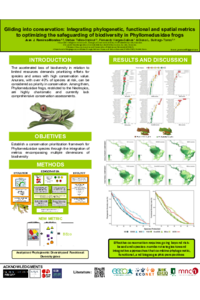
The accelerated loss of biodiversity demands prioritizing conservation efforts for species with high evolutionary and ecological value, particularly within the most threatened groups. Anurans, with over 40% of species at risk, are especially sensitive to habitat degradation, diseases, and climate change, making them key bioindicators. Within them, Phyllomedusidae frogs, restricted to the Neotropics, are high charismatic, highly vulnerable and currently lacks comprehensive conservation assessments.
In this study we evaluate whether approaches based on evolutionary history, ecological functions, and geographic distribution, identify Phyllomedusidae priority species in complementary or redundant ways. Moreover, we examine the effectiveness of these approaches compared with traditional strategies based solely on extinction risk.
We analyzed 66 species combining phylogenetic, functional, geographic distribution, and IUCN threat status data. We compiled public database records and literature to generate phylogenetic contribution metrics (ED, EDGE, BED) and functional metrics (FUD, EcoDGE, and a new proposal: BEco). We also analyzed spatial patterns of species richness and the mentioned metrics, compared congruence among approaches, and simulated diversity loss scenarios to assess performance under different conservation strategies.
The highest richness of Phyllomedusidae happens in the western Amazon and specific areas in Central America, the Caribbean, and the Atlantic Forest. EDGE and EcoDGE scores identified species both unique and threatened, while BED and BEco highlighted endemics or range-restricted taxa. Phylogenetic and functional metrics revealed partially overlapping spatial patterns with correlations up to r = 0.965. Extinction simulations showed that prioritizing conservation approaches based on ED and FUD scores retained more phylogenetic and functional diversity than strategies based on IUCN categories.
Therefore, integrating phylogenetic, functional, and spatial metrics allows identification of high evolutionary and ecological value species overlooked by traditional criteria. This framework enhances prioritization in megadiverse regions such as the Amazon and Atlantic Forest, optimizing conservation responses to the rapid loss of Neotropical amphibian diversity.
Keywords
Anuran conservation
Biodiversity loss
Conservation prioritization
Evolutionary distinctiveness
Functional traits.
Poster
Phyllomedusidae_IOCB1.pdf
Antimicrobial Resistance and Virulence of Aeromonas Isolates from Endangered Schizothoracinae
The 5×FAD Mouse Model: A Translational Tool for Understanding Amyloid Pathology and Cognitive Decline in Alzheimer’s Disease