Event submissions
Published
This submission belongs to the session S3. Conservation Biology of the event The 1st International Online Conference on Biology
Published date
05 Feb, 2026
Academic Editor
'%3e%3cpath%20d='M12.6657%2010.9104C12.4185%2010.325%2012.0599%209.79327%2011.6097%209.34482C11.1609%208.89508%2010.6293%208.5365%2010.0442%208.28888C10.0389%208.28626%2010.0337%208.28495%2010.0285%208.28233C10.8446%207.69279%2011.3752%206.73249%2011.3752%205.64904C11.3752%203.8542%209.92103%202.39999%208.1262%202.39999C6.33136%202.39999%204.87715%203.8542%204.87715%205.64904C4.87715%206.73249%205.40774%207.69279%206.22393%208.28364C6.21869%208.28626%206.21345%208.28757%206.20821%208.29019C5.62129%208.5378%205.09463%208.89284%204.64265%209.34613C4.1929%209.79493%203.83432%2010.3266%203.58671%2010.9117C3.34345%2011.4845%203.21226%2012.0987%203.20023%2012.7209C3.19988%2012.7349%203.20233%2012.7488%203.20744%2012.7619C3.21255%2012.7749%203.22022%2012.7867%203.22998%2012.7968C3.23975%2012.8068%203.25142%2012.8147%203.26431%2012.8202C3.2772%2012.8256%203.29105%2012.8284%203.30504%2012.8284H4.09109C4.14874%2012.8284%204.19459%2012.7825%204.1959%2012.7262C4.2221%2011.7148%204.62823%2010.7676%205.34617%2010.0497C6.08899%209.30683%207.0755%208.89808%208.1262%208.89808C9.17689%208.89808%2010.1634%209.30683%2010.9062%2010.0497C11.6242%2010.7676%2012.0303%2011.7148%2012.0565%2012.7262C12.0578%2012.7838%2012.1037%2012.8284%2012.1613%2012.8284H12.9474C12.9613%2012.8284%2012.9752%2012.8256%2012.9881%2012.8202C13.001%2012.8147%2013.0126%2012.8068%2013.0224%2012.7968C13.0322%2012.7867%2013.0398%2012.7749%2013.0449%2012.7619C13.0501%2012.7488%2013.0525%2012.7349%2013.0522%2012.7209C13.0391%2012.0947%2012.9094%2011.4855%2012.6657%2010.9104ZM8.1262%207.9024C7.52486%207.9024%206.9589%207.6679%206.53312%207.24211C6.10733%206.81633%205.87283%206.25037%205.87283%205.64904C5.87283%205.0477%206.10733%204.48174%206.53312%204.05596C6.9589%203.63018%207.52486%203.39567%208.1262%203.39567C8.72753%203.39567%209.29349%203.63018%209.71927%204.05596C10.1451%204.48174%2010.3796%205.0477%2010.3796%205.64904C10.3796%206.25037%2010.1451%206.81633%209.71927%207.24211C9.29349%207.6679%208.72753%207.9024%208.1262%207.9024Z'%20fill='%235D1EE1'/%3e%3c/g%3e%3c/svg%3e) Ettore Randi
Ettore RandiCitation
Guillermina Bautista Gómez, Habitat preferences and behavior of the Great-tailed Grackle Quiscalus mexicanus in wetlands with different levels of urbanization on the North Pacific Coast of Mexico, in Proceedings of The 1st International Online Conference on Biology, 10 February–12 February 2026, MDPI: Basel, Switzerland
Share
Email
Facebook
Twitter
LinkedIn
Habitat preferences and behavior of the Great-tailed Grackle Quiscalus mexicanus in wetlands with different levels of urbanization on the North Pacific Coast of Mexico

Guillermina Bautista Gómez 1
1. Center for Research and Studies on Environment and Development (CIIEMAD), National Polytechnic Institute (IPN), Mexico city, Mexico
Abstract
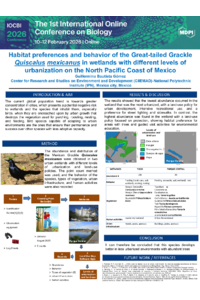
The current global population trend is towards greater concentration in cities, which presents a potential negative risk to wetlands and the species that inhabit them, especially birds, when they are encroached upon by urban growth that destroys the vegetation used for perching, roosting, nesting, and feeding. Bird species capable of adapting to urban environments are the ones that ensure their permanence and success over other species with less adaptive capacity. Therefore, in the present study, the abundance and distribution of the Mexican Grackle Quiscalus mexicanus were obtained in two urban wetlands with different levels of urbanization and land-use policies. The point count method was used, and the behavior of the species, types of vegetation, urban infrastructure, and human activities were also recorded. The results showed that the lowest abundance occurred in the wetland that was the most urbanized, with a land-use policy for urban development, intensive recreational use, and a preference for street lighting and sidewalks. In contrast, the highest abundance was found in the wetland with a land-use policy focused on protection, showing habitat preference for areas with trees and guided visit activities for environmental education. It can therefore be concluded that this species develops better in less urbanized environments with abundant trees.
Keywords
Land Use
Urbanization
Birds
Poster
sciforum-156558 poster Guillermina Bautista G.pdf
Prevalence and Genetic Characterization of Sarcocystis parasites in Brains of Small Mammals from Lithuania
Herons (Pelecaniformes: Ardeidae) associated with an artificial water body in Xalapa, Mexico.