Event submissions
Published
This submission belongs to the session S4. Infection Biology of the event The 1st International Online Conference on Biology
Published date
05 Feb, 2026
Academic Editor
'%3e%3cpath%20d='M12.6657%2010.9104C12.4185%2010.325%2012.0599%209.79327%2011.6097%209.34482C11.1609%208.89508%2010.6293%208.5365%2010.0442%208.28888C10.0389%208.28626%2010.0337%208.28495%2010.0285%208.28233C10.8446%207.69279%2011.3752%206.73249%2011.3752%205.64904C11.3752%203.8542%209.92103%202.39999%208.1262%202.39999C6.33136%202.39999%204.87715%203.8542%204.87715%205.64904C4.87715%206.73249%205.40774%207.69279%206.22393%208.28364C6.21869%208.28626%206.21345%208.28757%206.20821%208.29019C5.62129%208.5378%205.09463%208.89284%204.64265%209.34613C4.1929%209.79493%203.83432%2010.3266%203.58671%2010.9117C3.34345%2011.4845%203.21226%2012.0987%203.20023%2012.7209C3.19988%2012.7349%203.20233%2012.7488%203.20744%2012.7619C3.21255%2012.7749%203.22022%2012.7867%203.22998%2012.7968C3.23975%2012.8068%203.25142%2012.8147%203.26431%2012.8202C3.2772%2012.8256%203.29105%2012.8284%203.30504%2012.8284H4.09109C4.14874%2012.8284%204.19459%2012.7825%204.1959%2012.7262C4.2221%2011.7148%204.62823%2010.7676%205.34617%2010.0497C6.08899%209.30683%207.0755%208.89808%208.1262%208.89808C9.17689%208.89808%2010.1634%209.30683%2010.9062%2010.0497C11.6242%2010.7676%2012.0303%2011.7148%2012.0565%2012.7262C12.0578%2012.7838%2012.1037%2012.8284%2012.1613%2012.8284H12.9474C12.9613%2012.8284%2012.9752%2012.8256%2012.9881%2012.8202C13.001%2012.8147%2013.0126%2012.8068%2013.0224%2012.7968C13.0322%2012.7867%2013.0398%2012.7749%2013.0449%2012.7619C13.0501%2012.7488%2013.0525%2012.7349%2013.0522%2012.7209C13.0391%2012.0947%2012.9094%2011.4855%2012.6657%2010.9104ZM8.1262%207.9024C7.52486%207.9024%206.9589%207.6679%206.53312%207.24211C6.10733%206.81633%205.87283%206.25037%205.87283%205.64904C5.87283%205.0477%206.10733%204.48174%206.53312%204.05596C6.9589%203.63018%207.52486%203.39567%208.1262%203.39567C8.72753%203.39567%209.29349%203.63018%209.71927%204.05596C10.1451%204.48174%2010.3796%205.0477%2010.3796%205.64904C10.3796%206.25037%2010.1451%206.81633%209.71927%207.24211C9.29349%207.6679%208.72753%207.9024%208.1262%207.9024Z'%20fill='%235D1EE1'/%3e%3c/g%3e%3c/svg%3e) Oswaldo Palenzuela
Oswaldo PalenzuelaCitation
Olatunde Babatunde Akanbi, Olanrewaju Olaifa, Theophilus Jarikre, Benjamin Emipke, Joseph Busari, Parvovirus enteritis in Nigerian dogs: A Systematic Review (2009–2025) and a Six-Year Retrospective Cohort in the Veterinary Teaching Hospital, University of Ibadan, in Proceedings of The 1st International Online Conference on Biology, 10 February–12 February 2026, MDPI: Basel, Switzerland
Share
Email
Facebook
Twitter
LinkedIn
Parvovirus enteritis in Nigerian dogs: A Systematic Review (2009–2025) and a Six-Year Retrospective Cohort in the Veterinary Teaching Hospital, University of Ibadan
'%3e%3cpath%20d='M12.6647%2010.9104C12.4176%2010.325%2012.0589%209.7933%2011.6088%209.34485C11.16%208.89511%2010.6283%208.53653%2010.0432%208.28891C10.038%208.28629%2010.0327%208.28498%2010.0275%208.28236C10.8437%207.69282%2011.3743%206.73252%2011.3743%205.64907C11.3743%203.85423%209.92005%202.40002%208.12522%202.40002C6.33038%202.40002%204.87618%203.85423%204.87618%205.64907C4.87618%206.73252%205.40677%207.69282%206.22296%208.28367C6.21772%208.28629%206.21248%208.2876%206.20724%208.29022C5.62031%208.53783%205.09365%208.89287%204.64167%209.34616C4.19192%209.79496%203.83334%2010.3266%203.58573%2010.9117C3.34247%2011.4846%203.21128%2012.0987%203.19925%2012.721C3.1989%2012.735%203.20135%2012.7489%203.20646%2012.7619C3.21157%2012.7749%203.21924%2012.7868%203.22901%2012.7968C3.23877%2012.8068%203.25045%2012.8148%203.26334%2012.8202C3.27623%2012.8256%203.29007%2012.8284%203.30406%2012.8284H4.09012C4.14776%2012.8284%204.19362%2012.7825%204.19493%2012.7262C4.22113%2011.7148%204.62726%2010.7676%205.34519%2010.0497C6.08802%209.30686%207.07452%208.89811%208.12522%208.89811C9.17592%208.89811%2010.1624%209.30686%2010.9052%2010.0497C11.6232%2010.7676%2012.0293%2011.7148%2012.0555%2012.7262C12.0568%2012.7839%2012.1027%2012.8284%2012.1603%2012.8284H12.9464C12.9604%2012.8284%2012.9742%2012.8256%2012.9871%2012.8202C13%2012.8148%2013.0117%2012.8068%2013.0214%2012.7968C13.0312%2012.7868%2013.0389%2012.7749%2013.044%2012.7619C13.0491%2012.7489%2013.0515%2012.735%2013.0512%2012.721C13.0381%2012.0947%2012.9084%2011.4856%2012.6647%2010.9104ZM8.12522%207.90243C7.52388%207.90243%206.95792%207.66793%206.53214%207.24215C6.10636%206.81636%205.87185%206.2504%205.87185%205.64907C5.87185%205.04773%206.10636%204.48177%206.53214%204.05599C6.95792%203.63021%207.52388%203.3957%208.12522%203.3957C8.72655%203.3957%209.29252%203.63021%209.7183%204.05599C10.1441%204.48177%2010.3786%205.04773%2010.3786%205.64907C10.3786%206.2504%2010.1441%206.81636%209.7183%207.24215C9.29252%207.66793%208.72655%207.90243%208.12522%207.90243Z'%20fill='%235D1EE1'/%3e%3c/g%3e%3c/svg%3e)
Olatunde Babatunde Akanbi 1
Olanrewaju Olaifa 2
Theophilus Jarikre 2
Benjamin Emipke 3
Joseph Busari 2
1. Department of Veterinary Pathology, Faculty of Veterinary Medicine, University of Ilorin, Kwara, Nigeria
2. Department of Veterinary Pathology, Faculty of Veterinary Medicine, University of Ibadan, Ibadan, Nigeria
3. School of Veterinary Medicine, KNUST, Kumasi, Ghana
Abstract
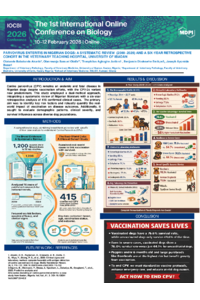
Canine parvovirus (CPV) enteritis is a leading cause of canine morbidity and mortality in Nigeria. This study synthesized evidence via a systematic review of the Nigerian literature (2009-2025) and a six-year retrospective cohort analysis of 415 laboratory-confirmed cases from the University of Ibadan Veterinary Teaching Hospital (2018-2024) to identify risk factors and quantify vaccine impact. A systematic search of Scopus, Web of science, PubMed, and AJOL identified peer-reviewed articles for qualitative synthesis. Retrospective data from the Veterinary Teaching Hospital, University of Ibadan, were analyzed for demographic patterns, and Chi-square tests assessed vaccination impact on survival across breeds and clinical severity strata. Meta-analysis identified young age (<24 weeks), incomplete vaccination, breed predisposition (notably Boerboels and German Shepherds), and environmental exposure as principal risk factors. The retrospective cohort showed a near-balanced sex ratio (52.1% female) and a mean age of 21.44 ± 22.77 weeks. Vaccination significantly improved survival (Table 2): 76.6% (49/64) of vaccinated dogs survived versus 49.6% (68/137) of unvaccinated dogs (χ² = 33.95, p < 0.001). This benefit was consistent across breeds, most markedly in Boerboels (93.3% vs. 46.2%; p = 0.002) (Figure 5), and persisted when stratified by clinical severity, including in dogs presenting with >two clinical signs (76.0% vs. 44.1%; χ² = 16.39, p = 0.003). This literature review suggests vaccine failures were linked to logistical issues like suboptimal handling and maternally derived antibody interference. We conclude that prior vaccination is strongly associated with a profound survival advantage in Nigerian dogs with CPV enteritis. Strengthening early diagnosis, optimizing vaccine delivery protocols, and ensuring complete vaccination schedules are critical to reducing the endemic CPV burden.
Keywords
Canine parvovirus
CPV enteritis
risk factors
vaccine efficacy
clinical signs
Nigeria.
Poster
PARVO REVIEW POSTER CONFERENCE 2025.pdf
Haematological dysregulation and tissue tropism in adult Clarias gariepinus experimentally infected with Aeromonas hydrophila
Predictive Hematological Modeling for Field-Based Diagnosis of Haemoparasitic Infections in Ruminants in Resource Limited Setting