Event submissions
Published
This submission belongs to the session S4. Infection Biology of the event The 1st International Online Conference on Biology
Published date
05 Feb, 2026
Academic Editor
'%3e%3cpath%20d='M12.6657%2010.9104C12.4185%2010.325%2012.0599%209.79327%2011.6097%209.34482C11.1609%208.89508%2010.6293%208.5365%2010.0442%208.28888C10.0389%208.28626%2010.0337%208.28495%2010.0285%208.28233C10.8446%207.69279%2011.3752%206.73249%2011.3752%205.64904C11.3752%203.8542%209.92103%202.39999%208.1262%202.39999C6.33136%202.39999%204.87715%203.8542%204.87715%205.64904C4.87715%206.73249%205.40774%207.69279%206.22393%208.28364C6.21869%208.28626%206.21345%208.28757%206.20821%208.29019C5.62129%208.5378%205.09463%208.89284%204.64265%209.34613C4.1929%209.79493%203.83432%2010.3266%203.58671%2010.9117C3.34345%2011.4845%203.21226%2012.0987%203.20023%2012.7209C3.19988%2012.7349%203.20233%2012.7488%203.20744%2012.7619C3.21255%2012.7749%203.22022%2012.7867%203.22998%2012.7968C3.23975%2012.8068%203.25142%2012.8147%203.26431%2012.8202C3.2772%2012.8256%203.29105%2012.8284%203.30504%2012.8284H4.09109C4.14874%2012.8284%204.19459%2012.7825%204.1959%2012.7262C4.2221%2011.7148%204.62823%2010.7676%205.34617%2010.0497C6.08899%209.30683%207.0755%208.89808%208.1262%208.89808C9.17689%208.89808%2010.1634%209.30683%2010.9062%2010.0497C11.6242%2010.7676%2012.0303%2011.7148%2012.0565%2012.7262C12.0578%2012.7838%2012.1037%2012.8284%2012.1613%2012.8284H12.9474C12.9613%2012.8284%2012.9752%2012.8256%2012.9881%2012.8202C13.001%2012.8147%2013.0126%2012.8068%2013.0224%2012.7968C13.0322%2012.7867%2013.0398%2012.7749%2013.0449%2012.7619C13.0501%2012.7488%2013.0525%2012.7349%2013.0522%2012.7209C13.0391%2012.0947%2012.9094%2011.4855%2012.6657%2010.9104ZM8.1262%207.9024C7.52486%207.9024%206.9589%207.6679%206.53312%207.24211C6.10733%206.81633%205.87283%206.25037%205.87283%205.64904C5.87283%205.0477%206.10733%204.48174%206.53312%204.05596C6.9589%203.63018%207.52486%203.39567%208.1262%203.39567C8.72753%203.39567%209.29349%203.63018%209.71927%204.05596C10.1451%204.48174%2010.3796%205.0477%2010.3796%205.64904C10.3796%206.25037%2010.1451%206.81633%209.71927%207.24211C9.29349%207.6679%208.72753%207.9024%208.1262%207.9024Z'%20fill='%235D1EE1'/%3e%3c/g%3e%3c/svg%3e) Oswaldo Palenzuela
Oswaldo PalenzuelaCitation
Brian Andrich La Valle Pollo, Julia Patricia Llagas, Riziel Hannah Aguimatang, Ayra Patrice Espiritu, Danica Ching, Maria Isabel Idolor, Ruby Anne King, Fresthel Monica Climacosa, Salvador Eugenio Caoili, Development and Accuracy Determination of a Peptide-based Diagnostic Test for SARS-CoV-2 Based on the N-terminal Ectodomain of the Membrane Glycoprotein, in Proceedings of The 1st International Online Conference on Biology, 10 February–12 February 2026, MDPI: Basel, Switzerland
Share
Email
Facebook
Twitter
LinkedIn
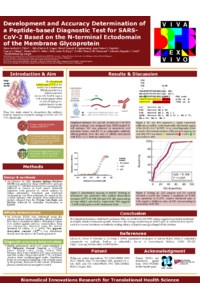
Development and Accuracy Determination of a Peptide-based Diagnostic Test for SARS-CoV-2 Based on the N-terminal Ectodomain of the Membrane Glycoprotein

Brian Andrich La Valle Pollo 1
'%3e%3cpath%20d='M12.6647%2010.9104C12.4176%2010.325%2012.0589%209.7933%2011.6088%209.34485C11.16%208.89511%2010.6283%208.53653%2010.0432%208.28891C10.038%208.28629%2010.0327%208.28498%2010.0275%208.28236C10.8437%207.69282%2011.3743%206.73252%2011.3743%205.64907C11.3743%203.85423%209.92005%202.40002%208.12522%202.40002C6.33038%202.40002%204.87618%203.85423%204.87618%205.64907C4.87618%206.73252%205.40677%207.69282%206.22296%208.28367C6.21772%208.28629%206.21248%208.2876%206.20724%208.29022C5.62031%208.53783%205.09365%208.89287%204.64167%209.34616C4.19192%209.79496%203.83334%2010.3266%203.58573%2010.9117C3.34247%2011.4846%203.21128%2012.0987%203.19925%2012.721C3.1989%2012.735%203.20135%2012.7489%203.20646%2012.7619C3.21157%2012.7749%203.21924%2012.7868%203.22901%2012.7968C3.23877%2012.8068%203.25045%2012.8148%203.26334%2012.8202C3.27623%2012.8256%203.29007%2012.8284%203.30406%2012.8284H4.09012C4.14776%2012.8284%204.19362%2012.7825%204.19493%2012.7262C4.22113%2011.7148%204.62726%2010.7676%205.34519%2010.0497C6.08802%209.30686%207.07452%208.89811%208.12522%208.89811C9.17592%208.89811%2010.1624%209.30686%2010.9052%2010.0497C11.6232%2010.7676%2012.0293%2011.7148%2012.0555%2012.7262C12.0568%2012.7839%2012.1027%2012.8284%2012.1603%2012.8284H12.9464C12.9604%2012.8284%2012.9742%2012.8256%2012.9871%2012.8202C13%2012.8148%2013.0117%2012.8068%2013.0214%2012.7968C13.0312%2012.7868%2013.0389%2012.7749%2013.044%2012.7619C13.0491%2012.7489%2013.0515%2012.735%2013.0512%2012.721C13.0381%2012.0947%2012.9084%2011.4856%2012.6647%2010.9104ZM8.12522%207.90243C7.52388%207.90243%206.95792%207.66793%206.53214%207.24215C6.10636%206.81636%205.87185%206.2504%205.87185%205.64907C5.87185%205.04773%206.10636%204.48177%206.53214%204.05599C6.95792%203.63021%207.52388%203.3957%208.12522%203.3957C8.72655%203.3957%209.29252%203.63021%209.7183%204.05599C10.1441%204.48177%2010.3786%205.04773%2010.3786%205.64907C10.3786%206.2504%2010.1441%206.81636%209.7183%207.24215C9.29252%207.66793%208.72655%207.90243%208.12522%207.90243Z'%20fill='%235D1EE1'/%3e%3c/g%3e%3c/svg%3e)
Julia Patricia Llagas 1
Riziel Hannah Aguimatang 1
Ayra Patrice Espiritu 1
Danica Ching 1,2
Maria Isabel Idolor 1
Ruby Anne King 1,3

Fresthel Monica Climacosa 1
Salvador Eugenio Caoili 1
1. Department of Biochemistry and Molecular Biology, College of Medicine, University of the Philippines Manila, Manila 1000, Philippines
2. Institute of Clinical Epidemiology, National Institutes for Health, Manila, Philippines
3. Department of Science and Technology - Philippine Council for Health Research and Development (DOST-PCHRD), Manila, Philippines
Abstract
Background: The N-terminal ectodomain (NTE) of the SARS-CoV-2 membrane (M) glycoprotein is a short, flexible region that remains exposed on the virion surface. Despite its small size and conformational plasticity, this region contains conserved linear epitopes that may serve as practical surrogates for full-length proteins in serological diagnostics.
Objective: The objective of this study was to develop and evaluate a synthetic peptide-based diagnostic assay targeting the NTE of the SARS-CoV-2 M protein.
Methods: Peptide analogs of SARS-CoV-2 M NTE were designed from a cluster of epitopes retrieved on February 2021 from the Immune Epitope Database (IEDB). M1 (CADSNGTITVEELKKLLEQC-am) is a polymerizable peptide used as coating antigen in a diagnostic indirect ELISA, while anti-M1 is an antipeptide antibody affinity-purified from the sera of rabbits immunized with M1i (MADSNGTITVEELKKLLEQC-am). The binding affinity of monomeric and polymeric M1 was estimated in terms of the dissociation constant (Kd), taken from the slope of ELISA data performed against anti-M1, and linearized using the Liliom method. To determine diagnostic accuracy, M1-based indirect ELISA was performed on 221 biobanked plasma controls and on 1,222 serum samples corresponding to 544 RT-PCR–confirmed adult patients admitted to the Philippine General Hospital, a 1,335-bed tertiary referral center, during October 2020–February 2021, before SARS-CoV-2 vaccines became available locally.
Results: Polymeric M1 exhibited a two-fold gain in apparent affinity (Kd = 4.33 nM) compared with the monomeric form (Kd = 8.00 nM). Clinical validation of the M1-based diagnostic ELISA yielded a post hoc (Youden J) sensitivity of 95.26% and specificity of 52.27%, with an overall diagnostic accuracy of 88.70%.
Conclusion: M1 demonstrates that synthetic peptide antigens can serve as stable, high-sensitivity antigens for diagnostic assays. This design principle may be applied to other emerging pathogens where rapid assay development and scalability are critical.
Keywords
Peptides
Antibodies
COVID-19
Enzyme-Linked Immunosorbent Assay
Protein Binding
Poster
M1s poster iocbi.pdf
Comparative Morphology of the Maxillary Dentition of 15 Neotropical Opisthoglyphous Snake Species found in Paraná, Brazil
Enzymatic Activity and Mass Production of Three Beauveria bassiana Isolates Using Local Substrates