Event submissions
Published
This submission belongs to the session S3. Conservation Biology of the event The 1st International Online Conference on Biology
Published date
05 Feb, 2026
Academic Editor
'%3e%3cpath%20d='M12.6657%2010.9104C12.4185%2010.325%2012.0599%209.79327%2011.6097%209.34482C11.1609%208.89508%2010.6293%208.5365%2010.0442%208.28888C10.0389%208.28626%2010.0337%208.28495%2010.0285%208.28233C10.8446%207.69279%2011.3752%206.73249%2011.3752%205.64904C11.3752%203.8542%209.92103%202.39999%208.1262%202.39999C6.33136%202.39999%204.87715%203.8542%204.87715%205.64904C4.87715%206.73249%205.40774%207.69279%206.22393%208.28364C6.21869%208.28626%206.21345%208.28757%206.20821%208.29019C5.62129%208.5378%205.09463%208.89284%204.64265%209.34613C4.1929%209.79493%203.83432%2010.3266%203.58671%2010.9117C3.34345%2011.4845%203.21226%2012.0987%203.20023%2012.7209C3.19988%2012.7349%203.20233%2012.7488%203.20744%2012.7619C3.21255%2012.7749%203.22022%2012.7867%203.22998%2012.7968C3.23975%2012.8068%203.25142%2012.8147%203.26431%2012.8202C3.2772%2012.8256%203.29105%2012.8284%203.30504%2012.8284H4.09109C4.14874%2012.8284%204.19459%2012.7825%204.1959%2012.7262C4.2221%2011.7148%204.62823%2010.7676%205.34617%2010.0497C6.08899%209.30683%207.0755%208.89808%208.1262%208.89808C9.17689%208.89808%2010.1634%209.30683%2010.9062%2010.0497C11.6242%2010.7676%2012.0303%2011.7148%2012.0565%2012.7262C12.0578%2012.7838%2012.1037%2012.8284%2012.1613%2012.8284H12.9474C12.9613%2012.8284%2012.9752%2012.8256%2012.9881%2012.8202C13.001%2012.8147%2013.0126%2012.8068%2013.0224%2012.7968C13.0322%2012.7867%2013.0398%2012.7749%2013.0449%2012.7619C13.0501%2012.7488%2013.0525%2012.7349%2013.0522%2012.7209C13.0391%2012.0947%2012.9094%2011.4855%2012.6657%2010.9104ZM8.1262%207.9024C7.52486%207.9024%206.9589%207.6679%206.53312%207.24211C6.10733%206.81633%205.87283%206.25037%205.87283%205.64904C5.87283%205.0477%206.10733%204.48174%206.53312%204.05596C6.9589%203.63018%207.52486%203.39567%208.1262%203.39567C8.72753%203.39567%209.29349%203.63018%209.71927%204.05596C10.1451%204.48174%2010.3796%205.0477%2010.3796%205.64904C10.3796%206.25037%2010.1451%206.81633%209.71927%207.24211C9.29349%207.6679%208.72753%207.9024%208.1262%207.9024Z'%20fill='%235D1EE1'/%3e%3c/g%3e%3c/svg%3e) Ettore Randi
Ettore RandiCitation
Eman Elbealy, Baboons at the crossroads: Comparative perspectives on geography, governance, and adaptation in Africa and Saudi Arabia, in Proceedings of The 1st International Online Conference on Biology, 10 February–12 February 2026, MDPI: Basel, Switzerland
Share
Email
Facebook
Twitter
LinkedIn
Baboons at the crossroads: Comparative perspectives on geography, governance, and adaptation in Africa and Saudi Arabia

Eman Elbealy 1
1. Department of Biology, College of Science, King Khalid University, Abha 62529, Saudi Arabia
Abstract
Baboons inhabit complex ecological and socio-political landscapes, from the savannahs, forests, and mountains of Africa to the arid, fragmented habitats of the Arabian Peninsula. These regions represent a crossroads where geography, governance, and adaptation intersect to shape intricate human–baboon dynamics. This integrative study synthesizes comparative insights across diverse species and management systems to reveal how spatial variation, policy frameworks, and behavioral plasticity jointly influence conflict patterns and conservation outcomes. Geography defines habitat heterogeneity and species distribution, influencing baboon ecological niches and interaction frequencies with human communities. Governance regimes range from decentralized, community-based management prevalent in African contexts to centralized, technology-driven approaches exemplified in Saudi Arabia, each mediating conflict mitigation and policy implementation differently. Adaptation, through behavioral flexibility and population responses, enables baboons to navigate increasingly anthropogenic landscapes, affecting coexistence potential and management challenges. Recognizing the convergence of these three pillars provides a multidimensional understanding essential for designing adaptive, locally tailored, and scalable conservation strategies. This framework highlights the importance of contextualizing human–wildlife interactions at ecological and governance crossroads to foster coexistence under accelerating environmental and social change. Our synthesis underscores priority areas for future research, particularly incorporating stakeholder perspectives, technological innovation, and climate resilience. Ultimately, this study offers a blueprint for reconciling ecological realities with socio-political complexities, advancing global baboon conservation in a dynamic Anthropocene.
Keywords
Adaptation
Africa
Arabia
Baboon conservation
Governance
Human–wildlife conflict
Socio-ecological systems
Poster
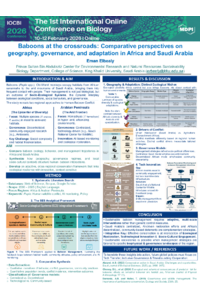
Elbealy Biol Conf poster.pdf
Population structure of the European seabass (Dicentrarchus labrax) in the Atlantic Iberian Peninsula waters inferred from otolith elemental signatures
The role of horizontal gene transfer in the spread of Snowflake Forming Collagen Binding Aggregation Factors in bacteria