Event submissions
Published
This submission belongs to the session S6. Marine Biology of the event The 1st International Online Conference on Biology
Published date
05 Feb, 2026
Academic Editor
'%3e%3cpath%20d='M12.6657%2010.9104C12.4185%2010.325%2012.0599%209.79327%2011.6097%209.34482C11.1609%208.89508%2010.6293%208.5365%2010.0442%208.28888C10.0389%208.28626%2010.0337%208.28495%2010.0285%208.28233C10.8446%207.69279%2011.3752%206.73249%2011.3752%205.64904C11.3752%203.8542%209.92103%202.39999%208.1262%202.39999C6.33136%202.39999%204.87715%203.8542%204.87715%205.64904C4.87715%206.73249%205.40774%207.69279%206.22393%208.28364C6.21869%208.28626%206.21345%208.28757%206.20821%208.29019C5.62129%208.5378%205.09463%208.89284%204.64265%209.34613C4.1929%209.79493%203.83432%2010.3266%203.58671%2010.9117C3.34345%2011.4845%203.21226%2012.0987%203.20023%2012.7209C3.19988%2012.7349%203.20233%2012.7488%203.20744%2012.7619C3.21255%2012.7749%203.22022%2012.7867%203.22998%2012.7968C3.23975%2012.8068%203.25142%2012.8147%203.26431%2012.8202C3.2772%2012.8256%203.29105%2012.8284%203.30504%2012.8284H4.09109C4.14874%2012.8284%204.19459%2012.7825%204.1959%2012.7262C4.2221%2011.7148%204.62823%2010.7676%205.34617%2010.0497C6.08899%209.30683%207.0755%208.89808%208.1262%208.89808C9.17689%208.89808%2010.1634%209.30683%2010.9062%2010.0497C11.6242%2010.7676%2012.0303%2011.7148%2012.0565%2012.7262C12.0578%2012.7838%2012.1037%2012.8284%2012.1613%2012.8284H12.9474C12.9613%2012.8284%2012.9752%2012.8256%2012.9881%2012.8202C13.001%2012.8147%2013.0126%2012.8068%2013.0224%2012.7968C13.0322%2012.7867%2013.0398%2012.7749%2013.0449%2012.7619C13.0501%2012.7488%2013.0525%2012.7349%2013.0522%2012.7209C13.0391%2012.0947%2012.9094%2011.4855%2012.6657%2010.9104ZM8.1262%207.9024C7.52486%207.9024%206.9589%207.6679%206.53312%207.24211C6.10733%206.81633%205.87283%206.25037%205.87283%205.64904C5.87283%205.0477%206.10733%204.48174%206.53312%204.05596C6.9589%203.63018%207.52486%203.39567%208.1262%203.39567C8.72753%203.39567%209.29349%203.63018%209.71927%204.05596C10.1451%204.48174%2010.3796%205.0477%2010.3796%205.64904C10.3796%206.25037%2010.1451%206.81633%209.71927%207.24211C9.29349%207.6679%208.72753%207.9024%208.1262%207.9024Z'%20fill='%235D1EE1'/%3e%3c/g%3e%3c/svg%3e) John Turner
John TurnerCitation
André Luiz Machado Pessanha, Fernando José König Clark, Caroline Stefani da Silva Lima, Rui Azevedo, Agostinho Almeida, Alberto Teodorico Correia, Otolith microchemistry to assess the habitat use of Atherinella brasiliensis in two estuaries with distinct salinity ranges in Northeastern Brazil, in Proceedings of The 1st International Online Conference on Biology, 10 February–12 February 2026, MDPI: Basel, Switzerland
Share
Email
Facebook
Twitter
LinkedIn
Otolith microchemistry to assess the habitat use of Atherinella brasiliensis in two estuaries with distinct salinity ranges in Northeastern Brazil
'%3e%3cpath%20d='M12.6647%2010.9104C12.4176%2010.325%2012.0589%209.7933%2011.6088%209.34485C11.16%208.89511%2010.6283%208.53653%2010.0432%208.28891C10.038%208.28629%2010.0327%208.28498%2010.0275%208.28236C10.8437%207.69282%2011.3743%206.73252%2011.3743%205.64907C11.3743%203.85423%209.92005%202.40002%208.12522%202.40002C6.33038%202.40002%204.87618%203.85423%204.87618%205.64907C4.87618%206.73252%205.40677%207.69282%206.22296%208.28367C6.21772%208.28629%206.21248%208.2876%206.20724%208.29022C5.62031%208.53783%205.09365%208.89287%204.64167%209.34616C4.19192%209.79496%203.83334%2010.3266%203.58573%2010.9117C3.34247%2011.4846%203.21128%2012.0987%203.19925%2012.721C3.1989%2012.735%203.20135%2012.7489%203.20646%2012.7619C3.21157%2012.7749%203.21924%2012.7868%203.22901%2012.7968C3.23877%2012.8068%203.25045%2012.8148%203.26334%2012.8202C3.27623%2012.8256%203.29007%2012.8284%203.30406%2012.8284H4.09012C4.14776%2012.8284%204.19362%2012.7825%204.19493%2012.7262C4.22113%2011.7148%204.62726%2010.7676%205.34519%2010.0497C6.08802%209.30686%207.07452%208.89811%208.12522%208.89811C9.17592%208.89811%2010.1624%209.30686%2010.9052%2010.0497C11.6232%2010.7676%2012.0293%2011.7148%2012.0555%2012.7262C12.0568%2012.7839%2012.1027%2012.8284%2012.1603%2012.8284H12.9464C12.9604%2012.8284%2012.9742%2012.8256%2012.9871%2012.8202C13%2012.8148%2013.0117%2012.8068%2013.0214%2012.7968C13.0312%2012.7868%2013.0389%2012.7749%2013.044%2012.7619C13.0491%2012.7489%2013.0515%2012.735%2013.0512%2012.721C13.0381%2012.0947%2012.9084%2011.4856%2012.6647%2010.9104ZM8.12522%207.90243C7.52388%207.90243%206.95792%207.66793%206.53214%207.24215C6.10636%206.81636%205.87185%206.2504%205.87185%205.64907C5.87185%205.04773%206.10636%204.48177%206.53214%204.05599C6.95792%203.63021%207.52388%203.3957%208.12522%203.3957C8.72655%203.3957%209.29252%203.63021%209.7183%204.05599C10.1441%204.48177%2010.3786%205.04773%2010.3786%205.64907C10.3786%206.2504%2010.1441%206.81636%209.7183%207.24215C9.29252%207.66793%208.72655%207.90243%208.12522%207.90243Z'%20fill='%235D1EE1'/%3e%3c/g%3e%3c/svg%3e)
André Luiz Machado Pessanha 1
Fernando José König Clark 1
Caroline Stefani da Silva Lima 1
Rui Azevedo 2

Agostinho Almeida 2

Alberto Teodorico Correia 3
1. Laboratório de Ecologia de Peixes, Universidade Estadual da Paraíba, Avenida das Baraúnas, 351, 58429-500, Campina Grande, PB, Brazil
2. LAQV/REQUIMTE, Department of Chemical Sciences, Faculty of Pharmacy, University of Porto, 4050-313 Porto, Portugal
3. Departamento de Produção Aquática, Instituto de Ciências Biomédicas Abel Salazar da Universidade do Porto (ICBAS-UP), Porto, Portugal
Abstract
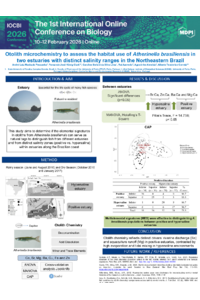
The estuarine ecosystems are driven by pronounced gradients and dynamic processes, leading to high spatial and temporal variability in both biotic communities and abiotic conditions. This study examines the effect of a range of salinities on the chemical composition of the sagittal otoliths of Brazilian silversides Atherinella brasiliensis from two tropical estuaries (positive and hypersaline). Beach seine sampling was conducted in the upper and lower zones of the estuaries during both the rainy (June, August 2016) and dry seasons (October 2016, January 2017). Multi-elemental signatures (MESs: Element:Ca) of the bulk otoliths were obtained using solution-based inductively coupled-plasma mass spectrometry (SB-ICP-MS). To determine the spatial variation in otolith signatures, we analyzed patterns of homogeneity and heterogeneity between estuaries using univariate and multivariate statistics. Overall, 121 otoliths were analyzed from adult fish collected in both estuaries. The data indicated significant differences in the elemental composition between individuals collected in positive and hypersaline estuaries. Elemental differences were mainly driven by Sr and Zn in the hypersaline estuary, while Ba and Mg were higher in the positive estuary. The MES compositions were correctly reclassified into their original groups in each zone from both estuaries: 86.7% and 83.3% in the positive estuary and 66.7% and 56.7% in the hypersaline estuary, for inferior and superior zones, respectively. The overall reclassification rate obtained using MESs was 73.3% for both estuaries. The salinity gradient in estuaries is the most influential habitat factor affecting species distributions, and the variation in elemental concentrations across the depositional time frame of the otolith reflects the exposure of fish to different salinity ranges.
Keywords
Natural tags
Otolith fingerprinting
Atherinopsidae
Estuarine species
Poster
156758.pdf
Population structure of the European seabass (Dicentrarchus labrax) in Atlantic Iberian coastal waters inferred from body morphometrics and otolith shape analysis
Biological Succession and Degradation in Biofouled Plastics