Event submissions
Published
This submission belongs to the session S7. Plant Biology of the event The 1st International Online Conference on Biology
Published date
05 Feb, 2026
Academic Editor
'%3e%3cpath%20d='M12.6657%2010.9104C12.4185%2010.325%2012.0599%209.79327%2011.6097%209.34482C11.1609%208.89508%2010.6293%208.5365%2010.0442%208.28888C10.0389%208.28626%2010.0337%208.28495%2010.0285%208.28233C10.8446%207.69279%2011.3752%206.73249%2011.3752%205.64904C11.3752%203.8542%209.92103%202.39999%208.1262%202.39999C6.33136%202.39999%204.87715%203.8542%204.87715%205.64904C4.87715%206.73249%205.40774%207.69279%206.22393%208.28364C6.21869%208.28626%206.21345%208.28757%206.20821%208.29019C5.62129%208.5378%205.09463%208.89284%204.64265%209.34613C4.1929%209.79493%203.83432%2010.3266%203.58671%2010.9117C3.34345%2011.4845%203.21226%2012.0987%203.20023%2012.7209C3.19988%2012.7349%203.20233%2012.7488%203.20744%2012.7619C3.21255%2012.7749%203.22022%2012.7867%203.22998%2012.7968C3.23975%2012.8068%203.25142%2012.8147%203.26431%2012.8202C3.2772%2012.8256%203.29105%2012.8284%203.30504%2012.8284H4.09109C4.14874%2012.8284%204.19459%2012.7825%204.1959%2012.7262C4.2221%2011.7148%204.62823%2010.7676%205.34617%2010.0497C6.08899%209.30683%207.0755%208.89808%208.1262%208.89808C9.17689%208.89808%2010.1634%209.30683%2010.9062%2010.0497C11.6242%2010.7676%2012.0303%2011.7148%2012.0565%2012.7262C12.0578%2012.7838%2012.1037%2012.8284%2012.1613%2012.8284H12.9474C12.9613%2012.8284%2012.9752%2012.8256%2012.9881%2012.8202C13.001%2012.8147%2013.0126%2012.8068%2013.0224%2012.7968C13.0322%2012.7867%2013.0398%2012.7749%2013.0449%2012.7619C13.0501%2012.7488%2013.0525%2012.7349%2013.0522%2012.7209C13.0391%2012.0947%2012.9094%2011.4855%2012.6657%2010.9104ZM8.1262%207.9024C7.52486%207.9024%206.9589%207.6679%206.53312%207.24211C6.10733%206.81633%205.87283%206.25037%205.87283%205.64904C5.87283%205.0477%206.10733%204.48174%206.53312%204.05596C6.9589%203.63018%207.52486%203.39567%208.1262%203.39567C8.72753%203.39567%209.29349%203.63018%209.71927%204.05596C10.1451%204.48174%2010.3796%205.0477%2010.3796%205.64904C10.3796%206.25037%2010.1451%206.81633%209.71927%207.24211C9.29349%207.6679%208.72753%207.9024%208.1262%207.9024Z'%20fill='%235D1EE1'/%3e%3c/g%3e%3c/svg%3e) Zdenko Rengel
Zdenko RengelCitation
Fatima zohra ALACHAHER, Djamil KROUF, In Vivo Assessment of Rosmarinus officinalis and Olea europaea Leaf Extracts Enriched in Rosmarinic Acid and Oleuropein as Modulators of Metabolic Inflammation, in Proceedings of The 1st International Online Conference on Biology, 10 February–12 February 2026, MDPI: Basel, Switzerland
Share
Email
Facebook
Twitter
LinkedIn
In Vivo Assessment of Rosmarinus officinalis and Olea europaea Leaf Extracts Enriched in Rosmarinic Acid and Oleuropein as Modulators of Metabolic Inflammation
'%3e%3cpath%20d='M12.6647%2010.9104C12.4176%2010.325%2012.0589%209.7933%2011.6088%209.34485C11.16%208.89511%2010.6283%208.53653%2010.0432%208.28891C10.038%208.28629%2010.0327%208.28498%2010.0275%208.28236C10.8437%207.69282%2011.3743%206.73252%2011.3743%205.64907C11.3743%203.85423%209.92005%202.40002%208.12522%202.40002C6.33038%202.40002%204.87618%203.85423%204.87618%205.64907C4.87618%206.73252%205.40677%207.69282%206.22296%208.28367C6.21772%208.28629%206.21248%208.2876%206.20724%208.29022C5.62031%208.53783%205.09365%208.89287%204.64167%209.34616C4.19192%209.79496%203.83334%2010.3266%203.58573%2010.9117C3.34247%2011.4846%203.21128%2012.0987%203.19925%2012.721C3.1989%2012.735%203.20135%2012.7489%203.20646%2012.7619C3.21157%2012.7749%203.21924%2012.7868%203.22901%2012.7968C3.23877%2012.8068%203.25045%2012.8148%203.26334%2012.8202C3.27623%2012.8256%203.29007%2012.8284%203.30406%2012.8284H4.09012C4.14776%2012.8284%204.19362%2012.7825%204.19493%2012.7262C4.22113%2011.7148%204.62726%2010.7676%205.34519%2010.0497C6.08802%209.30686%207.07452%208.89811%208.12522%208.89811C9.17592%208.89811%2010.1624%209.30686%2010.9052%2010.0497C11.6232%2010.7676%2012.0293%2011.7148%2012.0555%2012.7262C12.0568%2012.7839%2012.1027%2012.8284%2012.1603%2012.8284H12.9464C12.9604%2012.8284%2012.9742%2012.8256%2012.9871%2012.8202C13%2012.8148%2013.0117%2012.8068%2013.0214%2012.7968C13.0312%2012.7868%2013.0389%2012.7749%2013.044%2012.7619C13.0491%2012.7489%2013.0515%2012.735%2013.0512%2012.721C13.0381%2012.0947%2012.9084%2011.4856%2012.6647%2010.9104ZM8.12522%207.90243C7.52388%207.90243%206.95792%207.66793%206.53214%207.24215C6.10636%206.81636%205.87185%206.2504%205.87185%205.64907C5.87185%205.04773%206.10636%204.48177%206.53214%204.05599C6.95792%203.63021%207.52388%203.3957%208.12522%203.3957C8.72655%203.3957%209.29252%203.63021%209.7183%204.05599C10.1441%204.48177%2010.3786%205.04773%2010.3786%205.64907C10.3786%206.2504%2010.1441%206.81636%209.7183%207.24215C9.29252%207.66793%208.72655%207.90243%208.12522%207.90243Z'%20fill='%235D1EE1'/%3e%3c/g%3e%3c/svg%3e)
Fatima zohra ALACHAHER 1,2
Djamil KROUF 2
1. Laboratory of Beneficial Microorganisms, Functional Foods and Health (LMBAFS), Department of Food Sciences, Faculty of Life and Natural Science, Abdelhamid Ibn Badis University, Mostaganem 27000, Algeria
2. Laboratory of Clinical and Metabolic Nutrition, Department of Food Sciences, Faculty of Life and Natural Science, University of Oran1 Ahmed Benbella, 31000, Algeria
Abstract
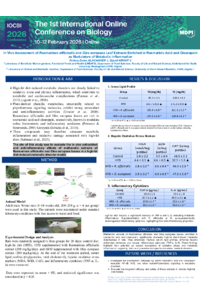
Plant-derived phenolic metabolites structurally related to phytohormone signaling molecules have gained interest for their potential to modulate oxidative stress and inflammation associated with metabolic disorders. Rosmarinus officinalis (rosemary) and Olea europaea (olive) leaves contain bioactive compounds such as rosmarinic acid and oleuropein, which are involved in plant defense and signaling pathways and may influence inflammatory processes in mammals. This study aimed to investigate the in vivo antioxidant and anti-inflammatory effects of these metabolites. Methanolic extracts of R. officinalis and O. europaea leaves were prepared and administered orally to adult male Wistar rats (8–10 weeks, 200–250 g; n = 6 per group) at 200 mg/kg/day for 28 days. Rats were assigned to control, high-fat diet (HFD), and HFD + plant extract groups. Extracts were characterized by HPLC, confirming rosmarinic acid (12.5 mg/g extract) and oleuropein (8.3 mg/g extract). Serum lipid profiles, hepatic oxidative markers (MDA, SOD, CAT), and inflammatory cytokines (TNF-α, IL-6) were quantified. Treatment with R. officinalis and O. europaea extracts significantly reduced serum triglycerides (−28%) and total cholesterol (−31%) compared with HFD rats. Hepatic MDA decreased by 36%, while SOD and CAT activities increased by 41% and 38%, respectively.NF-α and IL-6 levels were markedly downregulated, indicating attenuation of metabolic inflammation. These results demonstrate that phenolic metabolites structurally related to phytohormone signaling molecules exert potent antioxidant and anti-inflammatory effects in vivo, highlighting their potential as natural modulators of metabolic inflammation and contributors to metabolic homeostasis.
Keywords
Rosmarinus officinals
Olea europaea
inflammation
antioxidant
Poster
154933.pdf
Genotypic response of wheat against Stripe rust and Its Geospatial distribution in Southern Punjab
Chromosome Number Determination and Karyotype Evolution in Different Species of the Tribe Naupactini (Coleoptera, Curculionidae)