Event submissions
Published
This submission belongs to the session S7. Plant Biology of the event The 1st International Online Conference on Biology
Published date
05 Feb, 2026
Academic Editor
'%3e%3cpath%20d='M12.6657%2010.9104C12.4185%2010.325%2012.0599%209.79327%2011.6097%209.34482C11.1609%208.89508%2010.6293%208.5365%2010.0442%208.28888C10.0389%208.28626%2010.0337%208.28495%2010.0285%208.28233C10.8446%207.69279%2011.3752%206.73249%2011.3752%205.64904C11.3752%203.8542%209.92103%202.39999%208.1262%202.39999C6.33136%202.39999%204.87715%203.8542%204.87715%205.64904C4.87715%206.73249%205.40774%207.69279%206.22393%208.28364C6.21869%208.28626%206.21345%208.28757%206.20821%208.29019C5.62129%208.5378%205.09463%208.89284%204.64265%209.34613C4.1929%209.79493%203.83432%2010.3266%203.58671%2010.9117C3.34345%2011.4845%203.21226%2012.0987%203.20023%2012.7209C3.19988%2012.7349%203.20233%2012.7488%203.20744%2012.7619C3.21255%2012.7749%203.22022%2012.7867%203.22998%2012.7968C3.23975%2012.8068%203.25142%2012.8147%203.26431%2012.8202C3.2772%2012.8256%203.29105%2012.8284%203.30504%2012.8284H4.09109C4.14874%2012.8284%204.19459%2012.7825%204.1959%2012.7262C4.2221%2011.7148%204.62823%2010.7676%205.34617%2010.0497C6.08899%209.30683%207.0755%208.89808%208.1262%208.89808C9.17689%208.89808%2010.1634%209.30683%2010.9062%2010.0497C11.6242%2010.7676%2012.0303%2011.7148%2012.0565%2012.7262C12.0578%2012.7838%2012.1037%2012.8284%2012.1613%2012.8284H12.9474C12.9613%2012.8284%2012.9752%2012.8256%2012.9881%2012.8202C13.001%2012.8147%2013.0126%2012.8068%2013.0224%2012.7968C13.0322%2012.7867%2013.0398%2012.7749%2013.0449%2012.7619C13.0501%2012.7488%2013.0525%2012.7349%2013.0522%2012.7209C13.0391%2012.0947%2012.9094%2011.4855%2012.6657%2010.9104ZM8.1262%207.9024C7.52486%207.9024%206.9589%207.6679%206.53312%207.24211C6.10733%206.81633%205.87283%206.25037%205.87283%205.64904C5.87283%205.0477%206.10733%204.48174%206.53312%204.05596C6.9589%203.63018%207.52486%203.39567%208.1262%203.39567C8.72753%203.39567%209.29349%203.63018%209.71927%204.05596C10.1451%204.48174%2010.3796%205.0477%2010.3796%205.64904C10.3796%206.25037%2010.1451%206.81633%209.71927%207.24211C9.29349%207.6679%208.72753%207.9024%208.1262%207.9024Z'%20fill='%235D1EE1'/%3e%3c/g%3e%3c/svg%3e) Zdenko Rengel
Zdenko RengelCitation
Asmaa Ali Mohamed, Ahmed Sallam, Identification of DArT-genomic regions associated with morpho-physiological traits in spring wheat seedlings under drought conditions., in Proceedings of The 1st International Online Conference on Biology, 10 February–12 February 2026, MDPI: Basel, Switzerland
Share
Email
Facebook
Twitter
LinkedIn
Identification of DArT-genomic regions associated with morpho-physiological traits in spring wheat seedlings under drought conditions.
'%3e%3cpath%20d='M12.6647%2010.9104C12.4176%2010.325%2012.0589%209.7933%2011.6088%209.34485C11.16%208.89511%2010.6283%208.53653%2010.0432%208.28891C10.038%208.28629%2010.0327%208.28498%2010.0275%208.28236C10.8437%207.69282%2011.3743%206.73252%2011.3743%205.64907C11.3743%203.85423%209.92005%202.40002%208.12522%202.40002C6.33038%202.40002%204.87618%203.85423%204.87618%205.64907C4.87618%206.73252%205.40677%207.69282%206.22296%208.28367C6.21772%208.28629%206.21248%208.2876%206.20724%208.29022C5.62031%208.53783%205.09365%208.89287%204.64167%209.34616C4.19192%209.79496%203.83334%2010.3266%203.58573%2010.9117C3.34247%2011.4846%203.21128%2012.0987%203.19925%2012.721C3.1989%2012.735%203.20135%2012.7489%203.20646%2012.7619C3.21157%2012.7749%203.21924%2012.7868%203.22901%2012.7968C3.23877%2012.8068%203.25045%2012.8148%203.26334%2012.8202C3.27623%2012.8256%203.29007%2012.8284%203.30406%2012.8284H4.09012C4.14776%2012.8284%204.19362%2012.7825%204.19493%2012.7262C4.22113%2011.7148%204.62726%2010.7676%205.34519%2010.0497C6.08802%209.30686%207.07452%208.89811%208.12522%208.89811C9.17592%208.89811%2010.1624%209.30686%2010.9052%2010.0497C11.6232%2010.7676%2012.0293%2011.7148%2012.0555%2012.7262C12.0568%2012.7839%2012.1027%2012.8284%2012.1603%2012.8284H12.9464C12.9604%2012.8284%2012.9742%2012.8256%2012.9871%2012.8202C13%2012.8148%2013.0117%2012.8068%2013.0214%2012.7968C13.0312%2012.7868%2013.0389%2012.7749%2013.044%2012.7619C13.0491%2012.7489%2013.0515%2012.735%2013.0512%2012.721C13.0381%2012.0947%2012.9084%2011.4856%2012.6647%2010.9104ZM8.12522%207.90243C7.52388%207.90243%206.95792%207.66793%206.53214%207.24215C6.10636%206.81636%205.87185%206.2504%205.87185%205.64907C5.87185%205.04773%206.10636%204.48177%206.53214%204.05599C6.95792%203.63021%207.52388%203.3957%208.12522%203.3957C8.72655%203.3957%209.29252%203.63021%209.7183%204.05599C10.1441%204.48177%2010.3786%205.04773%2010.3786%205.64907C10.3786%206.2504%2010.1441%206.81636%209.7183%207.24215C9.29252%207.66793%208.72655%207.90243%208.12522%207.90243Z'%20fill='%235D1EE1'/%3e%3c/g%3e%3c/svg%3e)
Asmaa Ali Mohamed 1

Ahmed Sallam 1,2
1. Department of Genetics, Faculty of Agriculture, Assiut University, Assiut 71526, Egypt.
2. Department Genebank, Leibniz Institute of Plant Genetics and Crop Plant Research (IPK), Gatersleben, Germany.
Abstract
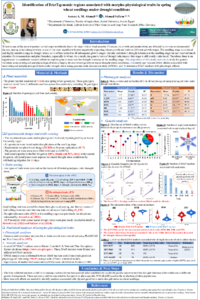
Although extensive research has been conducted on molecular breeding for drought stress tolerance in wheat, the study of drought stress at the seedling stage has not received much attention from researchers compared to other growth stages. As a result, the genetic basis of drought tolerance at the seedling stage is poorly understood, and very few genes associated with drought tolerance at this stage were identified. Therefore, there is an urgent need to concerted research efforts to explore genetic resources for drought tolerance at the seedling stage. In this study, 172 spring wheat genotypes from 20 different countries was screened under drought stress at the seedling stage. Drought stress was naturally applied by withholding irrigation for 13 days. Many morphological (leaf wilting (LW), days to wilting (DTW), days to regrowth (DTR), drought survivalrate(DSR)), and physiological traits (protein (P), amino acids (AM), proline (Pro), glucose (G) and fructose (F) were scored. The ANOVA analysis showed highly genetic differences among genotypes in all traits. The heritability (H2) estimates were very high in all traits. The H2 ranged from 0.84 to 0.92 for morphological traits, and from 0.97 to 0.99 for physiological traits. Moreover, significant correlations were found among traits under drought stress. Genome-wide association analysis (GWAS) was conducted for all traits using 407 Diversity Arrays Technology (DArT) markers. The GWAS analysis at significant level of p-value ≤ 0. 001 revealed 15 and one significant DArT markers associated with morphological and physiological traits, respectively. Out of all significant markers, only one marker (WPT-7063) found to be common in four morphological traits. Interestingly, four markers (TPT-3689, WPT-664309, WPT-7677, and RPT-7068) found in this study were previously reported for their association with drought tolerance in wheat. The preliminary findings of this study provided novel significant markers which, after validation, may be used in marker-assisted selection to accelerate genetic improvement of drought tolerance in wheat seedlings.
Keywords
Triticum aestivum L.
water deficit stress
seedling stage
morphological traits
physiological traits
DArT markers
GWAS analysis.
Poster
154227.pdf
Rapid evolutionary adaptations to parasitology: Insights from basal metazoans belonging to the Myxozoa (Cnidaria)
Whole-Genome Analysis of Mahsuri Rice and Its Blast-Resistant Mutant for Understanding Resistance Mechanisms