Event submissions
Published
This submission belongs to the session S1. Evolutionary Biology of the event The 1st International Online Conference on Biology
Published date
05 Feb, 2026
Academic Editor
'%3e%3cpath%20d='M12.6657%2010.9104C12.4185%2010.325%2012.0599%209.79327%2011.6097%209.34482C11.1609%208.89508%2010.6293%208.5365%2010.0442%208.28888C10.0389%208.28626%2010.0337%208.28495%2010.0285%208.28233C10.8446%207.69279%2011.3752%206.73249%2011.3752%205.64904C11.3752%203.8542%209.92103%202.39999%208.1262%202.39999C6.33136%202.39999%204.87715%203.8542%204.87715%205.64904C4.87715%206.73249%205.40774%207.69279%206.22393%208.28364C6.21869%208.28626%206.21345%208.28757%206.20821%208.29019C5.62129%208.5378%205.09463%208.89284%204.64265%209.34613C4.1929%209.79493%203.83432%2010.3266%203.58671%2010.9117C3.34345%2011.4845%203.21226%2012.0987%203.20023%2012.7209C3.19988%2012.7349%203.20233%2012.7488%203.20744%2012.7619C3.21255%2012.7749%203.22022%2012.7867%203.22998%2012.7968C3.23975%2012.8068%203.25142%2012.8147%203.26431%2012.8202C3.2772%2012.8256%203.29105%2012.8284%203.30504%2012.8284H4.09109C4.14874%2012.8284%204.19459%2012.7825%204.1959%2012.7262C4.2221%2011.7148%204.62823%2010.7676%205.34617%2010.0497C6.08899%209.30683%207.0755%208.89808%208.1262%208.89808C9.17689%208.89808%2010.1634%209.30683%2010.9062%2010.0497C11.6242%2010.7676%2012.0303%2011.7148%2012.0565%2012.7262C12.0578%2012.7838%2012.1037%2012.8284%2012.1613%2012.8284H12.9474C12.9613%2012.8284%2012.9752%2012.8256%2012.9881%2012.8202C13.001%2012.8147%2013.0126%2012.8068%2013.0224%2012.7968C13.0322%2012.7867%2013.0398%2012.7749%2013.0449%2012.7619C13.0501%2012.7488%2013.0525%2012.7349%2013.0522%2012.7209C13.0391%2012.0947%2012.9094%2011.4855%2012.6657%2010.9104ZM8.1262%207.9024C7.52486%207.9024%206.9589%207.6679%206.53312%207.24211C6.10733%206.81633%205.87283%206.25037%205.87283%205.64904C5.87283%205.0477%206.10733%204.48174%206.53312%204.05596C6.9589%203.63018%207.52486%203.39567%208.1262%203.39567C8.72753%203.39567%209.29349%203.63018%209.71927%204.05596C10.1451%204.48174%2010.3796%205.0477%2010.3796%205.64904C10.3796%206.25037%2010.1451%206.81633%209.71927%207.24211C9.29349%207.6679%208.72753%207.9024%208.1262%207.9024Z'%20fill='%235D1EE1'/%3e%3c/g%3e%3c/svg%3e) Antonio Carvajal-Rodríguez
Antonio Carvajal-RodríguezCitation
Celia Feria, María Arévalo, Lorena Ponce, Javier Escobar Cubiella, Javier Sarasqueta Mayans, Fernando Rodriguez Artalejo, Mercedes Sotos Prieto, Maria del Rosario Ortola Vidal, Susana Ruiz, Ana Barberá, Vicente Perez Brocal, Wladimiro Díaz Villanueva, Andrés Moya, The Early detection of frailty syndrome using a model that employs a combination of omic data, in Proceedings of The 1st International Online Conference on Biology, 10 February–12 February 2026, MDPI: Basel, Switzerland
Share
Email
Facebook
Twitter
LinkedIn
The Early detection of frailty syndrome using a model that employs a combination of omic data
'%3e%3cpath%20d='M12.6647%2010.9104C12.4176%2010.325%2012.0589%209.7933%2011.6088%209.34485C11.16%208.89511%2010.6283%208.53653%2010.0432%208.28891C10.038%208.28629%2010.0327%208.28498%2010.0275%208.28236C10.8437%207.69282%2011.3743%206.73252%2011.3743%205.64907C11.3743%203.85423%209.92005%202.40002%208.12522%202.40002C6.33038%202.40002%204.87618%203.85423%204.87618%205.64907C4.87618%206.73252%205.40677%207.69282%206.22296%208.28367C6.21772%208.28629%206.21248%208.2876%206.20724%208.29022C5.62031%208.53783%205.09365%208.89287%204.64167%209.34616C4.19192%209.79496%203.83334%2010.3266%203.58573%2010.9117C3.34247%2011.4846%203.21128%2012.0987%203.19925%2012.721C3.1989%2012.735%203.20135%2012.7489%203.20646%2012.7619C3.21157%2012.7749%203.21924%2012.7868%203.22901%2012.7968C3.23877%2012.8068%203.25045%2012.8148%203.26334%2012.8202C3.27623%2012.8256%203.29007%2012.8284%203.30406%2012.8284H4.09012C4.14776%2012.8284%204.19362%2012.7825%204.19493%2012.7262C4.22113%2011.7148%204.62726%2010.7676%205.34519%2010.0497C6.08802%209.30686%207.07452%208.89811%208.12522%208.89811C9.17592%208.89811%2010.1624%209.30686%2010.9052%2010.0497C11.6232%2010.7676%2012.0293%2011.7148%2012.0555%2012.7262C12.0568%2012.7839%2012.1027%2012.8284%2012.1603%2012.8284H12.9464C12.9604%2012.8284%2012.9742%2012.8256%2012.9871%2012.8202C13%2012.8148%2013.0117%2012.8068%2013.0214%2012.7968C13.0312%2012.7868%2013.0389%2012.7749%2013.044%2012.7619C13.0491%2012.7489%2013.0515%2012.735%2013.0512%2012.721C13.0381%2012.0947%2012.9084%2011.4856%2012.6647%2010.9104ZM8.12522%207.90243C7.52388%207.90243%206.95792%207.66793%206.53214%207.24215C6.10636%206.81636%205.87185%206.2504%205.87185%205.64907C5.87185%205.04773%206.10636%204.48177%206.53214%204.05599C6.95792%203.63021%207.52388%203.3957%208.12522%203.3957C8.72655%203.3957%209.29252%203.63021%209.7183%204.05599C10.1441%204.48177%2010.3786%205.04773%2010.3786%205.64907C10.3786%206.2504%2010.1441%206.81636%209.7183%207.24215C9.29252%207.66793%208.72655%207.90243%208.12522%207.90243Z'%20fill='%235D1EE1'/%3e%3c/g%3e%3c/svg%3e)
Celia Feria 1
María Arévalo 2
Lorena Ponce 2
Javier Escobar Cubiella 2
Javier Sarasqueta Mayans 2
Fernando Rodriguez Artalejo 3,4,5
Mercedes Sotos Prieto 3
Maria del Rosario Ortola Vidal 3
Susana Ruiz 1
Ana Barberá 1

Vicente Perez Brocal 1
Wladimiro Díaz Villanueva 1,4,6,7

Andrés Moya 1,4,6,7
1. FISABIO, Valencia, Spain
2. Sabartech, Valencia, Spain
3. Universidad Autónoma de Madrid, Madrid, Spain
4. CIBEResp, Madrid, Spain
5. IMDEA-Nutrition, Madrid, Spain
6. Institute for Integrative Systems Biology (I2SysBio), Valencia, Spain
7. Universidad de Valencia, Valencia, Spain
Abstract
Frailty syndrome (FS) is an age-related condition characterised by a loss of physiological reserves across multiple organs and systems, resulting in high vulnerability to even mild stressors [1]. This state of physiological deterioration and generalized loss of homeostasis has been shown to increase the risk of premature mortality, falls, fractures, hospitalization and institutionalization among the elderly [2]. An early and accurate diagnosis of FS is therefore critical for improving patient quality of life and guiding clinical decision-making.
FS is a complex phenotype influenced by multiple factors, with approximately 40% of its development attributable to genetic determinants. Genome-wide association studies have identified significant variants in genes involved in inflammation, neurotransmission, and aging pathways [3]. Concurrently, more evidence has emerged indicating a correlation between gut microbiota dysbiosis and the progression of FS [4].
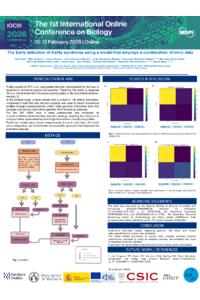
In this study, a cohort comprising 936 genomic samples (whole-genome DNA microarrays) and 199 microbiome profiles obtained through 16S rRNA sequencing was analysed. The cohort included both frail and healthy individuals aged ≥ 65 years. Supplementary clinical data provided additional context on participant health status. Predictive models were generated for each type of data: genomic, microbiome and clinical. Subsequently, an ensemble learning approach was implemented for the purpose of integrating all three model predictions, with a view to enhancing predictive accuracy.
The findings suggest that the combined ensemble model demonstrates superior performance in comparison to single-source predictors. The conclusions of the present study demonstrate the potential of omic data fusion and advanced machine learning techniques for FS diagnosis.
References:
-
Kim DH, Rockwood K. Frailty in Older Adults. N Engl J Med. 2024;391(6):538-548.
-
Khan KT, Hemati K, Donovan AL. Geriatric Physiology and the Frailty Syndrome. Anesthesiology clinics. 2019;37:453-474.
-
Weiss CO. Frailty and chronic diseases in older adults. Clinics in geriatric medicine. 2011;27:39-52.
-
Tongeren SP, Slaets JPJ, Harmsen HJM, Welling GW. Fecal microbiota composition and frailty. Applied and environmental microbiology. 2005;71:6438-6442.
Keywords
Frailty Syndrome
omics
machine learning
mixed model
Poster
sciforum-156345.pdf
FORMULATION OF BIOFUNGICIDE FOR LEAF BLIGHT OF JASMINUM SAMBAC
Metref, an auto-updatable web app for reference / representive genomes and their complexity metrics.