Event submissions
Published
This submission belongs to the session S7. Plant Biology of the event The 1st International Online Conference on Biology
Published date
05 Feb, 2026
Academic Editor
'%3e%3cpath%20d='M12.6657%2010.9104C12.4185%2010.325%2012.0599%209.79327%2011.6097%209.34482C11.1609%208.89508%2010.6293%208.5365%2010.0442%208.28888C10.0389%208.28626%2010.0337%208.28495%2010.0285%208.28233C10.8446%207.69279%2011.3752%206.73249%2011.3752%205.64904C11.3752%203.8542%209.92103%202.39999%208.1262%202.39999C6.33136%202.39999%204.87715%203.8542%204.87715%205.64904C4.87715%206.73249%205.40774%207.69279%206.22393%208.28364C6.21869%208.28626%206.21345%208.28757%206.20821%208.29019C5.62129%208.5378%205.09463%208.89284%204.64265%209.34613C4.1929%209.79493%203.83432%2010.3266%203.58671%2010.9117C3.34345%2011.4845%203.21226%2012.0987%203.20023%2012.7209C3.19988%2012.7349%203.20233%2012.7488%203.20744%2012.7619C3.21255%2012.7749%203.22022%2012.7867%203.22998%2012.7968C3.23975%2012.8068%203.25142%2012.8147%203.26431%2012.8202C3.2772%2012.8256%203.29105%2012.8284%203.30504%2012.8284H4.09109C4.14874%2012.8284%204.19459%2012.7825%204.1959%2012.7262C4.2221%2011.7148%204.62823%2010.7676%205.34617%2010.0497C6.08899%209.30683%207.0755%208.89808%208.1262%208.89808C9.17689%208.89808%2010.1634%209.30683%2010.9062%2010.0497C11.6242%2010.7676%2012.0303%2011.7148%2012.0565%2012.7262C12.0578%2012.7838%2012.1037%2012.8284%2012.1613%2012.8284H12.9474C12.9613%2012.8284%2012.9752%2012.8256%2012.9881%2012.8202C13.001%2012.8147%2013.0126%2012.8068%2013.0224%2012.7968C13.0322%2012.7867%2013.0398%2012.7749%2013.0449%2012.7619C13.0501%2012.7488%2013.0525%2012.7349%2013.0522%2012.7209C13.0391%2012.0947%2012.9094%2011.4855%2012.6657%2010.9104ZM8.1262%207.9024C7.52486%207.9024%206.9589%207.6679%206.53312%207.24211C6.10733%206.81633%205.87283%206.25037%205.87283%205.64904C5.87283%205.0477%206.10733%204.48174%206.53312%204.05596C6.9589%203.63018%207.52486%203.39567%208.1262%203.39567C8.72753%203.39567%209.29349%203.63018%209.71927%204.05596C10.1451%204.48174%2010.3796%205.0477%2010.3796%205.64904C10.3796%206.25037%2010.1451%206.81633%209.71927%207.24211C9.29349%207.6679%208.72753%207.9024%208.1262%207.9024Z'%20fill='%235D1EE1'/%3e%3c/g%3e%3c/svg%3e) Zdenko Rengel
Zdenko RengelCitation
Vasileios Papantzikos, Toward Sustainable Kiwi Cultivation: Growth and Metabolic Insights from a Case Study of the Application of Amino Acid and Organic-Based Biostimulants, in Proceedings of The 1st International Online Conference on Biology, 10 February–12 February 2026, MDPI: Basel, Switzerland
Share
Email
Facebook
Twitter
LinkedIn
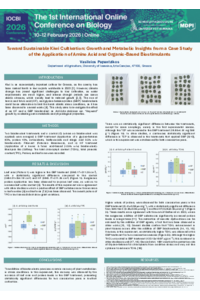
Toward Sustainable Kiwi Cultivation: Growth and Metabolic Insights from a Case Study of the Application of Amino Acid and Organic-Based Biostimulants

Vasileios Papantzikos 1
1. Department of Agriculture, University of Ioannina, Arta Campus, 47100, Greece
Abstract
The use of biostimulants is a sustainable agriculture approach as their rational application is likely to be accompanied by relying less on synthetic inputs. Investigating the application of biostimulants is considered more significant than ever, especially in the commercially important species Actinidia deliciosa L., in the face of climate change. In this work, the application of a glycine–betaine–proline-based biostimulant (GBP) and a humic and fulvic acid-based biostimulant (HF) was evaluated on the growth and metabolism of kiwi trees. The study was conducted at a commercial organic kiwi orchard in order to assess the effects under actual commercial field conditions. Three treatments were established: treatment GBP, treatment HF, and the control treatment C (absence of biostimulants). Throughout the two-year experiment, leaf areas (cm2) were measured in the field, and the metabolic traits such as total phenolic content (mg GAE g−1 Dry Leaf), proline concentration (µmol g−1 Fresh Leaf), and chlorophyll content (µg cm−2) were analyzed in the Productive Agriculture and Plant Health Laboratory in the Department of Agriculture of the University of Ioannina, to investigate the presence of abiotic stress among the treatments. The metabolic data showed that the kiwi trees of the GBP treatment were more robust, as indicated by the chlorophyll and proline analysis. This vigor of GBP treatment was also represented in leaf area when compared to the C. The implementation of biostimulants constitutes an ecological approach that can be integrated into biological crop management, as it is environmentally friendly, non-invasive to the ecosystem, and aims to promote crop resilience to biotic or abiotic stress.
Keywords
biostimulants
kiwi
Poster
POSTER IOCB 2026.pdf
Integrating Canopy Fluxes and Biochemical Traits to Enhance Crop Resilience under CO₂, Ozone, and Drought Stress
Root-Trait Adaptations in Chickpea (Cicer spp.) Under Drought Stress