Event submissions
Published
This submission belongs to the session S3. Conservation Biology of the event The 1st International Online Conference on Biology
Published date
05 Feb, 2026
Academic Editor
'%3e%3cpath%20d='M12.6657%2010.9104C12.4185%2010.325%2012.0599%209.79327%2011.6097%209.34482C11.1609%208.89508%2010.6293%208.5365%2010.0442%208.28888C10.0389%208.28626%2010.0337%208.28495%2010.0285%208.28233C10.8446%207.69279%2011.3752%206.73249%2011.3752%205.64904C11.3752%203.8542%209.92103%202.39999%208.1262%202.39999C6.33136%202.39999%204.87715%203.8542%204.87715%205.64904C4.87715%206.73249%205.40774%207.69279%206.22393%208.28364C6.21869%208.28626%206.21345%208.28757%206.20821%208.29019C5.62129%208.5378%205.09463%208.89284%204.64265%209.34613C4.1929%209.79493%203.83432%2010.3266%203.58671%2010.9117C3.34345%2011.4845%203.21226%2012.0987%203.20023%2012.7209C3.19988%2012.7349%203.20233%2012.7488%203.20744%2012.7619C3.21255%2012.7749%203.22022%2012.7867%203.22998%2012.7968C3.23975%2012.8068%203.25142%2012.8147%203.26431%2012.8202C3.2772%2012.8256%203.29105%2012.8284%203.30504%2012.8284H4.09109C4.14874%2012.8284%204.19459%2012.7825%204.1959%2012.7262C4.2221%2011.7148%204.62823%2010.7676%205.34617%2010.0497C6.08899%209.30683%207.0755%208.89808%208.1262%208.89808C9.17689%208.89808%2010.1634%209.30683%2010.9062%2010.0497C11.6242%2010.7676%2012.0303%2011.7148%2012.0565%2012.7262C12.0578%2012.7838%2012.1037%2012.8284%2012.1613%2012.8284H12.9474C12.9613%2012.8284%2012.9752%2012.8256%2012.9881%2012.8202C13.001%2012.8147%2013.0126%2012.8068%2013.0224%2012.7968C13.0322%2012.7867%2013.0398%2012.7749%2013.0449%2012.7619C13.0501%2012.7488%2013.0525%2012.7349%2013.0522%2012.7209C13.0391%2012.0947%2012.9094%2011.4855%2012.6657%2010.9104ZM8.1262%207.9024C7.52486%207.9024%206.9589%207.6679%206.53312%207.24211C6.10733%206.81633%205.87283%206.25037%205.87283%205.64904C5.87283%205.0477%206.10733%204.48174%206.53312%204.05596C6.9589%203.63018%207.52486%203.39567%208.1262%203.39567C8.72753%203.39567%209.29349%203.63018%209.71927%204.05596C10.1451%204.48174%2010.3796%205.0477%2010.3796%205.64904C10.3796%206.25037%2010.1451%206.81633%209.71927%207.24211C9.29349%207.6679%208.72753%207.9024%208.1262%207.9024Z'%20fill='%235D1EE1'/%3e%3c/g%3e%3c/svg%3e) Ettore Randi
Ettore RandiCitation
Md Towfiq Hasan, Najmul hasan, Harij Uddin, Ibrahim khalil Al Haidar, Mohammad Abdul Wahed Chowdhury, Ignoring Climate Change May Falsify Conservation Efforts for the Threatened Reptiles of Bangladesh, in Proceedings of The 1st International Online Conference on Biology, 10 February–12 February 2026, MDPI: Basel, Switzerland
Share
Email
Facebook
Twitter
LinkedIn
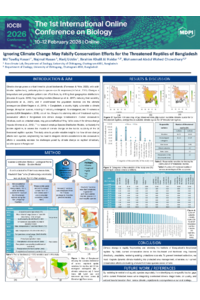
Ignoring Climate Change May Falsify Conservation Efforts for the Threatened Reptiles of Bangladesh
'%3e%3cpath%20d='M12.6647%2010.9104C12.4176%2010.325%2012.0589%209.7933%2011.6088%209.34485C11.16%208.89511%2010.6283%208.53653%2010.0432%208.28891C10.038%208.28629%2010.0327%208.28498%2010.0275%208.28236C10.8437%207.69282%2011.3743%206.73252%2011.3743%205.64907C11.3743%203.85423%209.92005%202.40002%208.12522%202.40002C6.33038%202.40002%204.87618%203.85423%204.87618%205.64907C4.87618%206.73252%205.40677%207.69282%206.22296%208.28367C6.21772%208.28629%206.21248%208.2876%206.20724%208.29022C5.62031%208.53783%205.09365%208.89287%204.64167%209.34616C4.19192%209.79496%203.83334%2010.3266%203.58573%2010.9117C3.34247%2011.4846%203.21128%2012.0987%203.19925%2012.721C3.1989%2012.735%203.20135%2012.7489%203.20646%2012.7619C3.21157%2012.7749%203.21924%2012.7868%203.22901%2012.7968C3.23877%2012.8068%203.25045%2012.8148%203.26334%2012.8202C3.27623%2012.8256%203.29007%2012.8284%203.30406%2012.8284H4.09012C4.14776%2012.8284%204.19362%2012.7825%204.19493%2012.7262C4.22113%2011.7148%204.62726%2010.7676%205.34519%2010.0497C6.08802%209.30686%207.07452%208.89811%208.12522%208.89811C9.17592%208.89811%2010.1624%209.30686%2010.9052%2010.0497C11.6232%2010.7676%2012.0293%2011.7148%2012.0555%2012.7262C12.0568%2012.7839%2012.1027%2012.8284%2012.1603%2012.8284H12.9464C12.9604%2012.8284%2012.9742%2012.8256%2012.9871%2012.8202C13%2012.8148%2013.0117%2012.8068%2013.0214%2012.7968C13.0312%2012.7868%2013.0389%2012.7749%2013.044%2012.7619C13.0491%2012.7489%2013.0515%2012.735%2013.0512%2012.721C13.0381%2012.0947%2012.9084%2011.4856%2012.6647%2010.9104ZM8.12522%207.90243C7.52388%207.90243%206.95792%207.66793%206.53214%207.24215C6.10636%206.81636%205.87185%206.2504%205.87185%205.64907C5.87185%205.04773%206.10636%204.48177%206.53214%204.05599C6.95792%203.63021%207.52388%203.3957%208.12522%203.3957C8.72655%203.3957%209.29252%203.63021%209.7183%204.05599C10.1441%204.48177%2010.3786%205.04773%2010.3786%205.64907C10.3786%206.2504%2010.1441%206.81636%209.7183%207.24215C9.29252%207.66793%208.72655%207.90243%208.12522%207.90243Z'%20fill='%235D1EE1'/%3e%3c/g%3e%3c/svg%3e)
Md Towfiq Hasan 1

Najmul hasan 1
Harij Uddin 1
Ibrahim khalil Al Haidar 1

Mohammad Abdul Wahed Chowdhury 1
1. Eco-climate Lab, Department of Zoology, University of Chittagong, Chattogram 4331, Bangladesh
Abstract
Climate change is one of the major threats facing our planet in the coming years, and its detrimental impacts on biodiversity are being documented. Numerous threatened species have already experienced population and species-level extinctions as a result of these effects. Detailed information regarding the distribution patterns, habitats, suitable space, and responsible variables that limit and shift the distribution of these threatened species is necessary for effective and targeted conservation planning and forecasting, particularly in situations where they face multiple conservation challenges. Species Distribution Models (SDMs) are frequently used to measure the correlation between the occurrence of such species and spatial variables, enabling the extrapolation of this relationship to new areas or time periods. Twelve bioclimatic and seven environmental variables from 100 occurrence points of 37 threatened reptiles of Bangladesh are used to train the Bioclim model under current climatic conditions. The model is then projected into the 2080 climatic scenario to illustrate how collective and individual species are expected to respond to future climate change under various assumptions. Out of the 37 species of threatened reptiles, 10 species (Batagur baska, Chelonia mydas, Lepidochelys olivacea, Dermochelys coriacea, Dopasia gracilis, Lygosoma punctata, Rhabdophis himalayanus, Boiga siamensis, Crocodylus porosus, and Heosemys depressa) are predicted to lose 100% of their suitable climatic space by the year 2080. Elevation and bio-ecological subregions play pivotal roles in shaping and constraining the distribution of these reptiles due to their impact on habitat suitability and climatic conditions. Proactive conservation strategies, such as the establishment and expansion of protected areas within their climatically appropriate space, should be taken into consideration in order to preserve these imperiled species.
Keywords
Climate change
Threatened reptiles
Species distribution model
Geospatial parameters
extinction
Poster
Poster_Md_Towfiq_Hasan.pdf
Contribution of the Functional Feeding Group (FFG) Approach to the Ecological Classification of Streams in Arid to Semi-Arid Regions: The Case of North African Wadis
Between Vulnerability and Resilience: Adaptive Responses of Aquatic Birds to Environmental Pressures in Algerian Wetlands.