Event submissions
Published
This submission belongs to the session S3. Conservation Biology of the event The 1st International Online Conference on Biology
Published date
05 Feb, 2026
Academic Editor
'%3e%3cpath%20d='M12.6657%2010.9104C12.4185%2010.325%2012.0599%209.79327%2011.6097%209.34482C11.1609%208.89508%2010.6293%208.5365%2010.0442%208.28888C10.0389%208.28626%2010.0337%208.28495%2010.0285%208.28233C10.8446%207.69279%2011.3752%206.73249%2011.3752%205.64904C11.3752%203.8542%209.92103%202.39999%208.1262%202.39999C6.33136%202.39999%204.87715%203.8542%204.87715%205.64904C4.87715%206.73249%205.40774%207.69279%206.22393%208.28364C6.21869%208.28626%206.21345%208.28757%206.20821%208.29019C5.62129%208.5378%205.09463%208.89284%204.64265%209.34613C4.1929%209.79493%203.83432%2010.3266%203.58671%2010.9117C3.34345%2011.4845%203.21226%2012.0987%203.20023%2012.7209C3.19988%2012.7349%203.20233%2012.7488%203.20744%2012.7619C3.21255%2012.7749%203.22022%2012.7867%203.22998%2012.7968C3.23975%2012.8068%203.25142%2012.8147%203.26431%2012.8202C3.2772%2012.8256%203.29105%2012.8284%203.30504%2012.8284H4.09109C4.14874%2012.8284%204.19459%2012.7825%204.1959%2012.7262C4.2221%2011.7148%204.62823%2010.7676%205.34617%2010.0497C6.08899%209.30683%207.0755%208.89808%208.1262%208.89808C9.17689%208.89808%2010.1634%209.30683%2010.9062%2010.0497C11.6242%2010.7676%2012.0303%2011.7148%2012.0565%2012.7262C12.0578%2012.7838%2012.1037%2012.8284%2012.1613%2012.8284H12.9474C12.9613%2012.8284%2012.9752%2012.8256%2012.9881%2012.8202C13.001%2012.8147%2013.0126%2012.8068%2013.0224%2012.7968C13.0322%2012.7867%2013.0398%2012.7749%2013.0449%2012.7619C13.0501%2012.7488%2013.0525%2012.7349%2013.0522%2012.7209C13.0391%2012.0947%2012.9094%2011.4855%2012.6657%2010.9104ZM8.1262%207.9024C7.52486%207.9024%206.9589%207.6679%206.53312%207.24211C6.10733%206.81633%205.87283%206.25037%205.87283%205.64904C5.87283%205.0477%206.10733%204.48174%206.53312%204.05596C6.9589%203.63018%207.52486%203.39567%208.1262%203.39567C8.72753%203.39567%209.29349%203.63018%209.71927%204.05596C10.1451%204.48174%2010.3796%205.0477%2010.3796%205.64904C10.3796%206.25037%2010.1451%206.81633%209.71927%207.24211C9.29349%207.6679%208.72753%207.9024%208.1262%207.9024Z'%20fill='%235D1EE1'/%3e%3c/g%3e%3c/svg%3e) Ettore Randi
Ettore RandiCitation
Fahmida Faiza, Ibrahim Khalil Al Haidar, Mohammed Noman, Md. Towfiq Hasan, Najmul Hasan, Mohammad Abdul Wahed Chowdhury, Conservation at Risk: Ignoring Climate, Land Use, Trade, and Pesticide Threats May Cause Extinction of Amphibians in Bangladesh, in Proceedings of The 1st International Online Conference on Biology, 10 February–12 February 2026, MDPI: Basel, Switzerland
Share
Email
Facebook
Twitter
LinkedIn
Conservation at Risk: Ignoring Climate, Land Use, Trade, and Pesticide Threats May Cause Extinction of Amphibians in Bangladesh
'%3e%3cpath%20d='M12.6647%2010.9104C12.4176%2010.325%2012.0589%209.7933%2011.6088%209.34485C11.16%208.89511%2010.6283%208.53653%2010.0432%208.28891C10.038%208.28629%2010.0327%208.28498%2010.0275%208.28236C10.8437%207.69282%2011.3743%206.73252%2011.3743%205.64907C11.3743%203.85423%209.92005%202.40002%208.12522%202.40002C6.33038%202.40002%204.87618%203.85423%204.87618%205.64907C4.87618%206.73252%205.40677%207.69282%206.22296%208.28367C6.21772%208.28629%206.21248%208.2876%206.20724%208.29022C5.62031%208.53783%205.09365%208.89287%204.64167%209.34616C4.19192%209.79496%203.83334%2010.3266%203.58573%2010.9117C3.34247%2011.4846%203.21128%2012.0987%203.19925%2012.721C3.1989%2012.735%203.20135%2012.7489%203.20646%2012.7619C3.21157%2012.7749%203.21924%2012.7868%203.22901%2012.7968C3.23877%2012.8068%203.25045%2012.8148%203.26334%2012.8202C3.27623%2012.8256%203.29007%2012.8284%203.30406%2012.8284H4.09012C4.14776%2012.8284%204.19362%2012.7825%204.19493%2012.7262C4.22113%2011.7148%204.62726%2010.7676%205.34519%2010.0497C6.08802%209.30686%207.07452%208.89811%208.12522%208.89811C9.17592%208.89811%2010.1624%209.30686%2010.9052%2010.0497C11.6232%2010.7676%2012.0293%2011.7148%2012.0555%2012.7262C12.0568%2012.7839%2012.1027%2012.8284%2012.1603%2012.8284H12.9464C12.9604%2012.8284%2012.9742%2012.8256%2012.9871%2012.8202C13%2012.8148%2013.0117%2012.8068%2013.0214%2012.7968C13.0312%2012.7868%2013.0389%2012.7749%2013.044%2012.7619C13.0491%2012.7489%2013.0515%2012.735%2013.0512%2012.721C13.0381%2012.0947%2012.9084%2011.4856%2012.6647%2010.9104ZM8.12522%207.90243C7.52388%207.90243%206.95792%207.66793%206.53214%207.24215C6.10636%206.81636%205.87185%206.2504%205.87185%205.64907C5.87185%205.04773%206.10636%204.48177%206.53214%204.05599C6.95792%203.63021%207.52388%203.3957%208.12522%203.3957C8.72655%203.3957%209.29252%203.63021%209.7183%204.05599C10.1441%204.48177%2010.3786%205.04773%2010.3786%205.64907C10.3786%206.2504%2010.1441%206.81636%209.7183%207.24215C9.29252%207.66793%208.72655%207.90243%208.12522%207.90243Z'%20fill='%235D1EE1'/%3e%3c/g%3e%3c/svg%3e)
Fahmida Faiza 1
Ibrahim Khalil Al Haidar 1,2

Mohammed Noman 1,2
Md. Towfiq Hasan 1

Najmul Hasan 1

Mohammad Abdul Wahed Chowdhury 1,2
1. Eco-Climate Lab Bangladesh, Department of Zoology, University of Chittagong, Chattogram 4331, Bangladesh
2. Venom Research Centre, Bangladesh, Department of Medicine, Chittagong Medical College, Chattogram 4203, Bangladesh
Abstract
Climate change, the defining challenge of this century, is profoundly reshaping ecosystems, intensifying biodiversity loss, and driving range shifts and species extinctions. Bangladesh, with its subtropical monsoon climate and rich biodiversity, supports numerous amphibian species, of which 20.41% are currently threatened. Amphibians are particularly vulnerable due to their ectothermic physiology, complex life cycles, permeable skin, and unprotected eggs, making them highly sensitive to temperature fluctuations, habitat alteration, pesticide exposure, and overexploitation. However, few studies have simultaneously examined climate and anthropogenic pressures on these species.
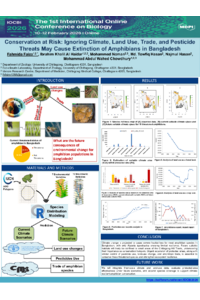
This study assessed the potential impacts of climate change on ten threatened amphibian species by developing Species Distribution Models (SDMs) that incorporated climatic, land-use, pesticide, and wildlife trade data. Using 100 georeferenced occurrence records and 26 environmental predictors (19 bioclimatic and 7 ecological), I modelled current and projected (2080) suitable habitats in R with the bioclim() function.
The models predict a drastic contraction of suitable habitats by 2080, placing nine species at imminent risk of local extinction, with only one species (Kaloula taprobanica) retaining 18.67% of its current range. Presently, 50% of the species occur in the Eastern Hills and Hill Tracts, while other regions host 1–2 species in fragmented patches. Spatial analysis of 49 terrestrial protected areas (9,699 km²) revealed that most suitable habitats lie outside protected boundaries; only K. taprobanica maintains significant overlap (1,833 km²). Land-use change analysis showed a reduction in forest cover to 13% by 2019, coupled with cropland and settlement expansion. Pesticide use rose from 0.21 kg/ha (1990s) to 1.1 kg/ha (2020s), posing additional chemical threats. Amphibian trade collapsed post-1990, revealing major monitoring gaps.
These findings underscore the urgent need for proactive conservation—expanding protected areas into future refugia and enforcing stricter regulations on pesticide use, land conversion, and wildlife trade—to safeguard Bangladesh’s amphibian biodiversity under changing climates.
Keywords
Amphibian conservation
Climate change
Species distribution modelling (SDM)
Land-use change
Pesticide exposure
Wildlife trade
Bangladesh
Poster
Poster_conservation_biology(sciforum-156623).pdf
Between Vulnerability and Resilience: Adaptive Responses of Aquatic Birds to Environmental Pressures in Algerian Wetlands.
Linking bacterial colony growth dynamics to indoor environments