Event submissions
Published
This submission belongs to the session S4. AI-Enhanced Design Strategies for Energy Efficiency in Built and Urban Environments of the event The 1st International Online Conference on Designs
Published date
06 Feb, 2026
Academic Editor
'%3e%3cpath%20d='M12.6657%2010.9104C12.4185%2010.325%2012.0599%209.79327%2011.6097%209.34482C11.1609%208.89508%2010.6293%208.5365%2010.0442%208.28888C10.0389%208.28626%2010.0337%208.28495%2010.0285%208.28233C10.8446%207.69279%2011.3752%206.73249%2011.3752%205.64904C11.3752%203.8542%209.92103%202.39999%208.1262%202.39999C6.33136%202.39999%204.87715%203.8542%204.87715%205.64904C4.87715%206.73249%205.40774%207.69279%206.22393%208.28364C6.21869%208.28626%206.21345%208.28757%206.20821%208.29019C5.62129%208.5378%205.09463%208.89284%204.64265%209.34613C4.1929%209.79493%203.83432%2010.3266%203.58671%2010.9117C3.34345%2011.4845%203.21226%2012.0987%203.20023%2012.7209C3.19988%2012.7349%203.20233%2012.7488%203.20744%2012.7619C3.21255%2012.7749%203.22022%2012.7867%203.22998%2012.7968C3.23975%2012.8068%203.25142%2012.8147%203.26431%2012.8202C3.2772%2012.8256%203.29105%2012.8284%203.30504%2012.8284H4.09109C4.14874%2012.8284%204.19459%2012.7825%204.1959%2012.7262C4.2221%2011.7148%204.62823%2010.7676%205.34617%2010.0497C6.08899%209.30683%207.0755%208.89808%208.1262%208.89808C9.17689%208.89808%2010.1634%209.30683%2010.9062%2010.0497C11.6242%2010.7676%2012.0303%2011.7148%2012.0565%2012.7262C12.0578%2012.7838%2012.1037%2012.8284%2012.1613%2012.8284H12.9474C12.9613%2012.8284%2012.9752%2012.8256%2012.9881%2012.8202C13.001%2012.8147%2013.0126%2012.8068%2013.0224%2012.7968C13.0322%2012.7867%2013.0398%2012.7749%2013.0449%2012.7619C13.0501%2012.7488%2013.0525%2012.7349%2013.0522%2012.7209C13.0391%2012.0947%2012.9094%2011.4855%2012.6657%2010.9104ZM8.1262%207.9024C7.52486%207.9024%206.9589%207.6679%206.53312%207.24211C6.10733%206.81633%205.87283%206.25037%205.87283%205.64904C5.87283%205.0477%206.10733%204.48174%206.53312%204.05596C6.9589%203.63018%207.52486%203.39567%208.1262%203.39567C8.72753%203.39567%209.29349%203.63018%209.71927%204.05596C10.1451%204.48174%2010.3796%205.0477%2010.3796%205.64904C10.3796%206.25037%2010.1451%206.81633%209.71927%207.24211C9.29349%207.6679%208.72753%207.9024%208.1262%207.9024Z'%20fill='%235D1EE1'/%3e%3c/g%3e%3c/svg%3e) Elena Lucchi
Elena LucchiCitation
Sk. Tanjim Jaman Supto, Md. Nurjaman Ridoy, AI-Enhanced Strategies for Energy-Efficient Urban Environments, in Proceedings of The 1st International Online Conference on Designs, 9 February–10 February 2026, MDPI: Basel, Switzerland
Share
Email
Facebook
Twitter
LinkedIn
AI-Enhanced Strategies for Energy-Efficient Urban Environments

Sk. Tanjim Jaman Supto 1

Md. Nurjaman Ridoy 1
1. Department of Environmental Research, Nano Research Centre, Sylhet, 3114, Bangladesh
Abstract
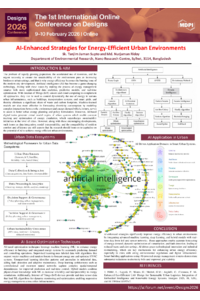
Artificial intelligence (AI) is reshaping urban energy management by linking predictive analytics with closed-loop control across buildings, grids, mobility, and planning. This paper investigates which AI strategies deliver verified, scalable efficiency gains in cities and under what conditions they outperform conventional practice. Synthesizing recent applications, we compare measured and simulated outcomes across asset scales. In buildings, machine learning for forecasting, fault detection, and supervisory control, including reinforcement-learning policies, commonly yields ~10–37% operational energy savings while maintaining comfort. AI-enabled digital twins that fuse BIM/IoT with physics-guided models support anomaly detection and set-point optimization, with documented energy reductions of ~5–17% and improvements in indoor environmental quality. On the supply side, AI strengthens smart-grid operations through improved demand and renewable forecasting, demand–response orchestration, and predictive maintenance, enabling higher variable-renewable penetration and lowering peaks. In urban mobility, adaptive, AI-coordinated signaling reduces intersection delays by ~10–30%, with fuel and emission co-benefits. Realizing system-level gains, however, depends on high-quality data, robust calibration, and human-in-the-loop operation; key barriers include fragmented data governance, limited generalization across climates and vintages, interoperability gaps among BMS/IoT/twin platforms, and privacy–cybersecurity risks. We argue that durable impact will come from physics-guided ML and RL/MPC with explicit comfort, equity, and safety constraints; secure, interoperable digital-twin backbones; and standardized, transparent measurement-and-verification protocols. Implemented at scale alongside retrofits and clean power, AI-enhanced strategies can materially reduce urban energy use and CO₂ emissions while preserving service quality, offering a pragmatic path for cities to accelerate decarbonization
Keywords
artificial intelligence
urban energy efficiency
smart buildings
hvac optimization
reinforcement learning
model predictive control
digital twins
internet of things (iot)
demand response
smart grids
load forecasting
fault detection and diagnostic
Poster
sciforum-153457.pdf
AI-Enhanced Detection of Thermal Anomalies in Urban Roofs via Drone-assisted Infrared Thermography (UAV-IRT)
Multi-objective optimization method of combined air conditioning based on building conformity prediction