Event submissions
Published
This submission belongs to the session S1. Artificial Intelligence for Renewable Energy Systems and Optimization of the event The 1st International Online Conference on Designs
Published date
06 Feb, 2026
Academic Editor
'%3e%3cpath%20d='M12.6657%2010.9104C12.4185%2010.325%2012.0599%209.79327%2011.6097%209.34482C11.1609%208.89508%2010.6293%208.5365%2010.0442%208.28888C10.0389%208.28626%2010.0337%208.28495%2010.0285%208.28233C10.8446%207.69279%2011.3752%206.73249%2011.3752%205.64904C11.3752%203.8542%209.92103%202.39999%208.1262%202.39999C6.33136%202.39999%204.87715%203.8542%204.87715%205.64904C4.87715%206.73249%205.40774%207.69279%206.22393%208.28364C6.21869%208.28626%206.21345%208.28757%206.20821%208.29019C5.62129%208.5378%205.09463%208.89284%204.64265%209.34613C4.1929%209.79493%203.83432%2010.3266%203.58671%2010.9117C3.34345%2011.4845%203.21226%2012.0987%203.20023%2012.7209C3.19988%2012.7349%203.20233%2012.7488%203.20744%2012.7619C3.21255%2012.7749%203.22022%2012.7867%203.22998%2012.7968C3.23975%2012.8068%203.25142%2012.8147%203.26431%2012.8202C3.2772%2012.8256%203.29105%2012.8284%203.30504%2012.8284H4.09109C4.14874%2012.8284%204.19459%2012.7825%204.1959%2012.7262C4.2221%2011.7148%204.62823%2010.7676%205.34617%2010.0497C6.08899%209.30683%207.0755%208.89808%208.1262%208.89808C9.17689%208.89808%2010.1634%209.30683%2010.9062%2010.0497C11.6242%2010.7676%2012.0303%2011.7148%2012.0565%2012.7262C12.0578%2012.7838%2012.1037%2012.8284%2012.1613%2012.8284H12.9474C12.9613%2012.8284%2012.9752%2012.8256%2012.9881%2012.8202C13.001%2012.8147%2013.0126%2012.8068%2013.0224%2012.7968C13.0322%2012.7867%2013.0398%2012.7749%2013.0449%2012.7619C13.0501%2012.7488%2013.0525%2012.7349%2013.0522%2012.7209C13.0391%2012.0947%2012.9094%2011.4855%2012.6657%2010.9104ZM8.1262%207.9024C7.52486%207.9024%206.9589%207.6679%206.53312%207.24211C6.10733%206.81633%205.87283%206.25037%205.87283%205.64904C5.87283%205.0477%206.10733%204.48174%206.53312%204.05596C6.9589%203.63018%207.52486%203.39567%208.1262%203.39567C8.72753%203.39567%209.29349%203.63018%209.71927%204.05596C10.1451%204.48174%2010.3796%205.0477%2010.3796%205.64904C10.3796%206.25037%2010.1451%206.81633%209.71927%207.24211C9.29349%207.6679%208.72753%207.9024%208.1262%207.9024Z'%20fill='%235D1EE1'/%3e%3c/g%3e%3c/svg%3e) Ziliang Wang
Ziliang WangCitation
Md. Nurjaman Ridoy, Sk. Tanjim Jaman Supto, The Role of Artificial Intelligence in Driving Renewable Energy Transition from the Current Landscape to Future Pathways, in Proceedings of The 1st International Online Conference on Designs, 9 February–10 February 2026, MDPI: Basel, Switzerland
Share
Email
Facebook
Twitter
LinkedIn
The Role of Artificial Intelligence in Driving Renewable Energy Transition from the Current Landscape to Future Pathways

Md. Nurjaman Ridoy 1

Sk. Tanjim Jaman Supto 1
1. Department of Environmental Research, Nano Research Centre, Sylhet, 3114, Bangladesh
Abstract
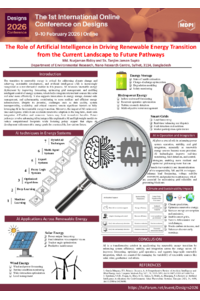
The shift from fossil fuels to renewable energy (RE) is a key component in achieving global sustainability and dealing with climate change. Natural resources, such as sunlight, air, water, and biomass, have tremendous potential to create clean energy; however, exploiting these resources in an efficient, stable, and large-scale integration manner is difficult due to their variable and distributed nature. Artificial intelligence (AI) approaches that mimic human learning and decision-making have recently become viable approaches to solve renewable energy problems. This study mainly examines the current landscape of AI applications across solar, wind, hydro, geothermal, ocean, hydrogen, bioenergy, and hybrid energy systems. Findings indicate that AI enhances renewable energy forecasting, improves power system frequency analysis and stability assessments, and optimizes dispatch and distribution networks. Beyond technical optimization, AI also contributes to broader sustainability goals, including energy efficiency improvements, intelligent smart grid management, and enabling mechanisms such as carbon trading and circular economy practices to reduce exposure to climate extremes. Drawing on evidence from a range of renewable energy areas, this study highlights the importance of artificial intelligence (AI) in bridging the link between technology innovation and sustainable energy management. This paper discusses potential future research avenues, such as building sophisticated AI designs, energy-efficient chips, and data communication networks. Ultimately, the synergy between AI and renewable energy systems represents not only a technological advancement but also a transformative pathway toward a resilient, low-carbon future.
Keywords
artificial intelligence
renewable energy
sustainability
climate change
clean energy
machine learning
energy forecasting
circular economy
solar energy
energy-efficient chips
low-carbon future
energy
Poster
sciforum-153574.pdf
Multi-objective optimization method of combined air conditioning based on building conformity prediction
Advancements in Artificial Intelligence for Renewable Energy Systems over the Past Decades.