Event submissions
Published
This submission belongs to the session S1. Artificial Intelligence for Renewable Energy Systems and Optimization of the event The 1st International Online Conference on Designs
Published date
06 Feb, 2026
Academic Editor
'%3e%3cpath%20d='M12.6657%2010.9104C12.4185%2010.325%2012.0599%209.79327%2011.6097%209.34482C11.1609%208.89508%2010.6293%208.5365%2010.0442%208.28888C10.0389%208.28626%2010.0337%208.28495%2010.0285%208.28233C10.8446%207.69279%2011.3752%206.73249%2011.3752%205.64904C11.3752%203.8542%209.92103%202.39999%208.1262%202.39999C6.33136%202.39999%204.87715%203.8542%204.87715%205.64904C4.87715%206.73249%205.40774%207.69279%206.22393%208.28364C6.21869%208.28626%206.21345%208.28757%206.20821%208.29019C5.62129%208.5378%205.09463%208.89284%204.64265%209.34613C4.1929%209.79493%203.83432%2010.3266%203.58671%2010.9117C3.34345%2011.4845%203.21226%2012.0987%203.20023%2012.7209C3.19988%2012.7349%203.20233%2012.7488%203.20744%2012.7619C3.21255%2012.7749%203.22022%2012.7867%203.22998%2012.7968C3.23975%2012.8068%203.25142%2012.8147%203.26431%2012.8202C3.2772%2012.8256%203.29105%2012.8284%203.30504%2012.8284H4.09109C4.14874%2012.8284%204.19459%2012.7825%204.1959%2012.7262C4.2221%2011.7148%204.62823%2010.7676%205.34617%2010.0497C6.08899%209.30683%207.0755%208.89808%208.1262%208.89808C9.17689%208.89808%2010.1634%209.30683%2010.9062%2010.0497C11.6242%2010.7676%2012.0303%2011.7148%2012.0565%2012.7262C12.0578%2012.7838%2012.1037%2012.8284%2012.1613%2012.8284H12.9474C12.9613%2012.8284%2012.9752%2012.8256%2012.9881%2012.8202C13.001%2012.8147%2013.0126%2012.8068%2013.0224%2012.7968C13.0322%2012.7867%2013.0398%2012.7749%2013.0449%2012.7619C13.0501%2012.7488%2013.0525%2012.7349%2013.0522%2012.7209C13.0391%2012.0947%2012.9094%2011.4855%2012.6657%2010.9104ZM8.1262%207.9024C7.52486%207.9024%206.9589%207.6679%206.53312%207.24211C6.10733%206.81633%205.87283%206.25037%205.87283%205.64904C5.87283%205.0477%206.10733%204.48174%206.53312%204.05596C6.9589%203.63018%207.52486%203.39567%208.1262%203.39567C8.72753%203.39567%209.29349%203.63018%209.71927%204.05596C10.1451%204.48174%2010.3796%205.0477%2010.3796%205.64904C10.3796%206.25037%2010.1451%206.81633%209.71927%207.24211C9.29349%207.6679%208.72753%207.9024%208.1262%207.9024Z'%20fill='%235D1EE1'/%3e%3c/g%3e%3c/svg%3e) Ziliang Wang
Ziliang WangCitation
Abhishek Bajirao Katkar, A Hybrid Co-variance-Guided ABC–NSGA-II Metaheuristic for Multi-Objective Multi-Area Dynamic Economic–Emission Dispatch with Renewable Integration and Implicit Constraint Handling, in Proceedings of The 1st International Online Conference on Designs, 9 February–10 February 2026, MDPI: Basel, Switzerland
Share
Email
Facebook
Twitter
LinkedIn
A Hybrid Co-variance-Guided ABC–NSGA-II Metaheuristic for Multi-Objective Multi-Area Dynamic Economic–Emission Dispatch with Renewable Integration and Implicit Constraint Handling
'%3e%3cpath%20d='M12.6647%2010.9104C12.4176%2010.325%2012.0589%209.7933%2011.6088%209.34485C11.16%208.89511%2010.6283%208.53653%2010.0432%208.28891C10.038%208.28629%2010.0327%208.28498%2010.0275%208.28236C10.8437%207.69282%2011.3743%206.73252%2011.3743%205.64907C11.3743%203.85423%209.92005%202.40002%208.12522%202.40002C6.33038%202.40002%204.87618%203.85423%204.87618%205.64907C4.87618%206.73252%205.40677%207.69282%206.22296%208.28367C6.21772%208.28629%206.21248%208.2876%206.20724%208.29022C5.62031%208.53783%205.09365%208.89287%204.64167%209.34616C4.19192%209.79496%203.83334%2010.3266%203.58573%2010.9117C3.34247%2011.4846%203.21128%2012.0987%203.19925%2012.721C3.1989%2012.735%203.20135%2012.7489%203.20646%2012.7619C3.21157%2012.7749%203.21924%2012.7868%203.22901%2012.7968C3.23877%2012.8068%203.25045%2012.8148%203.26334%2012.8202C3.27623%2012.8256%203.29007%2012.8284%203.30406%2012.8284H4.09012C4.14776%2012.8284%204.19362%2012.7825%204.19493%2012.7262C4.22113%2011.7148%204.62726%2010.7676%205.34519%2010.0497C6.08802%209.30686%207.07452%208.89811%208.12522%208.89811C9.17592%208.89811%2010.1624%209.30686%2010.9052%2010.0497C11.6232%2010.7676%2012.0293%2011.7148%2012.0555%2012.7262C12.0568%2012.7839%2012.1027%2012.8284%2012.1603%2012.8284H12.9464C12.9604%2012.8284%2012.9742%2012.8256%2012.9871%2012.8202C13%2012.8148%2013.0117%2012.8068%2013.0214%2012.7968C13.0312%2012.7868%2013.0389%2012.7749%2013.044%2012.7619C13.0491%2012.7489%2013.0515%2012.735%2013.0512%2012.721C13.0381%2012.0947%2012.9084%2011.4856%2012.6647%2010.9104ZM8.12522%207.90243C7.52388%207.90243%206.95792%207.66793%206.53214%207.24215C6.10636%206.81636%205.87185%206.2504%205.87185%205.64907C5.87185%205.04773%206.10636%204.48177%206.53214%204.05599C6.95792%203.63021%207.52388%203.3957%208.12522%203.3957C8.72655%203.3957%209.29252%203.63021%209.7183%204.05599C10.1441%204.48177%2010.3786%205.04773%2010.3786%205.64907C10.3786%206.2504%2010.1441%206.81636%209.7183%207.24215C9.29252%207.66793%208.72655%207.90243%208.12522%207.90243Z'%20fill='%235D1EE1'/%3e%3c/g%3e%3c/svg%3e)
Abhishek Bajirao Katkar 1
1. Electrical Engineering, Government Polytechnic, An Autonomous Institute of State of Maharashtra, Kolhapur, 416004, India
Abstract
The increasing penetration of wind and solar resources in interconnected grids has made multi-area dynamic economic–emission dispatch (MADEED) a significantly more challenging optimization problem due to multi-temporal coupling, stochastic renewable fluctuations, inter-area power exchanges, and complex nonlinear constraints such as ramp limits, valve-point effects, and prohibited zones. Existing intelligent optimization techniques often show limited scalability, slow convergence, or poor constraint feasibility when applied to large multi-area systems. To overcome these limitations, this study proposes a hybrid Co-variance Guided Artificial Bee Colony (CG-ABC) and NSGA-II framework equipped with boundary-update implicit constraint handling and BWM–TOPSIS decision analytics for identifying the Best Compromise Solution (BCS) across conflicting economic and emission objectives.
The proposed CG-ABC enhances the original ABC by introducing a co-variance learning matrix, enabling bees to adapt search directions based on population distribution and correlated variable dynamics. This significantly improves global exploration and local exploitation in large-scale dispatch spaces. The hybridization with NSGA-II ensures robust non-dominated sorting, crowding-distance-based diversity management, and stable Pareto-front generation under multi-objective competition. An implicit constraint-handling mechanism based on boundary-repair and feasibility-preserving updates ensures strict adherence to tie-line flow limits, dynamic ramping limits, and inter-area balance constraints without requiring penalty parameter tuning.
The method is validated on multi-area test systems referenced in the recent literature, including two-area (6 units), three-area (10 units), and four-area (40 units) setups incorporating wind and solar generation modeled using Weibull and lognormal distributions. Comparative studies demonstrate that the proposed hybrid algorithm provides smoother, denser Pareto fronts, faster convergence, and superior feasibility preservation compared to recent high-performance algorithms reported in the literature. With BWM–TOPSIS aiding operator-level decision-making, the proposed framework offers a robust and sustainable tool for renewable-integrated multi-area power scheduling aligned with future low-carbon grid objectives.
Keywords
Multi-Area Dynamic Economic–Emission Dispatch
Renewable Energy Integration
Co-variance Guided ABC
NSGA-II
Implicit Constraint Handling
Pareto Optimization
BWM–TOPSIS Decision Making
Poster
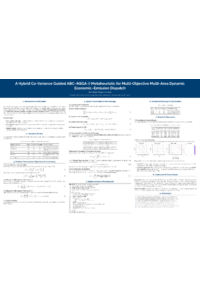
Poster_conference_ABK.pdf
AI-Integrated Courtyard Geometry Optimization: A Smart BAS-Facade Framework for Climate-Responsive Architecture in Tamil Nadu
Data-Driven Performance Analysis of Net-Zero Buildings: Quantifying Ecosystem Services and Operational Efficiency in the Bullitt Center