Event submissions
Published
This submission belongs to the session S1. Artificial Intelligence for Renewable Energy Systems and Optimization of the event The 1st International Online Conference on Designs
Published date
06 Feb, 2026
Academic Editor
'%3e%3cpath%20d='M12.6657%2010.9104C12.4185%2010.325%2012.0599%209.79327%2011.6097%209.34482C11.1609%208.89508%2010.6293%208.5365%2010.0442%208.28888C10.0389%208.28626%2010.0337%208.28495%2010.0285%208.28233C10.8446%207.69279%2011.3752%206.73249%2011.3752%205.64904C11.3752%203.8542%209.92103%202.39999%208.1262%202.39999C6.33136%202.39999%204.87715%203.8542%204.87715%205.64904C4.87715%206.73249%205.40774%207.69279%206.22393%208.28364C6.21869%208.28626%206.21345%208.28757%206.20821%208.29019C5.62129%208.5378%205.09463%208.89284%204.64265%209.34613C4.1929%209.79493%203.83432%2010.3266%203.58671%2010.9117C3.34345%2011.4845%203.21226%2012.0987%203.20023%2012.7209C3.19988%2012.7349%203.20233%2012.7488%203.20744%2012.7619C3.21255%2012.7749%203.22022%2012.7867%203.22998%2012.7968C3.23975%2012.8068%203.25142%2012.8147%203.26431%2012.8202C3.2772%2012.8256%203.29105%2012.8284%203.30504%2012.8284H4.09109C4.14874%2012.8284%204.19459%2012.7825%204.1959%2012.7262C4.2221%2011.7148%204.62823%2010.7676%205.34617%2010.0497C6.08899%209.30683%207.0755%208.89808%208.1262%208.89808C9.17689%208.89808%2010.1634%209.30683%2010.9062%2010.0497C11.6242%2010.7676%2012.0303%2011.7148%2012.0565%2012.7262C12.0578%2012.7838%2012.1037%2012.8284%2012.1613%2012.8284H12.9474C12.9613%2012.8284%2012.9752%2012.8256%2012.9881%2012.8202C13.001%2012.8147%2013.0126%2012.8068%2013.0224%2012.7968C13.0322%2012.7867%2013.0398%2012.7749%2013.0449%2012.7619C13.0501%2012.7488%2013.0525%2012.7349%2013.0522%2012.7209C13.0391%2012.0947%2012.9094%2011.4855%2012.6657%2010.9104ZM8.1262%207.9024C7.52486%207.9024%206.9589%207.6679%206.53312%207.24211C6.10733%206.81633%205.87283%206.25037%205.87283%205.64904C5.87283%205.0477%206.10733%204.48174%206.53312%204.05596C6.9589%203.63018%207.52486%203.39567%208.1262%203.39567C8.72753%203.39567%209.29349%203.63018%209.71927%204.05596C10.1451%204.48174%2010.3796%205.0477%2010.3796%205.64904C10.3796%206.25037%2010.1451%206.81633%209.71927%207.24211C9.29349%207.6679%208.72753%207.9024%208.1262%207.9024Z'%20fill='%235D1EE1'/%3e%3c/g%3e%3c/svg%3e) Ziliang Wang
Ziliang WangCitation
Amel Brik, KOUBA Nour EL Yakine, Ladjici Ahmed Amine, Selkim Djamel, Boudoucha Aimad, Optimization of Power Stability Index in Presence of Large-scale Integration of Green Power Generation, in Proceedings of The 1st International Online Conference on Designs, 9 February–10 February 2026, MDPI: Basel, Switzerland
Share
Email
Facebook
Twitter
LinkedIn
Optimization of Power Stability Index in Presence of Large-scale Integration of Green Power Generation
'%3e%3cpath%20d='M12.6647%2010.9104C12.4176%2010.325%2012.0589%209.7933%2011.6088%209.34485C11.16%208.89511%2010.6283%208.53653%2010.0432%208.28891C10.038%208.28629%2010.0327%208.28498%2010.0275%208.28236C10.8437%207.69282%2011.3743%206.73252%2011.3743%205.64907C11.3743%203.85423%209.92005%202.40002%208.12522%202.40002C6.33038%202.40002%204.87618%203.85423%204.87618%205.64907C4.87618%206.73252%205.40677%207.69282%206.22296%208.28367C6.21772%208.28629%206.21248%208.2876%206.20724%208.29022C5.62031%208.53783%205.09365%208.89287%204.64167%209.34616C4.19192%209.79496%203.83334%2010.3266%203.58573%2010.9117C3.34247%2011.4846%203.21128%2012.0987%203.19925%2012.721C3.1989%2012.735%203.20135%2012.7489%203.20646%2012.7619C3.21157%2012.7749%203.21924%2012.7868%203.22901%2012.7968C3.23877%2012.8068%203.25045%2012.8148%203.26334%2012.8202C3.27623%2012.8256%203.29007%2012.8284%203.30406%2012.8284H4.09012C4.14776%2012.8284%204.19362%2012.7825%204.19493%2012.7262C4.22113%2011.7148%204.62726%2010.7676%205.34519%2010.0497C6.08802%209.30686%207.07452%208.89811%208.12522%208.89811C9.17592%208.89811%2010.1624%209.30686%2010.9052%2010.0497C11.6232%2010.7676%2012.0293%2011.7148%2012.0555%2012.7262C12.0568%2012.7839%2012.1027%2012.8284%2012.1603%2012.8284H12.9464C12.9604%2012.8284%2012.9742%2012.8256%2012.9871%2012.8202C13%2012.8148%2013.0117%2012.8068%2013.0214%2012.7968C13.0312%2012.7868%2013.0389%2012.7749%2013.044%2012.7619C13.0491%2012.7489%2013.0515%2012.735%2013.0512%2012.721C13.0381%2012.0947%2012.9084%2011.4856%2012.6647%2010.9104ZM8.12522%207.90243C7.52388%207.90243%206.95792%207.66793%206.53214%207.24215C6.10636%206.81636%205.87185%206.2504%205.87185%205.64907C5.87185%205.04773%206.10636%204.48177%206.53214%204.05599C6.95792%203.63021%207.52388%203.3957%208.12522%203.3957C8.72655%203.3957%209.29252%203.63021%209.7183%204.05599C10.1441%204.48177%2010.3786%205.04773%2010.3786%205.64907C10.3786%206.2504%2010.1441%206.81636%209.7183%207.24215C9.29252%207.66793%208.72655%207.90243%208.12522%207.90243Z'%20fill='%235D1EE1'/%3e%3c/g%3e%3c/svg%3e)
Amel Brik 1
KOUBA Nour EL Yakine 1
Ladjici Ahmed Amine 1
Selkim Djamel 1
Boudoucha Aimad 1
1. Faculty of Electrical Engineering, University of Sciences and Technology Houari Boumediene, Algiers 16111, Algeria
Abstract
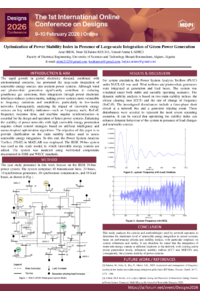
Currently, the large-scale integration of renewable energy sources (RESs) such as wind and solar photovoltaic generators is profoundly altering the dynamic behaviors of electrical grids, notably by reducing their inertia and making transient stability more critical. The originality of this work lies in its systematic exploration of the nonlinear dynamics of electrical networks, analyzing in depth the impact of RESs integration on grid stability and focusing on frequency response and rotor angle dynamics. This work proposes a methodology for evaluating and optimizing power system stability index, focusing on two major indicators: the Critical Clearing Time (CCT) and the Rate of Change of Frequency (ROCOF). The IEEE 39-bus test system is used as a test bench to simulate different renewable energy injection and microgrid (MG) location scenarios. Three-phase faults are applied to several grid lines to determine the corresponding CCTs and assess the system's ability to recover a stable state after disturbance. An automated approach was developed to calculate the CCT, enabling faster convergence and simultaneous testing of multiple fault locations. Variations in the ROCOF were also measured to quantify the effect of microgrids on frequency stability. The results show that high renewable energy penetration tends to reduce the CCT and increase the ROCOF, indicating a loss of dynamic robustness. However, optimizing the microgrid location to include an energy storage system (ESS) improves overall stability. These observations are supported by comparative simulations with and without renewable energy integration. Ultimately, this work highlights the importance of optimally locating distributed units and using CCT and ROCOF indices as diagnostic and optimization tools for modern power grids with high renewable energy penetration.
Keywords
Renewable Energy Sources
Transient Stability
Frequency Control
Critical Clearing Time (CCT)
Rate of Change of Frequency (ROCOF)
Energy Storage System (ESS).
Poster
sciforum-159164.pdf
Python-Based Automated Response Surface Methodology: Computational Replication and Validation Framework for Supercapattery Materials Optimization
Optimizing MPPT Control Methods Using Nature-Inspired Metaheuristic Algorithms To Maximize The Use Of Renewable Energies