Event submissions
Published
This submission belongs to the session S1. Artificial Intelligence for Renewable Energy Systems and Optimization of the event The 1st International Online Conference on Designs
Published date
06 Feb, 2026
Academic Editor
'%3e%3cpath%20d='M12.6657%2010.9104C12.4185%2010.325%2012.0599%209.79327%2011.6097%209.34482C11.1609%208.89508%2010.6293%208.5365%2010.0442%208.28888C10.0389%208.28626%2010.0337%208.28495%2010.0285%208.28233C10.8446%207.69279%2011.3752%206.73249%2011.3752%205.64904C11.3752%203.8542%209.92103%202.39999%208.1262%202.39999C6.33136%202.39999%204.87715%203.8542%204.87715%205.64904C4.87715%206.73249%205.40774%207.69279%206.22393%208.28364C6.21869%208.28626%206.21345%208.28757%206.20821%208.29019C5.62129%208.5378%205.09463%208.89284%204.64265%209.34613C4.1929%209.79493%203.83432%2010.3266%203.58671%2010.9117C3.34345%2011.4845%203.21226%2012.0987%203.20023%2012.7209C3.19988%2012.7349%203.20233%2012.7488%203.20744%2012.7619C3.21255%2012.7749%203.22022%2012.7867%203.22998%2012.7968C3.23975%2012.8068%203.25142%2012.8147%203.26431%2012.8202C3.2772%2012.8256%203.29105%2012.8284%203.30504%2012.8284H4.09109C4.14874%2012.8284%204.19459%2012.7825%204.1959%2012.7262C4.2221%2011.7148%204.62823%2010.7676%205.34617%2010.0497C6.08899%209.30683%207.0755%208.89808%208.1262%208.89808C9.17689%208.89808%2010.1634%209.30683%2010.9062%2010.0497C11.6242%2010.7676%2012.0303%2011.7148%2012.0565%2012.7262C12.0578%2012.7838%2012.1037%2012.8284%2012.1613%2012.8284H12.9474C12.9613%2012.8284%2012.9752%2012.8256%2012.9881%2012.8202C13.001%2012.8147%2013.0126%2012.8068%2013.0224%2012.7968C13.0322%2012.7867%2013.0398%2012.7749%2013.0449%2012.7619C13.0501%2012.7488%2013.0525%2012.7349%2013.0522%2012.7209C13.0391%2012.0947%2012.9094%2011.4855%2012.6657%2010.9104ZM8.1262%207.9024C7.52486%207.9024%206.9589%207.6679%206.53312%207.24211C6.10733%206.81633%205.87283%206.25037%205.87283%205.64904C5.87283%205.0477%206.10733%204.48174%206.53312%204.05596C6.9589%203.63018%207.52486%203.39567%208.1262%203.39567C8.72753%203.39567%209.29349%203.63018%209.71927%204.05596C10.1451%204.48174%2010.3796%205.0477%2010.3796%205.64904C10.3796%206.25037%2010.1451%206.81633%209.71927%207.24211C9.29349%207.6679%208.72753%207.9024%208.1262%207.9024Z'%20fill='%235D1EE1'/%3e%3c/g%3e%3c/svg%3e) Ziliang Wang
Ziliang WangCitation
Djamel Selkim, Nour El Yakine Kouba, Amirouche Nait-Seghir, Amel Brik, Optimizing MPPT Control Methods Using Nature-Inspired Metaheuristic Algorithms To Maximize The Use Of Renewable Energies, in Proceedings of The 1st International Online Conference on Designs, 9 February–10 February 2026, MDPI: Basel, Switzerland
Share
Email
Facebook
Twitter
LinkedIn
Optimizing MPPT Control Methods Using Nature-Inspired Metaheuristic Algorithms To Maximize The Use Of Renewable Energies

Djamel Selkim 1
'%3e%3cpath%20d='M12.6647%2010.9104C12.4176%2010.325%2012.0589%209.7933%2011.6088%209.34485C11.16%208.89511%2010.6283%208.53653%2010.0432%208.28891C10.038%208.28629%2010.0327%208.28498%2010.0275%208.28236C10.8437%207.69282%2011.3743%206.73252%2011.3743%205.64907C11.3743%203.85423%209.92005%202.40002%208.12522%202.40002C6.33038%202.40002%204.87618%203.85423%204.87618%205.64907C4.87618%206.73252%205.40677%207.69282%206.22296%208.28367C6.21772%208.28629%206.21248%208.2876%206.20724%208.29022C5.62031%208.53783%205.09365%208.89287%204.64167%209.34616C4.19192%209.79496%203.83334%2010.3266%203.58573%2010.9117C3.34247%2011.4846%203.21128%2012.0987%203.19925%2012.721C3.1989%2012.735%203.20135%2012.7489%203.20646%2012.7619C3.21157%2012.7749%203.21924%2012.7868%203.22901%2012.7968C3.23877%2012.8068%203.25045%2012.8148%203.26334%2012.8202C3.27623%2012.8256%203.29007%2012.8284%203.30406%2012.8284H4.09012C4.14776%2012.8284%204.19362%2012.7825%204.19493%2012.7262C4.22113%2011.7148%204.62726%2010.7676%205.34519%2010.0497C6.08802%209.30686%207.07452%208.89811%208.12522%208.89811C9.17592%208.89811%2010.1624%209.30686%2010.9052%2010.0497C11.6232%2010.7676%2012.0293%2011.7148%2012.0555%2012.7262C12.0568%2012.7839%2012.1027%2012.8284%2012.1603%2012.8284H12.9464C12.9604%2012.8284%2012.9742%2012.8256%2012.9871%2012.8202C13%2012.8148%2013.0117%2012.8068%2013.0214%2012.7968C13.0312%2012.7868%2013.0389%2012.7749%2013.044%2012.7619C13.0491%2012.7489%2013.0515%2012.735%2013.0512%2012.721C13.0381%2012.0947%2012.9084%2011.4856%2012.6647%2010.9104ZM8.12522%207.90243C7.52388%207.90243%206.95792%207.66793%206.53214%207.24215C6.10636%206.81636%205.87185%206.2504%205.87185%205.64907C5.87185%205.04773%206.10636%204.48177%206.53214%204.05599C6.95792%203.63021%207.52388%203.3957%208.12522%203.3957C8.72655%203.3957%209.29252%203.63021%209.7183%204.05599C10.1441%204.48177%2010.3786%205.04773%2010.3786%205.64907C10.3786%206.2504%2010.1441%206.81636%209.7183%207.24215C9.29252%207.66793%208.72655%207.90243%208.12522%207.90243Z'%20fill='%235D1EE1'/%3e%3c/g%3e%3c/svg%3e)
Nour El Yakine Kouba 1
Amirouche Nait-Seghir 1
Amel Brik 1
1. Laboratory of Electrical and Industrial Systems (LSEI), Department of Electrical Engineering, University of Sciences and Technology Houari Boumediene, Bab Ezzouar (USTHB), Algeirs, Algeria
Abstract
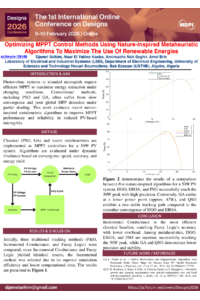
Maximum Power Point Tracking (MPPT) is essential to maximize energy extraction from photovoltaic (PV) arrays, especially in islanded microgrids, where grid support is absent and energy margins are tight. Traditional MPPT techniques and established metaheuristics such as Particle Swarm Optimization (PSO) and Genetic Algorithms (GA) have been applied widely, but they can suffer from slow convergence, premature trapping in local maxima under partial shading and variable irradiance, and suboptimal tradeoffs between tracking speed and steady-state oscillation. This paper systematically evaluates and compares a set of established and novel nature and bio-inspired metaheuristic optimizers for MPPT in an isolated microgrid context. First, PSO and GA are implemented as baseline methods under standard and partial-shading scenarios. Second, three recently proposed metaheuristics—Quokka Swarm Optimization (QSO), Dendritic Growth Optimization (DGO), and Brown-Bear Enhanced Optimization (EBOA)—are adapted to design an enhanced MPPT and tested for the first time in this application. The investigated algorithms are benchmarked in simulations against realistic PV models, dynamic irradiance/temperature profiles, and common partial-shading patterns. Performance metrics include convergence time to global MPP, energy capture over daily cycles, robustness to measurement noise, computational load, and susceptibility to false local maxima. Obtained results show that several of the newer optimizers achieve faster convergence and improved global MPP identification under challenging conditions while maintaining acceptable computational costs, suggesting promising alternatives to classical approaches for islanded microgrids. The paper concludes with implementation notes for embedded controllers and recommendations for future hardware validation.
Keywords
Nature-Inspired Optimization
Maximum Power Point Tracking (MPPT)
Renewable Energy
Microgrids
Photovoltaic Systems
Poster
sciforum-159168.pdf
Optimization of Power Stability Index in Presence of Large-scale Integration of Green Power Generation
AI-Enhanced Energy Monitoring Framework for Smart Factories: A Neural Network and Six Sigma-Driven Approach