Event submissions
Published
This submission belongs to the session S5. Data-Driven Design for Energy Forecasting, Security, and Resilience of the event The 1st International Online Conference on Designs
Published date
06 Feb, 2026
Academic Editor
'%3e%3cpath%20d='M12.6657%2010.9104C12.4185%2010.325%2012.0599%209.79327%2011.6097%209.34482C11.1609%208.89508%2010.6293%208.5365%2010.0442%208.28888C10.0389%208.28626%2010.0337%208.28495%2010.0285%208.28233C10.8446%207.69279%2011.3752%206.73249%2011.3752%205.64904C11.3752%203.8542%209.92103%202.39999%208.1262%202.39999C6.33136%202.39999%204.87715%203.8542%204.87715%205.64904C4.87715%206.73249%205.40774%207.69279%206.22393%208.28364C6.21869%208.28626%206.21345%208.28757%206.20821%208.29019C5.62129%208.5378%205.09463%208.89284%204.64265%209.34613C4.1929%209.79493%203.83432%2010.3266%203.58671%2010.9117C3.34345%2011.4845%203.21226%2012.0987%203.20023%2012.7209C3.19988%2012.7349%203.20233%2012.7488%203.20744%2012.7619C3.21255%2012.7749%203.22022%2012.7867%203.22998%2012.7968C3.23975%2012.8068%203.25142%2012.8147%203.26431%2012.8202C3.2772%2012.8256%203.29105%2012.8284%203.30504%2012.8284H4.09109C4.14874%2012.8284%204.19459%2012.7825%204.1959%2012.7262C4.2221%2011.7148%204.62823%2010.7676%205.34617%2010.0497C6.08899%209.30683%207.0755%208.89808%208.1262%208.89808C9.17689%208.89808%2010.1634%209.30683%2010.9062%2010.0497C11.6242%2010.7676%2012.0303%2011.7148%2012.0565%2012.7262C12.0578%2012.7838%2012.1037%2012.8284%2012.1613%2012.8284H12.9474C12.9613%2012.8284%2012.9752%2012.8256%2012.9881%2012.8202C13.001%2012.8147%2013.0126%2012.8068%2013.0224%2012.7968C13.0322%2012.7867%2013.0398%2012.7749%2013.0449%2012.7619C13.0501%2012.7488%2013.0525%2012.7349%2013.0522%2012.7209C13.0391%2012.0947%2012.9094%2011.4855%2012.6657%2010.9104ZM8.1262%207.9024C7.52486%207.9024%206.9589%207.6679%206.53312%207.24211C6.10733%206.81633%205.87283%206.25037%205.87283%205.64904C5.87283%205.0477%206.10733%204.48174%206.53312%204.05596C6.9589%203.63018%207.52486%203.39567%208.1262%203.39567C8.72753%203.39567%209.29349%203.63018%209.71927%204.05596C10.1451%204.48174%2010.3796%205.0477%2010.3796%205.64904C10.3796%206.25037%2010.1451%206.81633%209.71927%207.24211C9.29349%207.6679%208.72753%207.9024%208.1262%207.9024Z'%20fill='%235D1EE1'/%3e%3c/g%3e%3c/svg%3e) Yichen Zong
Yichen ZongCitation
Shonisani Salvation Muthubi, Dorcas Museme Mabulay, Pascal Kilunji Mwenge, Modelling and MATLAB-Based Optimization of Carbon Dioxide Adsorption Using Zn-MOF-5, in Proceedings of The 1st International Online Conference on Designs, 9 February–10 February 2026, MDPI: Basel, Switzerland
Share
Email
Facebook
Twitter
LinkedIn
Modelling and MATLAB-Based Optimization of Carbon Dioxide Adsorption Using Zn-MOF-5
'%3e%3cpath%20d='M12.6647%2010.9104C12.4176%2010.325%2012.0589%209.7933%2011.6088%209.34485C11.16%208.89511%2010.6283%208.53653%2010.0432%208.28891C10.038%208.28629%2010.0327%208.28498%2010.0275%208.28236C10.8437%207.69282%2011.3743%206.73252%2011.3743%205.64907C11.3743%203.85423%209.92005%202.40002%208.12522%202.40002C6.33038%202.40002%204.87618%203.85423%204.87618%205.64907C4.87618%206.73252%205.40677%207.69282%206.22296%208.28367C6.21772%208.28629%206.21248%208.2876%206.20724%208.29022C5.62031%208.53783%205.09365%208.89287%204.64167%209.34616C4.19192%209.79496%203.83334%2010.3266%203.58573%2010.9117C3.34247%2011.4846%203.21128%2012.0987%203.19925%2012.721C3.1989%2012.735%203.20135%2012.7489%203.20646%2012.7619C3.21157%2012.7749%203.21924%2012.7868%203.22901%2012.7968C3.23877%2012.8068%203.25045%2012.8148%203.26334%2012.8202C3.27623%2012.8256%203.29007%2012.8284%203.30406%2012.8284H4.09012C4.14776%2012.8284%204.19362%2012.7825%204.19493%2012.7262C4.22113%2011.7148%204.62726%2010.7676%205.34519%2010.0497C6.08802%209.30686%207.07452%208.89811%208.12522%208.89811C9.17592%208.89811%2010.1624%209.30686%2010.9052%2010.0497C11.6232%2010.7676%2012.0293%2011.7148%2012.0555%2012.7262C12.0568%2012.7839%2012.1027%2012.8284%2012.1603%2012.8284H12.9464C12.9604%2012.8284%2012.9742%2012.8256%2012.9871%2012.8202C13%2012.8148%2013.0117%2012.8068%2013.0214%2012.7968C13.0312%2012.7868%2013.0389%2012.7749%2013.044%2012.7619C13.0491%2012.7489%2013.0515%2012.735%2013.0512%2012.721C13.0381%2012.0947%2012.9084%2011.4856%2012.6647%2010.9104ZM8.12522%207.90243C7.52388%207.90243%206.95792%207.66793%206.53214%207.24215C6.10636%206.81636%205.87185%206.2504%205.87185%205.64907C5.87185%205.04773%206.10636%204.48177%206.53214%204.05599C6.95792%203.63021%207.52388%203.3957%208.12522%203.3957C8.72655%203.3957%209.29252%203.63021%209.7183%204.05599C10.1441%204.48177%2010.3786%205.04773%2010.3786%205.64907C10.3786%206.2504%2010.1441%206.81636%209.7183%207.24215C9.29252%207.66793%208.72655%207.90243%208.12522%207.90243Z'%20fill='%235D1EE1'/%3e%3c/g%3e%3c/svg%3e)
Shonisani Salvation Muthubi 1
Dorcas Museme Mabulay 1

Pascal Kilunji Mwenge 1
1. Department of Chemical and Metallurgical Engineering, Vaal University of Technology, Vanderbijlpark 1900, South Africa
Abstract
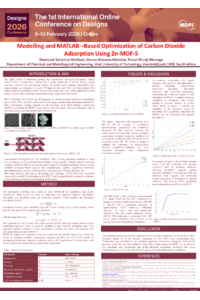
The growing concern over greenhouse gas emissions has prompted the need for efficient carbon dioxide (CO₂) capture technologies. This study focuses on simulating CO₂ adsorption using a zinc-based metal-organic framework (Zn-MOF-5). The primary aim is to develop and refine a robust approach using MATLAB for equilibrium and kinetic modelling through the Linear Driving Force (LDF) model and Langmuir isotherm, which can accurately predict CO₂ adsorption performance under varying operational conditions. By employing advanced computational methods, this research seeks to streamline the process design and enhance the feasibility of sustainable CO₂ capture solutions. Excel was used for statistical analysis and validation, while MATLAB R2025a was utilised for equilibrium and kinetic modelling using the Linear Driving Force (LDF) model and the Langmuir isotherm. The independent impacts of temperature, pressure, and flow rate were evaluated using the variable effect method. This study found a significant negative association between temperature and CO₂ uptake, consistent with the exothermic nature of the adsorption process. Pressure had a considerable impact on adsorption, but flow rate had little effect within the investigated range. The simulated CO₂ uptake (21.196 mmol/g) closely matched the experimental data (21.07 mmol/g) with a 0.59% variance, validating the model's reliability. The research demonstrates that Zn-MOF-5 exhibits strong adsorption potential and that simulation tools can significantly reduce experimental costs and time. This underscores the potential of simulation tools to reduce costs and time, paving the way for more efficient carbon capture solutions. This initiative optimizes process design and promotes sustainable practices in addressing global CO₂ emissions. By contributing to process optimisation, this study aligns with the United Nations Sustainable Development Goal (SDG) 13, Climate Action, emphasizing the urgent need for innovative solutions to combat climate change and its impacts while supporting broader efforts for environmental sustainability.
Keywords
Zinc-based metal-organic framework (Zn-MOF-5)
Carbon Capture
Linear Driving Force (LDF)
Langmuir isotherm
Sustainable Process Engineering
Process Simulation
Poster
sciforum-159231.pdf
AI-Enhanced Energy Monitoring Framework for Smart Factories: A Neural Network and Six Sigma-Driven Approach
Intelligent Control of Energy Sharing in Wind Based Microgrids