Event submissions
Published
This submission belongs to the session S1. Artificial Intelligence for Renewable Energy Systems and Optimization of the event The 1st International Online Conference on Designs
Published date
06 Feb, 2026
Academic Editor
'%3e%3cpath%20d='M12.6657%2010.9104C12.4185%2010.325%2012.0599%209.79327%2011.6097%209.34482C11.1609%208.89508%2010.6293%208.5365%2010.0442%208.28888C10.0389%208.28626%2010.0337%208.28495%2010.0285%208.28233C10.8446%207.69279%2011.3752%206.73249%2011.3752%205.64904C11.3752%203.8542%209.92103%202.39999%208.1262%202.39999C6.33136%202.39999%204.87715%203.8542%204.87715%205.64904C4.87715%206.73249%205.40774%207.69279%206.22393%208.28364C6.21869%208.28626%206.21345%208.28757%206.20821%208.29019C5.62129%208.5378%205.09463%208.89284%204.64265%209.34613C4.1929%209.79493%203.83432%2010.3266%203.58671%2010.9117C3.34345%2011.4845%203.21226%2012.0987%203.20023%2012.7209C3.19988%2012.7349%203.20233%2012.7488%203.20744%2012.7619C3.21255%2012.7749%203.22022%2012.7867%203.22998%2012.7968C3.23975%2012.8068%203.25142%2012.8147%203.26431%2012.8202C3.2772%2012.8256%203.29105%2012.8284%203.30504%2012.8284H4.09109C4.14874%2012.8284%204.19459%2012.7825%204.1959%2012.7262C4.2221%2011.7148%204.62823%2010.7676%205.34617%2010.0497C6.08899%209.30683%207.0755%208.89808%208.1262%208.89808C9.17689%208.89808%2010.1634%209.30683%2010.9062%2010.0497C11.6242%2010.7676%2012.0303%2011.7148%2012.0565%2012.7262C12.0578%2012.7838%2012.1037%2012.8284%2012.1613%2012.8284H12.9474C12.9613%2012.8284%2012.9752%2012.8256%2012.9881%2012.8202C13.001%2012.8147%2013.0126%2012.8068%2013.0224%2012.7968C13.0322%2012.7867%2013.0398%2012.7749%2013.0449%2012.7619C13.0501%2012.7488%2013.0525%2012.7349%2013.0522%2012.7209C13.0391%2012.0947%2012.9094%2011.4855%2012.6657%2010.9104ZM8.1262%207.9024C7.52486%207.9024%206.9589%207.6679%206.53312%207.24211C6.10733%206.81633%205.87283%206.25037%205.87283%205.64904C5.87283%205.0477%206.10733%204.48174%206.53312%204.05596C6.9589%203.63018%207.52486%203.39567%208.1262%203.39567C8.72753%203.39567%209.29349%203.63018%209.71927%204.05596C10.1451%204.48174%2010.3796%205.0477%2010.3796%205.64904C10.3796%206.25037%2010.1451%206.81633%209.71927%207.24211C9.29349%207.6679%208.72753%207.9024%208.1262%207.9024Z'%20fill='%235D1EE1'/%3e%3c/g%3e%3c/svg%3e) Ziliang Wang
Ziliang WangCitation
Thiago Ferro de Oliveira, Fabiane da Silva Queiroz, Andre Luiz Lins de Aquino, The Role of Attention Mechanisms in Deep Learning for Hourly Solar Forecasting: A Case Study in Tropical Brazil, in Proceedings of The 1st International Online Conference on Designs, 9 February–10 February 2026, MDPI: Basel, Switzerland
Share
Email
Facebook
Twitter
LinkedIn
The Role of Attention Mechanisms in Deep Learning for Hourly Solar Forecasting: A Case Study in Tropical Brazil

Thiago Ferro de Oliveira 1,2,3
'%3e%3cpath%20d='M12.6647%2010.9104C12.4176%2010.325%2012.0589%209.7933%2011.6088%209.34485C11.16%208.89511%2010.6283%208.53653%2010.0432%208.28891C10.038%208.28629%2010.0327%208.28498%2010.0275%208.28236C10.8437%207.69282%2011.3743%206.73252%2011.3743%205.64907C11.3743%203.85423%209.92005%202.40002%208.12522%202.40002C6.33038%202.40002%204.87618%203.85423%204.87618%205.64907C4.87618%206.73252%205.40677%207.69282%206.22296%208.28367C6.21772%208.28629%206.21248%208.2876%206.20724%208.29022C5.62031%208.53783%205.09365%208.89287%204.64167%209.34616C4.19192%209.79496%203.83334%2010.3266%203.58573%2010.9117C3.34247%2011.4846%203.21128%2012.0987%203.19925%2012.721C3.1989%2012.735%203.20135%2012.7489%203.20646%2012.7619C3.21157%2012.7749%203.21924%2012.7868%203.22901%2012.7968C3.23877%2012.8068%203.25045%2012.8148%203.26334%2012.8202C3.27623%2012.8256%203.29007%2012.8284%203.30406%2012.8284H4.09012C4.14776%2012.8284%204.19362%2012.7825%204.19493%2012.7262C4.22113%2011.7148%204.62726%2010.7676%205.34519%2010.0497C6.08802%209.30686%207.07452%208.89811%208.12522%208.89811C9.17592%208.89811%2010.1624%209.30686%2010.9052%2010.0497C11.6232%2010.7676%2012.0293%2011.7148%2012.0555%2012.7262C12.0568%2012.7839%2012.1027%2012.8284%2012.1603%2012.8284H12.9464C12.9604%2012.8284%2012.9742%2012.8256%2012.9871%2012.8202C13%2012.8148%2013.0117%2012.8068%2013.0214%2012.7968C13.0312%2012.7868%2013.0389%2012.7749%2013.044%2012.7619C13.0491%2012.7489%2013.0515%2012.735%2013.0512%2012.721C13.0381%2012.0947%2012.9084%2011.4856%2012.6647%2010.9104ZM8.12522%207.90243C7.52388%207.90243%206.95792%207.66793%206.53214%207.24215C6.10636%206.81636%205.87185%206.2504%205.87185%205.64907C5.87185%205.04773%206.10636%204.48177%206.53214%204.05599C6.95792%203.63021%207.52388%203.3957%208.12522%203.3957C8.72655%203.3957%209.29252%203.63021%209.7183%204.05599C10.1441%204.48177%2010.3786%205.04773%2010.3786%205.64907C10.3786%206.2504%2010.1441%206.81636%209.7183%207.24215C9.29252%207.66793%208.72655%207.90243%208.12522%207.90243Z'%20fill='%235D1EE1'/%3e%3c/g%3e%3c/svg%3e)
Fabiane da Silva Queiroz 2,3,4
Andre Luiz Lins de Aquino 2,3,5
1. Institute of Mathematics, Federal University of Alagoas, Av. Lourival Melo Mota, S/N, Tabuleiro do Martins, Maceió - AL, 57072-970, Brazil
2. Postgraduate Program in Renewable Energies, Federal University of Alagoas, BR-104, Km 85, s/n, Rio Largo - AL , 57100-000, Brazil
3. Orion Laboratory, Federal University of Alagoas, R. Melo Póvoas, 110, Jaraguá, Maceió - AL, 57022-230, Brazil
4. Engineering and Agricultural Sciences Campus, Federal University of Alagoas, BR-104, Km 85, s/n, Rio Largo - AL , 57100-000, Brazil
5. Institute of Computing, Federal University of Alagoas, Av. Lourival Melo Mota, S/N, Tabuleiro do Martins, Maceió - AL, 57072-970, Brazil
Abstract
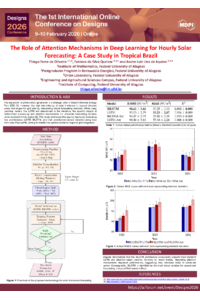
Accurate solar irradiance forecasting is essential for the secure integration of photovoltaic energy into power grids, especially in tropical regions with high intermittency [1]. While deep learning models like Long Short-Term Memory (LSTM) networks have been applied to this task, the potential of enhanced architectures, specifically Bidirectional LSTM (BiLSTM) and models incorporating attention mechanisms, for univariate hourly forecasting in tropical climates remains a significant research gap. This study addresses this gap by investigating whether these advanced AI architectures improve prediction accuracy in the context of Northeastern Brazil. We developed and rigorously compared four deep recurrent neural network models: LSTM, LSTM with attention, BiLSTM, and BiLSTM with attention. The models were trained on hourly data (2022–2024, 7:00–22:00 UTC) from João Pessoa, PB, preprocessed with Min-Max normalization [0.1, 0.9], and evaluated using standard metrics (RMSE, MAE, and R²) [2]. Performance was assessed robustly through 10 executions per model with 12- and 24-hour lookback windows. Contrary to expectations from recent AI trends, the results demonstrate that while BiLSTM architectures consistently outperformed standard LSTM, the integration of attention mechanisms degraded forecast performance across all configurations. This key finding suggests that for univariate solar irradiance series in tropical Brazil, the added complexity of attention gates may not capture beneficial additional temporal dependencies. This study provides empirical evidence for optimal model selection (BiLSTM) in regional grid integration applications and challenges the assumed universal utility of attention mechanisms in time-series forecasting for renewable energy.
References:
[1] Ministério de Minas e Energia. Plano Nacional de Energia 2050. Empresa de Pesquisa Energética: Brasília, Brazil, 2020.
[2] de O. Santos, D.S., Jr.; et al. Solar Irradiance Forecasting Using Dynamic Ensemble Selection. Appl. Sci. 2022, 12 (7), 3510.
Keywords
Renewable power integration
Grid stability
Recurrent Neural Networks (RNN)
Time series analysis
Model comparison
Poster
sciforum-159137.pdf
Optimal Power Sharing Between Multi-Microgrids To Improve Electrical Grid Resilience After Disconnection
Evolution of Smart and Micro-Grid Laboratories toward Real-Time Co-Simulation and Digital Twin Testbeds