Event submissions
Published
This submission belongs to the session S6. Digital Design Technologies for Energy Equipment and Systems of the event The 1st International Online Conference on Designs
Published date
06 Feb, 2026
Academic Editor
'%3e%3cpath%20d='M12.6657%2010.9104C12.4185%2010.325%2012.0599%209.79327%2011.6097%209.34482C11.1609%208.89508%2010.6293%208.5365%2010.0442%208.28888C10.0389%208.28626%2010.0337%208.28495%2010.0285%208.28233C10.8446%207.69279%2011.3752%206.73249%2011.3752%205.64904C11.3752%203.8542%209.92103%202.39999%208.1262%202.39999C6.33136%202.39999%204.87715%203.8542%204.87715%205.64904C4.87715%206.73249%205.40774%207.69279%206.22393%208.28364C6.21869%208.28626%206.21345%208.28757%206.20821%208.29019C5.62129%208.5378%205.09463%208.89284%204.64265%209.34613C4.1929%209.79493%203.83432%2010.3266%203.58671%2010.9117C3.34345%2011.4845%203.21226%2012.0987%203.20023%2012.7209C3.19988%2012.7349%203.20233%2012.7488%203.20744%2012.7619C3.21255%2012.7749%203.22022%2012.7867%203.22998%2012.7968C3.23975%2012.8068%203.25142%2012.8147%203.26431%2012.8202C3.2772%2012.8256%203.29105%2012.8284%203.30504%2012.8284H4.09109C4.14874%2012.8284%204.19459%2012.7825%204.1959%2012.7262C4.2221%2011.7148%204.62823%2010.7676%205.34617%2010.0497C6.08899%209.30683%207.0755%208.89808%208.1262%208.89808C9.17689%208.89808%2010.1634%209.30683%2010.9062%2010.0497C11.6242%2010.7676%2012.0303%2011.7148%2012.0565%2012.7262C12.0578%2012.7838%2012.1037%2012.8284%2012.1613%2012.8284H12.9474C12.9613%2012.8284%2012.9752%2012.8256%2012.9881%2012.8202C13.001%2012.8147%2013.0126%2012.8068%2013.0224%2012.7968C13.0322%2012.7867%2013.0398%2012.7749%2013.0449%2012.7619C13.0501%2012.7488%2013.0525%2012.7349%2013.0522%2012.7209C13.0391%2012.0947%2012.9094%2011.4855%2012.6657%2010.9104ZM8.1262%207.9024C7.52486%207.9024%206.9589%207.6679%206.53312%207.24211C6.10733%206.81633%205.87283%206.25037%205.87283%205.64904C5.87283%205.0477%206.10733%204.48174%206.53312%204.05596C6.9589%203.63018%207.52486%203.39567%208.1262%203.39567C8.72753%203.39567%209.29349%203.63018%209.71927%204.05596C10.1451%204.48174%2010.3796%205.0477%2010.3796%205.64904C10.3796%206.25037%2010.1451%206.81633%209.71927%207.24211C9.29349%207.6679%208.72753%207.9024%208.1262%207.9024Z'%20fill='%235D1EE1'/%3e%3c/g%3e%3c/svg%3e) Wenbin Yu
Wenbin YuCitation
Anis Tarfaya, Mohamed Djemana, Enhanced Structural Damage Detection Under Thermal Variations Using Finite Element-Based EMI Modeling, in Proceedings of The 1st International Online Conference on Designs, 9 February–10 February 2026, MDPI: Basel, Switzerland
Share
Email
Facebook
Twitter
LinkedIn
Enhanced Structural Damage Detection Under Thermal Variations Using Finite Element-Based EMI Modeling
'%3e%3cpath%20d='M12.6647%2010.9104C12.4176%2010.325%2012.0589%209.7933%2011.6088%209.34485C11.16%208.89511%2010.6283%208.53653%2010.0432%208.28891C10.038%208.28629%2010.0327%208.28498%2010.0275%208.28236C10.8437%207.69282%2011.3743%206.73252%2011.3743%205.64907C11.3743%203.85423%209.92005%202.40002%208.12522%202.40002C6.33038%202.40002%204.87618%203.85423%204.87618%205.64907C4.87618%206.73252%205.40677%207.69282%206.22296%208.28367C6.21772%208.28629%206.21248%208.2876%206.20724%208.29022C5.62031%208.53783%205.09365%208.89287%204.64167%209.34616C4.19192%209.79496%203.83334%2010.3266%203.58573%2010.9117C3.34247%2011.4846%203.21128%2012.0987%203.19925%2012.721C3.1989%2012.735%203.20135%2012.7489%203.20646%2012.7619C3.21157%2012.7749%203.21924%2012.7868%203.22901%2012.7968C3.23877%2012.8068%203.25045%2012.8148%203.26334%2012.8202C3.27623%2012.8256%203.29007%2012.8284%203.30406%2012.8284H4.09012C4.14776%2012.8284%204.19362%2012.7825%204.19493%2012.7262C4.22113%2011.7148%204.62726%2010.7676%205.34519%2010.0497C6.08802%209.30686%207.07452%208.89811%208.12522%208.89811C9.17592%208.89811%2010.1624%209.30686%2010.9052%2010.0497C11.6232%2010.7676%2012.0293%2011.7148%2012.0555%2012.7262C12.0568%2012.7839%2012.1027%2012.8284%2012.1603%2012.8284H12.9464C12.9604%2012.8284%2012.9742%2012.8256%2012.9871%2012.8202C13%2012.8148%2013.0117%2012.8068%2013.0214%2012.7968C13.0312%2012.7868%2013.0389%2012.7749%2013.044%2012.7619C13.0491%2012.7489%2013.0515%2012.735%2013.0512%2012.721C13.0381%2012.0947%2012.9084%2011.4856%2012.6647%2010.9104ZM8.12522%207.90243C7.52388%207.90243%206.95792%207.66793%206.53214%207.24215C6.10636%206.81636%205.87185%206.2504%205.87185%205.64907C5.87185%205.04773%206.10636%204.48177%206.53214%204.05599C6.95792%203.63021%207.52388%203.3957%208.12522%203.3957C8.72655%203.3957%209.29252%203.63021%209.7183%204.05599C10.1441%204.48177%2010.3786%205.04773%2010.3786%205.64907C10.3786%206.2504%2010.1441%206.81636%209.7183%207.24215C9.29252%207.66793%208.72655%207.90243%208.12522%207.90243Z'%20fill='%235D1EE1'/%3e%3c/g%3e%3c/svg%3e)
Anis Tarfaya 1
Mohamed Djemana 2
1. Department of Electromechanical, Institute of Industrial Maintenance and Safety, University of Oran 2 Mohamed Ben Ahmed, Oran 31000, Algeria
2. Department of Industrial Engineering, National Higher School of Technology and Engineering, Laboratory, Annaba 23005 , Algeria
Abstract
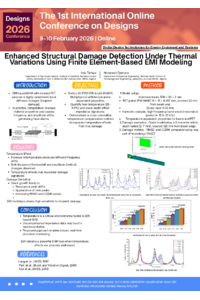
Structural Health Monitoring (SHM) has increasingly shifted toward smart-material-based solutions capable of providing continuous and real-time assessment of structural integrity. Among these approaches, the Electro-Mechanical Impedance (EMI) technique has emerged as a highly sensitive method for detecting incipient damage through the electromechanical coupling characteristics of piezoelectric (PZT) sensors. This study contributes to EMI-based SHM by numerically investigating the combined effects of structural damage and temperature variations on the impedance response of a PZT patch bonded to an aluminum beam.
The methodology relies on three-dimensional finite element modelling performed in ANSYS Multiphysics, incorporating temperature-dependent material properties for both the host structure and the PZT sensor. Several damage scenarios were simulated by introducing cracks of varying depths at a fixed distance from the sensor. Temperature was varied from 25°C to 85°C to evaluate its influence on the electrical impedance signature. Harmonic analyses were conducted over a high-frequency range (18.5–21 kHz) to obtain both the real and imaginary components of the impedance. Damage indices such as Root Mean Square Deviation (RMSD) and Correlation Coefficient Deviation Metric (CCDM) were computed to quantify structural changes.
The results show that increasing temperature produces notable horizontal and vertical shifts in impedance peaks, while increasing crack depth leads to frequency shifts and the emergence of new resonance peaks due to stiffness reduction. Although temperature effects can mask true damage signatures, the application of a cross-correlation-based compensation technique successfully mitigates these distortions, enabling clear distinction between temperature-induced variations and actual structural deterioration.
Overall, the numerical findings confirm that the EMI technique, when combined with adequate temperature compensation strategies ,offers high sensitivity and robustness for reliable, continuous structural health monitoring.
Keywords
Structural health monitoring (SHM)
electro mechanical impedance (EMI)
piezoelectric sensor
damage detection
temperature
Poster
sciforum-159433.pdf
Predictive Maintenance of Three-Phase Induction Motors Using AI and Machine Learning: A Smart Industry 4.0 Framework
Short-Term Wind Speed Forecasting at Termas Station: A SimpleRNN Pipeline with Weibull Characterisation