Event submissions
Published
This submission belongs to the session S1. Gravitation and Cosmology of the event The 3rd International Online Conference on Universe
Published date
27 Feb, 2026
Academic Editor
'%3e%3cpath%20d='M12.6657%2010.9104C12.4185%2010.325%2012.0599%209.79327%2011.6097%209.34482C11.1609%208.89508%2010.6293%208.5365%2010.0442%208.28888C10.0389%208.28626%2010.0337%208.28495%2010.0285%208.28233C10.8446%207.69279%2011.3752%206.73249%2011.3752%205.64904C11.3752%203.8542%209.92103%202.39999%208.1262%202.39999C6.33136%202.39999%204.87715%203.8542%204.87715%205.64904C4.87715%206.73249%205.40774%207.69279%206.22393%208.28364C6.21869%208.28626%206.21345%208.28757%206.20821%208.29019C5.62129%208.5378%205.09463%208.89284%204.64265%209.34613C4.1929%209.79493%203.83432%2010.3266%203.58671%2010.9117C3.34345%2011.4845%203.21226%2012.0987%203.20023%2012.7209C3.19988%2012.7349%203.20233%2012.7488%203.20744%2012.7619C3.21255%2012.7749%203.22022%2012.7867%203.22998%2012.7968C3.23975%2012.8068%203.25142%2012.8147%203.26431%2012.8202C3.2772%2012.8256%203.29105%2012.8284%203.30504%2012.8284H4.09109C4.14874%2012.8284%204.19459%2012.7825%204.1959%2012.7262C4.2221%2011.7148%204.62823%2010.7676%205.34617%2010.0497C6.08899%209.30683%207.0755%208.89808%208.1262%208.89808C9.17689%208.89808%2010.1634%209.30683%2010.9062%2010.0497C11.6242%2010.7676%2012.0303%2011.7148%2012.0565%2012.7262C12.0578%2012.7838%2012.1037%2012.8284%2012.1613%2012.8284H12.9474C12.9613%2012.8284%2012.9752%2012.8256%2012.9881%2012.8202C13.001%2012.8147%2013.0126%2012.8068%2013.0224%2012.7968C13.0322%2012.7867%2013.0398%2012.7749%2013.0449%2012.7619C13.0501%2012.7488%2013.0525%2012.7349%2013.0522%2012.7209C13.0391%2012.0947%2012.9094%2011.4855%2012.6657%2010.9104ZM8.1262%207.9024C7.52486%207.9024%206.9589%207.6679%206.53312%207.24211C6.10733%206.81633%205.87283%206.25037%205.87283%205.64904C5.87283%205.0477%206.10733%204.48174%206.53312%204.05596C6.9589%203.63018%207.52486%203.39567%208.1262%203.39567C8.72753%203.39567%209.29349%203.63018%209.71927%204.05596C10.1451%204.48174%2010.3796%205.0477%2010.3796%205.64904C10.3796%206.25037%2010.1451%206.81633%209.71927%207.24211C9.29349%207.6679%208.72753%207.9024%208.1262%207.9024Z'%20fill='%235D1EE1'/%3e%3c/g%3e%3c/svg%3e) Lorenzo Iorio
Lorenzo IorioCitation
Değer Sofuoğlu, Bhupendra Kumar Shukla, Aroonkumar Beesham, Scalar Field Cosmology with Logarithmic Deceleration Parameter, in Proceedings of The 3rd International Online Conference on Universe, 4 March–6 March 2026, MDPI: Basel, Switzerland
Share
Email
Facebook
Twitter
LinkedIn
Scalar Field Cosmology with Logarithmic Deceleration Parameter
'%3e%3cpath%20d='M12.6647%2010.9104C12.4176%2010.325%2012.0589%209.7933%2011.6088%209.34485C11.16%208.89511%2010.6283%208.53653%2010.0432%208.28891C10.038%208.28629%2010.0327%208.28498%2010.0275%208.28236C10.8437%207.69282%2011.3743%206.73252%2011.3743%205.64907C11.3743%203.85423%209.92005%202.40002%208.12522%202.40002C6.33038%202.40002%204.87618%203.85423%204.87618%205.64907C4.87618%206.73252%205.40677%207.69282%206.22296%208.28367C6.21772%208.28629%206.21248%208.2876%206.20724%208.29022C5.62031%208.53783%205.09365%208.89287%204.64167%209.34616C4.19192%209.79496%203.83334%2010.3266%203.58573%2010.9117C3.34247%2011.4846%203.21128%2012.0987%203.19925%2012.721C3.1989%2012.735%203.20135%2012.7489%203.20646%2012.7619C3.21157%2012.7749%203.21924%2012.7868%203.22901%2012.7968C3.23877%2012.8068%203.25045%2012.8148%203.26334%2012.8202C3.27623%2012.8256%203.29007%2012.8284%203.30406%2012.8284H4.09012C4.14776%2012.8284%204.19362%2012.7825%204.19493%2012.7262C4.22113%2011.7148%204.62726%2010.7676%205.34519%2010.0497C6.08802%209.30686%207.07452%208.89811%208.12522%208.89811C9.17592%208.89811%2010.1624%209.30686%2010.9052%2010.0497C11.6232%2010.7676%2012.0293%2011.7148%2012.0555%2012.7262C12.0568%2012.7839%2012.1027%2012.8284%2012.1603%2012.8284H12.9464C12.9604%2012.8284%2012.9742%2012.8256%2012.9871%2012.8202C13%2012.8148%2013.0117%2012.8068%2013.0214%2012.7968C13.0312%2012.7868%2013.0389%2012.7749%2013.044%2012.7619C13.0491%2012.7489%2013.0515%2012.735%2013.0512%2012.721C13.0381%2012.0947%2012.9084%2011.4856%2012.6647%2010.9104ZM8.12522%207.90243C7.52388%207.90243%206.95792%207.66793%206.53214%207.24215C6.10636%206.81636%205.87185%206.2504%205.87185%205.64907C5.87185%205.04773%206.10636%204.48177%206.53214%204.05599C6.95792%203.63021%207.52388%203.3957%208.12522%203.3957C8.72655%203.3957%209.29252%203.63021%209.7183%204.05599C10.1441%204.48177%2010.3786%205.04773%2010.3786%205.64907C10.3786%206.2504%2010.1441%206.81636%209.7183%207.24215C9.29252%207.66793%208.72655%207.90243%208.12522%207.90243Z'%20fill='%235D1EE1'/%3e%3c/g%3e%3c/svg%3e)
Değer Sofuoğlu 1
Bhupendra Kumar Shukla 2
Aroonkumar Beesham 3
1. Department of Physics, Istanbul University, Vezneciler 34134, Fatih, Istanbul, Turkey
2. Department of Mathematics, Govt. Tilak PG College, Katni Madhya Pradesh 483501, India
3. Department of Mathematical Sciences, University of Zululand,
P Bag X1001, Kwa-Dlangezwa 3886, South Africa
Abstract
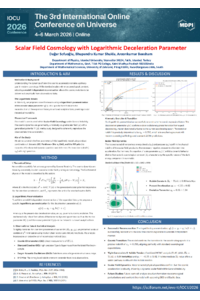
In this study, we present an alternative framework for understanding the dynamics of late-time cosmic acceleration. Central to our research is a specific methodology for modeling the expansion history of the universe and the nature of dark energy by a logarithmic parametrization of the deceleration parameter q(z). This specific form facilitates a model-independent reconstruction of the expansion history, allowing the cosmic evolution to be determined empirically, yet it remains fully consistent with scalar-field-driven dark energy models within the framework of General Relativity.
Our theoretical structure is built upon Scalar Field Cosmology, where cosmic dynamics are governed by a minimally coupled scalar field (ϕ) possessing a generalized potential V(ϕ). This potential is meticulously designed to coherently reproduce the observed late-time acceleration phase of the universe. The logarithmic form of q(z) allows for the reconstruction of all fundamental dynamic quantities in a closed analytical form. This analytical tractability is crucial for theoretical analysis and direct comparison with observations.
To constrain the model’s free parameters, we utilized a robust and extensive set of observational data. This includes Cosmic Chronometers (CCs), high-precision Standard Candle (SC) observations from Type Ia Supernovae (specifically the Pantheon+ sample), Baryon Acoustic Oscillation (BAO) data, and the strong constraint provided by the R19 local Hubble constant prior. All datasets were meticulously combined and analyzed through a combined χ^2 minimization procedure, ensuring the maximization of the model’s observational consistency and statistical power.
The results unequivocally demonstrate a clear evolutionary transition from a past decelerating phase to the current accelerating phase. The reconstructed transition redshift (zt) is found to lie within the interval zt ≈ 0.70–0.90, which is remarkably consistent with modern cosmological findings. The high degree of consistency between our model and the observational data proves that the logarithmic deceleration mechanism can provide a successful explanation for the universe's evolution.
Keywords
Scalar Field
Logarithmic Deceleration Parameter
Observational Constraints
Poster
poster-IOCU2026.pdf
Study of the effect of the area and curvature terms in the quark and gluon density of states on the transition temperature
Dark Neutron Decay in Neutron Stars