Event submissions
Published
This submission belongs to the session S1. Gravitation and Cosmology of the event The 3rd International Online Conference on Universe
Published date
27 Feb, 2026
Academic Editor
'%3e%3cpath%20d='M12.6657%2010.9104C12.4185%2010.325%2012.0599%209.79327%2011.6097%209.34482C11.1609%208.89508%2010.6293%208.5365%2010.0442%208.28888C10.0389%208.28626%2010.0337%208.28495%2010.0285%208.28233C10.8446%207.69279%2011.3752%206.73249%2011.3752%205.64904C11.3752%203.8542%209.92103%202.39999%208.1262%202.39999C6.33136%202.39999%204.87715%203.8542%204.87715%205.64904C4.87715%206.73249%205.40774%207.69279%206.22393%208.28364C6.21869%208.28626%206.21345%208.28757%206.20821%208.29019C5.62129%208.5378%205.09463%208.89284%204.64265%209.34613C4.1929%209.79493%203.83432%2010.3266%203.58671%2010.9117C3.34345%2011.4845%203.21226%2012.0987%203.20023%2012.7209C3.19988%2012.7349%203.20233%2012.7488%203.20744%2012.7619C3.21255%2012.7749%203.22022%2012.7867%203.22998%2012.7968C3.23975%2012.8068%203.25142%2012.8147%203.26431%2012.8202C3.2772%2012.8256%203.29105%2012.8284%203.30504%2012.8284H4.09109C4.14874%2012.8284%204.19459%2012.7825%204.1959%2012.7262C4.2221%2011.7148%204.62823%2010.7676%205.34617%2010.0497C6.08899%209.30683%207.0755%208.89808%208.1262%208.89808C9.17689%208.89808%2010.1634%209.30683%2010.9062%2010.0497C11.6242%2010.7676%2012.0303%2011.7148%2012.0565%2012.7262C12.0578%2012.7838%2012.1037%2012.8284%2012.1613%2012.8284H12.9474C12.9613%2012.8284%2012.9752%2012.8256%2012.9881%2012.8202C13.001%2012.8147%2013.0126%2012.8068%2013.0224%2012.7968C13.0322%2012.7867%2013.0398%2012.7749%2013.0449%2012.7619C13.0501%2012.7488%2013.0525%2012.7349%2013.0522%2012.7209C13.0391%2012.0947%2012.9094%2011.4855%2012.6657%2010.9104ZM8.1262%207.9024C7.52486%207.9024%206.9589%207.6679%206.53312%207.24211C6.10733%206.81633%205.87283%206.25037%205.87283%205.64904C5.87283%205.0477%206.10733%204.48174%206.53312%204.05596C6.9589%203.63018%207.52486%203.39567%208.1262%203.39567C8.72753%203.39567%209.29349%203.63018%209.71927%204.05596C10.1451%204.48174%2010.3796%205.0477%2010.3796%205.64904C10.3796%206.25037%2010.1451%206.81633%209.71927%207.24211C9.29349%207.6679%208.72753%207.9024%208.1262%207.9024Z'%20fill='%235D1EE1'/%3e%3c/g%3e%3c/svg%3e) Lorenzo Iorio
Lorenzo IorioCitation
Saddam Hussain, Evidence for Dynamical Dark Energy from BAO Data: Testing Double-Crossing Parametrizations, in Proceedings of The 3rd International Online Conference on Universe, 4 March–6 March 2026, MDPI: Basel, Switzerland
Share
Email
Facebook
Twitter
LinkedIn
Evidence for Dynamical Dark Energy from BAO Data: Testing Double-Crossing Parametrizations

Saddam Hussain 1
1. Institute for Theoretical Physics and Cosmology, Zhejiang University of Technology, Hangzhou, 310023, China
Abstract
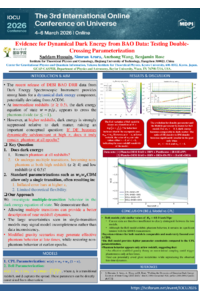
Recent BAO (Baryonic Acoustic Oscillation) observations—large-scale clustering features of galaxies that act as a standard ruler for cosmic expansion—from dark energy surveys have reignited the debate over the dynamical nature of dark energy, revealing deviations from the standard LambdaCDM model at more than the 4sigma level. To capture departures from a cosmological constant, several parametric models of the dark energy equation of state have been proposed, often based on series expansions in redshift. These studies consistently suggest phantom behavior, characterized by an equation-of-state parameter, at higher redshifts. Such behavior is theoretically problematic, as it can lead to ghost instabilities, namely negative-energy degrees of freedom that render the theory unstable at the perturbative level.
Since the influence of dark energy naturally weakens at high redshifts, we propose a double-crossing, bell-shaped parametrization of the dark energy equation of state, where the cosmological constant boundary is crossed twice during cosmic evolution. This form is more sensitive to low-redshift dynamics compared to conventional series-based parametrizations. We show that this model exhibits transient phantom behavior (w<-1) near the matter–dark energy equality epoch, but evolves into a quintessential regime (w>-1) at present and at higher redshifts, thereby avoiding ghost-related instabilities. Such short-lived phantom behavior at low redshifts may arise from mechanisms such as non-minimally coupled gravity theories. Furthermore, we demonstrate that non-canonical scalar field models interacting with dark matter, when constrained by multiple cosmological probes, favor a quintessential-like evolution with no evidence for phantom behavior, supporting the possibility that modified gravity effects play a role primarily at low-redshift epochs.
Keywords
Cosmological data analysis
BAO Observation
non-canonical scalar fields
interacting dark energy
Poster
mdpi poster.pdf
Falling test electric dipole in the Schwarzschild geometry
Planetary dependency: the signature for streaming dark matter