Event submissions
Published
This submission belongs to the session S6. Galaxies, Clusters and Compact Objects of the event The 3rd International Online Conference on Universe
Published date
27 Feb, 2026
Academic Editor
'%3e%3cpath%20d='M12.6657%2010.9104C12.4185%2010.325%2012.0599%209.79327%2011.6097%209.34482C11.1609%208.89508%2010.6293%208.5365%2010.0442%208.28888C10.0389%208.28626%2010.0337%208.28495%2010.0285%208.28233C10.8446%207.69279%2011.3752%206.73249%2011.3752%205.64904C11.3752%203.8542%209.92103%202.39999%208.1262%202.39999C6.33136%202.39999%204.87715%203.8542%204.87715%205.64904C4.87715%206.73249%205.40774%207.69279%206.22393%208.28364C6.21869%208.28626%206.21345%208.28757%206.20821%208.29019C5.62129%208.5378%205.09463%208.89284%204.64265%209.34613C4.1929%209.79493%203.83432%2010.3266%203.58671%2010.9117C3.34345%2011.4845%203.21226%2012.0987%203.20023%2012.7209C3.19988%2012.7349%203.20233%2012.7488%203.20744%2012.7619C3.21255%2012.7749%203.22022%2012.7867%203.22998%2012.7968C3.23975%2012.8068%203.25142%2012.8147%203.26431%2012.8202C3.2772%2012.8256%203.29105%2012.8284%203.30504%2012.8284H4.09109C4.14874%2012.8284%204.19459%2012.7825%204.1959%2012.7262C4.2221%2011.7148%204.62823%2010.7676%205.34617%2010.0497C6.08899%209.30683%207.0755%208.89808%208.1262%208.89808C9.17689%208.89808%2010.1634%209.30683%2010.9062%2010.0497C11.6242%2010.7676%2012.0303%2011.7148%2012.0565%2012.7262C12.0578%2012.7838%2012.1037%2012.8284%2012.1613%2012.8284H12.9474C12.9613%2012.8284%2012.9752%2012.8256%2012.9881%2012.8202C13.001%2012.8147%2013.0126%2012.8068%2013.0224%2012.7968C13.0322%2012.7867%2013.0398%2012.7749%2013.0449%2012.7619C13.0501%2012.7488%2013.0525%2012.7349%2013.0522%2012.7209C13.0391%2012.0947%2012.9094%2011.4855%2012.6657%2010.9104ZM8.1262%207.9024C7.52486%207.9024%206.9589%207.6679%206.53312%207.24211C6.10733%206.81633%205.87283%206.25037%205.87283%205.64904C5.87283%205.0477%206.10733%204.48174%206.53312%204.05596C6.9589%203.63018%207.52486%203.39567%208.1262%203.39567C8.72753%203.39567%209.29349%203.63018%209.71927%204.05596C10.1451%204.48174%2010.3796%205.0477%2010.3796%205.64904C10.3796%206.25037%2010.1451%206.81633%209.71927%207.24211C9.29349%207.6679%208.72753%207.9024%208.1262%207.9024Z'%20fill='%235D1EE1'/%3e%3c/g%3e%3c/svg%3e) Lorenzo Iorio
Lorenzo IorioCitation
Ivan Zhogin, On gravity at large (galactic) scales, in Proceedings of The 3rd International Online Conference on Universe, 4 March–6 March 2026, MDPI: Basel, Switzerland
Share
Email
Facebook
Twitter
LinkedIn
On gravity at large (galactic) scales
'%3e%3cpath%20d='M12.6647%2010.9104C12.4176%2010.325%2012.0589%209.7933%2011.6088%209.34485C11.16%208.89511%2010.6283%208.53653%2010.0432%208.28891C10.038%208.28629%2010.0327%208.28498%2010.0275%208.28236C10.8437%207.69282%2011.3743%206.73252%2011.3743%205.64907C11.3743%203.85423%209.92005%202.40002%208.12522%202.40002C6.33038%202.40002%204.87618%203.85423%204.87618%205.64907C4.87618%206.73252%205.40677%207.69282%206.22296%208.28367C6.21772%208.28629%206.21248%208.2876%206.20724%208.29022C5.62031%208.53783%205.09365%208.89287%204.64167%209.34616C4.19192%209.79496%203.83334%2010.3266%203.58573%2010.9117C3.34247%2011.4846%203.21128%2012.0987%203.19925%2012.721C3.1989%2012.735%203.20135%2012.7489%203.20646%2012.7619C3.21157%2012.7749%203.21924%2012.7868%203.22901%2012.7968C3.23877%2012.8068%203.25045%2012.8148%203.26334%2012.8202C3.27623%2012.8256%203.29007%2012.8284%203.30406%2012.8284H4.09012C4.14776%2012.8284%204.19362%2012.7825%204.19493%2012.7262C4.22113%2011.7148%204.62726%2010.7676%205.34519%2010.0497C6.08802%209.30686%207.07452%208.89811%208.12522%208.89811C9.17592%208.89811%2010.1624%209.30686%2010.9052%2010.0497C11.6232%2010.7676%2012.0293%2011.7148%2012.0555%2012.7262C12.0568%2012.7839%2012.1027%2012.8284%2012.1603%2012.8284H12.9464C12.9604%2012.8284%2012.9742%2012.8256%2012.9871%2012.8202C13%2012.8148%2013.0117%2012.8068%2013.0214%2012.7968C13.0312%2012.7868%2013.0389%2012.7749%2013.044%2012.7619C13.0491%2012.7489%2013.0515%2012.735%2013.0512%2012.721C13.0381%2012.0947%2012.9084%2011.4856%2012.6647%2010.9104ZM8.12522%207.90243C7.52388%207.90243%206.95792%207.66793%206.53214%207.24215C6.10636%206.81636%205.87185%206.2504%205.87185%205.64907C5.87185%205.04773%206.10636%204.48177%206.53214%204.05599C6.95792%203.63021%207.52388%203.3957%208.12522%203.3957C8.72655%203.3957%209.29252%203.63021%209.7183%204.05599C10.1441%204.48177%2010.3786%205.04773%2010.3786%205.64907C10.3786%206.2504%2010.1441%206.81636%209.7183%207.24215C9.29252%207.66793%208.72655%207.90243%208.12522%207.90243Z'%20fill='%235D1EE1'/%3e%3c/g%3e%3c/svg%3e)
Ivan Zhogin 1
1. Laboratory # 9 (Synchrotron Radiation methods), Institute of Solid State Chemistry and Mechanochemistry
of the Siberian Branch of the Russian Academy of Sciences (ISSCM SB RAS), Novosibirsk, 63000, Russia
Abstract
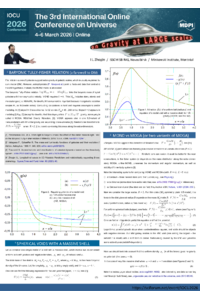
The baryonic Tully–Fisher relation logMbar=c+blogVflat links the baryonic mass of spiral-galaxies with their asymptotic velocity. Flat rotation curves suggest extra-gravity at galactic scales, which is explained by dark matter. However, astrophysicists point to facts/data that contradict the DM-hypothesis (P.Kroupa). Instead, the MOND-model is advocated, which requires b=4. Mbar includes stars, atomic/molecular gas, and HI/HeI/H2; for dwarfs, HII-component is important (intergalactic radiation ionizes, as N.Gnedin notes). Сonducting calculations is hard and requires assumptions/modeling; in [1] slope b≈3 was obtained for spirals (Vflat≈45...280km/s). Slope b=2 appears in modeling [2;App.G] (except for dwarfs); this indicates F~Mbar/R gravity;.This is possible for one 5D-variant of Teleparallelism with 4th-order gravity and expanding brane-universe [3]: Newton's law transforms to F/m=GM/(LR) when R>L (L is brane's co-moving thickness along the extra-dimension). This model, called MOGA, unlike MOND, preserves the momentum/angular momentum and stability of three-body systems (Toxvaerd S. arXiv:2512.03823; MOdifiedGravityAttraction).
For thin (SO2-symmetry; 1/R-model) disks, the force/acceleration in the disk-plane, at radius R, depends on the mass MR inside R: F(R)/m=GMR/(LR); on the axis (uniform discs, radius a; 'test-mass' m): F(Z)/m=GMZ/(La2) ln(1+a2/Z2). For balls/bulges, one finds (let GMm/L=1):
F(R)=3/(8a){a/R+R/a–0.5(a/R–R/a)2 ln[(R+a)/|R–a|]}=R/a2{1–(R/a)2/5–...–3(R/a)2n/[(2n–1)(2n+1)(2n+3)]–...}=1/R{1–(a/R)2/5–...}.
Logarithmic potential growth stops when "underdensities" appear, and voids should be objects with negative masses. Our MW-galaxy resides in the KBC-void (among the largest—redshift z is small!) with a shift from its center. Defocussing caused by the KBC-void provides some extra-dipoles (redshift-dependent).
1. Ponomareva A.A. etal. MNRAS.474(2018)4366(hal-02117129f).
2. Valageas P., Schaeffer R. Astron.Astrophys.345(1999)329(arXiv:astro-ph/9812213).
3. Zhogin I.L. Space,Time&Fund.Inter.#2(2025)40(stfi.ru/journal/STFI_2025_02/STFI_2025_02_Zhogin.pdf).
Keywords
baryonic Tully-Fisher relation
Absolute Parallelism
4th-order gravity in 5D AP
Poster
poster_Zhogin_corr.pdf
Contradictory results in the rock magnetic and SEM-EDS characteristics of the carbonaceous chondrite NWA 11469
Impact of Equation of State Parameters on the Complexity of Anisotropic Stellar Models