Event submissions
Published
This submission belongs to the session S6. Galaxies, Clusters and Compact Objects of the event The 3rd International Online Conference on Universe
Published date
27 Feb, 2026
Academic Editor
'%3e%3cpath%20d='M12.6657%2010.9104C12.4185%2010.325%2012.0599%209.79327%2011.6097%209.34482C11.1609%208.89508%2010.6293%208.5365%2010.0442%208.28888C10.0389%208.28626%2010.0337%208.28495%2010.0285%208.28233C10.8446%207.69279%2011.3752%206.73249%2011.3752%205.64904C11.3752%203.8542%209.92103%202.39999%208.1262%202.39999C6.33136%202.39999%204.87715%203.8542%204.87715%205.64904C4.87715%206.73249%205.40774%207.69279%206.22393%208.28364C6.21869%208.28626%206.21345%208.28757%206.20821%208.29019C5.62129%208.5378%205.09463%208.89284%204.64265%209.34613C4.1929%209.79493%203.83432%2010.3266%203.58671%2010.9117C3.34345%2011.4845%203.21226%2012.0987%203.20023%2012.7209C3.19988%2012.7349%203.20233%2012.7488%203.20744%2012.7619C3.21255%2012.7749%203.22022%2012.7867%203.22998%2012.7968C3.23975%2012.8068%203.25142%2012.8147%203.26431%2012.8202C3.2772%2012.8256%203.29105%2012.8284%203.30504%2012.8284H4.09109C4.14874%2012.8284%204.19459%2012.7825%204.1959%2012.7262C4.2221%2011.7148%204.62823%2010.7676%205.34617%2010.0497C6.08899%209.30683%207.0755%208.89808%208.1262%208.89808C9.17689%208.89808%2010.1634%209.30683%2010.9062%2010.0497C11.6242%2010.7676%2012.0303%2011.7148%2012.0565%2012.7262C12.0578%2012.7838%2012.1037%2012.8284%2012.1613%2012.8284H12.9474C12.9613%2012.8284%2012.9752%2012.8256%2012.9881%2012.8202C13.001%2012.8147%2013.0126%2012.8068%2013.0224%2012.7968C13.0322%2012.7867%2013.0398%2012.7749%2013.0449%2012.7619C13.0501%2012.7488%2013.0525%2012.7349%2013.0522%2012.7209C13.0391%2012.0947%2012.9094%2011.4855%2012.6657%2010.9104ZM8.1262%207.9024C7.52486%207.9024%206.9589%207.6679%206.53312%207.24211C6.10733%206.81633%205.87283%206.25037%205.87283%205.64904C5.87283%205.0477%206.10733%204.48174%206.53312%204.05596C6.9589%203.63018%207.52486%203.39567%208.1262%203.39567C8.72753%203.39567%209.29349%203.63018%209.71927%204.05596C10.1451%204.48174%2010.3796%205.0477%2010.3796%205.64904C10.3796%206.25037%2010.1451%206.81633%209.71927%207.24211C9.29349%207.6679%208.72753%207.9024%208.1262%207.9024Z'%20fill='%235D1EE1'/%3e%3c/g%3e%3c/svg%3e) Nicolas Chamel
Nicolas ChamelCitation
Paola Marziani, Flagging super-Eddington candidates among gamma-ray-emitting AGN, in Proceedings of The 3rd International Online Conference on Universe, 4 March–6 March 2026, MDPI: Basel, Switzerland
Share
Email
Facebook
Twitter
LinkedIn
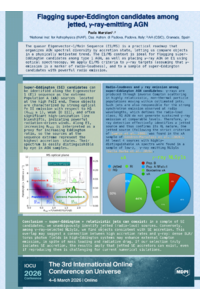
Flagging super-Eddington candidates among gamma-ray-emitting AGN

Paola Marziani 1,2
1. National Institute for Astrophysics (INAF), Astronomical Observatory of Padua, Padua, Italy
2. Instituto de Astrofisica de Andalucia (CSIC), Glorieta de la Astronomía s/n, ES18008 Granada, Spain
Abstract
The quasar Eigenvector-1/Main Sequence (E1/MS) is a practical roadmap that organizes AGN spectral diversity by accretion state, letting us compare objects in a common, physically motivated trend. Past applications of the E1/MS sequence made it possible to identify the effects of intrinsic viewing angle, black hole mass, and luminosity. We propose an E1/MS-driven framework to clarify the accretion status of gamma-ray-emitting AGN with an emphasis on radio-loud narrow-line Seyfert 1s (NLSy1s) and Population A sources. We argue that the E1/MS context is ideal for flagging super-Eddington candidates among radio-loud NLSy1s and other Population A sources that also host relativistic jets. An optimal strategy would be to place gamma-ray AGN on E1 using optical/UV spectroscopy, to derive disk-based bolometric luminosities from line or IR reprocessing (or jet-quiet SED states), and to correct single-epoch black hole masses for orientation and radiation pressure biases. This strategy should identify super-Eddington candidates and reflect a physical link between accretion state and gamma-ray efficiency: dense broad-line region/torus photon fields in high-Eddington-ratio systems should boost the external Compton emission, whereas mass loading and radiative drag shape moderate bulk Lorentz factors in gamma-ray emitters observed with VLBI. We apply the method based on the E1/MS criteria to targets for which high-S/N optical and UV spectra as well as multi-frequency coverage are available.
Keywords
AGN
accretion (super-Eddington)
gamma-rays
black hole physics
Poster
iocu2026poster.pdf
White dwarf mass accretion in AGN accretion disk
FORS2 Spectroscopy of a Pure Sample of Narrow-Line Seyfert 1 Galaxies