Event submissions
Published
This submission belongs to the session S2. Environmental Impact and Risk Assessment of the event The 1st International Online Conference on Environments
Published date
27 Feb, 2026
Academic Editor
'%3e%3cpath%20d='M12.6657%2010.9104C12.4185%2010.325%2012.0599%209.79327%2011.6097%209.34482C11.1609%208.89508%2010.6293%208.5365%2010.0442%208.28888C10.0389%208.28626%2010.0337%208.28495%2010.0285%208.28233C10.8446%207.69279%2011.3752%206.73249%2011.3752%205.64904C11.3752%203.8542%209.92103%202.39999%208.1262%202.39999C6.33136%202.39999%204.87715%203.8542%204.87715%205.64904C4.87715%206.73249%205.40774%207.69279%206.22393%208.28364C6.21869%208.28626%206.21345%208.28757%206.20821%208.29019C5.62129%208.5378%205.09463%208.89284%204.64265%209.34613C4.1929%209.79493%203.83432%2010.3266%203.58671%2010.9117C3.34345%2011.4845%203.21226%2012.0987%203.20023%2012.7209C3.19988%2012.7349%203.20233%2012.7488%203.20744%2012.7619C3.21255%2012.7749%203.22022%2012.7867%203.22998%2012.7968C3.23975%2012.8068%203.25142%2012.8147%203.26431%2012.8202C3.2772%2012.8256%203.29105%2012.8284%203.30504%2012.8284H4.09109C4.14874%2012.8284%204.19459%2012.7825%204.1959%2012.7262C4.2221%2011.7148%204.62823%2010.7676%205.34617%2010.0497C6.08899%209.30683%207.0755%208.89808%208.1262%208.89808C9.17689%208.89808%2010.1634%209.30683%2010.9062%2010.0497C11.6242%2010.7676%2012.0303%2011.7148%2012.0565%2012.7262C12.0578%2012.7838%2012.1037%2012.8284%2012.1613%2012.8284H12.9474C12.9613%2012.8284%2012.9752%2012.8256%2012.9881%2012.8202C13.001%2012.8147%2013.0126%2012.8068%2013.0224%2012.7968C13.0322%2012.7867%2013.0398%2012.7749%2013.0449%2012.7619C13.0501%2012.7488%2013.0525%2012.7349%2013.0522%2012.7209C13.0391%2012.0947%2012.9094%2011.4855%2012.6657%2010.9104ZM8.1262%207.9024C7.52486%207.9024%206.9589%207.6679%206.53312%207.24211C6.10733%206.81633%205.87283%206.25037%205.87283%205.64904C5.87283%205.0477%206.10733%204.48174%206.53312%204.05596C6.9589%203.63018%207.52486%203.39567%208.1262%203.39567C8.72753%203.39567%209.29349%203.63018%209.71927%204.05596C10.1451%204.48174%2010.3796%205.0477%2010.3796%205.64904C10.3796%206.25037%2010.1451%206.81633%209.71927%207.24211C9.29349%207.6679%208.72753%207.9024%208.1262%207.9024Z'%20fill='%235D1EE1'/%3e%3c/g%3e%3c/svg%3e) Ioannis Kalavrouziotis
Ioannis KalavrouziotisCitation
Melissa Garutti, Bruno Lemos Batista, Caroline Cristine Augusto, Bruna Moreira Freire, Optimizing SP-ICP-MS for Detection of Silver Nanoparticles in Water: Implications for Environmental Monitoring, in Proceedings of The 1st International Online Conference on Environments, 2 March–4 March 2026, MDPI: Basel, Switzerland
Share
Email
Facebook
Twitter
LinkedIn
Optimizing SP-ICP-MS for Detection of Silver Nanoparticles in Water: Implications for Environmental Monitoring
'%3e%3cpath%20d='M12.6647%2010.9104C12.4176%2010.325%2012.0589%209.7933%2011.6088%209.34485C11.16%208.89511%2010.6283%208.53653%2010.0432%208.28891C10.038%208.28629%2010.0327%208.28498%2010.0275%208.28236C10.8437%207.69282%2011.3743%206.73252%2011.3743%205.64907C11.3743%203.85423%209.92005%202.40002%208.12522%202.40002C6.33038%202.40002%204.87618%203.85423%204.87618%205.64907C4.87618%206.73252%205.40677%207.69282%206.22296%208.28367C6.21772%208.28629%206.21248%208.2876%206.20724%208.29022C5.62031%208.53783%205.09365%208.89287%204.64167%209.34616C4.19192%209.79496%203.83334%2010.3266%203.58573%2010.9117C3.34247%2011.4846%203.21128%2012.0987%203.19925%2012.721C3.1989%2012.735%203.20135%2012.7489%203.20646%2012.7619C3.21157%2012.7749%203.21924%2012.7868%203.22901%2012.7968C3.23877%2012.8068%203.25045%2012.8148%203.26334%2012.8202C3.27623%2012.8256%203.29007%2012.8284%203.30406%2012.8284H4.09012C4.14776%2012.8284%204.19362%2012.7825%204.19493%2012.7262C4.22113%2011.7148%204.62726%2010.7676%205.34519%2010.0497C6.08802%209.30686%207.07452%208.89811%208.12522%208.89811C9.17592%208.89811%2010.1624%209.30686%2010.9052%2010.0497C11.6232%2010.7676%2012.0293%2011.7148%2012.0555%2012.7262C12.0568%2012.7839%2012.1027%2012.8284%2012.1603%2012.8284H12.9464C12.9604%2012.8284%2012.9742%2012.8256%2012.9871%2012.8202C13%2012.8148%2013.0117%2012.8068%2013.0214%2012.7968C13.0312%2012.7868%2013.0389%2012.7749%2013.044%2012.7619C13.0491%2012.7489%2013.0515%2012.735%2013.0512%2012.721C13.0381%2012.0947%2012.9084%2011.4856%2012.6647%2010.9104ZM8.12522%207.90243C7.52388%207.90243%206.95792%207.66793%206.53214%207.24215C6.10636%206.81636%205.87185%206.2504%205.87185%205.64907C5.87185%205.04773%206.10636%204.48177%206.53214%204.05599C6.95792%203.63021%207.52388%203.3957%208.12522%203.3957C8.72655%203.3957%209.29252%203.63021%209.7183%204.05599C10.1441%204.48177%2010.3786%205.04773%2010.3786%205.64907C10.3786%206.2504%2010.1441%206.81636%209.7183%207.24215C9.29252%207.66793%208.72655%207.90243%208.12522%207.90243Z'%20fill='%235D1EE1'/%3e%3c/g%3e%3c/svg%3e)
Melissa Garutti 1

Bruno Lemos Batista 1
Caroline Cristine Augusto 1

Bruna Moreira Freire 1
1. Federal University of ABC (UFABC), Center for Natural and Human Sciences (CCNH), Santo André, São Paulo, Brazil, 09210-580
Abstract
Nanotechnology is a multidisciplinary field that has gained increasing attention. Silver nanoparticles (AgNPs) stand out due to their broad-spectrum antimicrobial activity and widespread use in medical, food, cosmetic, and textile applications. However, the lack of data on the release of AgNPs into water and soil, along with the absence of standardized protocols for analyzing them in environmentally relevant samples and concentrations, raises concerns regarding their environmental impact and potential human exposure. In this context, analytical techniques for NP characterization are essential. Single particle ICP-MS (SP-ICP-MS) has emerged as a powerful tool for the detection of nanoparticles in aqueous solutions. Nevertheless, further studies are required to optimize and expand the application of this technique. This study aims to optimize a SP-ICP-MS method for the detection of AgNPs in water samples. The following aspects were evaluated: detection of AgNPs through adequate signal-to-noise separation; transport efficiency, size limit of detection (LODsize); and the ability to distinguish nanoparticles of different sizes within the same suspension. The optimized method enabled the detection of AgNPs as small as 12 nm at environmentally relevant concentrations (in the ppt range). It was also possible to distinguish between AgNPs of 50 and 80 nm within the same sample. The optimized methodology was then applied to water samples collected from the ABC Paulista region (Brazil), along downstream sections of the Tamanduateí River and nearby residential, industrial, and tourist zones as a proof of concept. The addition and recovery study with commercial AgNPs confirmed the applicability of the method for environmental samples. No AgNPs were detected in the collected water samples of the ABC Paulista region, indicating no health risk regarding AgNPs exposure. These findings help address existing gaps in analytical methods for detecting metallic nanoparticles and may contribute to the monitoring of AgNPs and other NPs in environmental samples.
Keywords
SP-ICP-MS
AgNPs
Water Samples
Environmental Impact
Poster
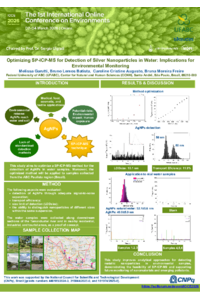
Optimizing SP-ICP-MS for Detection of Silver Nanoparticles in Water Implic_20260221_183516_0000.pdf
Carbon footprint related to municipal solid waste management in upper middle-income countries: a multi-factorial study based on composition, operations and management strategies
Nueva Esperanza rural settlement: Challenges of a public policy for environmental and territorial Development in the peri-urban area of Neuquén (1993–2018), Argentina.