Event submissions
Published
This submission belongs to the session S2. Environmental Impact and Risk Assessment of the event The 1st International Online Conference on Environments
Published date
27 Feb, 2026
Academic Editor
'%3e%3cpath%20d='M12.6657%2010.9104C12.4185%2010.325%2012.0599%209.79327%2011.6097%209.34482C11.1609%208.89508%2010.6293%208.5365%2010.0442%208.28888C10.0389%208.28626%2010.0337%208.28495%2010.0285%208.28233C10.8446%207.69279%2011.3752%206.73249%2011.3752%205.64904C11.3752%203.8542%209.92103%202.39999%208.1262%202.39999C6.33136%202.39999%204.87715%203.8542%204.87715%205.64904C4.87715%206.73249%205.40774%207.69279%206.22393%208.28364C6.21869%208.28626%206.21345%208.28757%206.20821%208.29019C5.62129%208.5378%205.09463%208.89284%204.64265%209.34613C4.1929%209.79493%203.83432%2010.3266%203.58671%2010.9117C3.34345%2011.4845%203.21226%2012.0987%203.20023%2012.7209C3.19988%2012.7349%203.20233%2012.7488%203.20744%2012.7619C3.21255%2012.7749%203.22022%2012.7867%203.22998%2012.7968C3.23975%2012.8068%203.25142%2012.8147%203.26431%2012.8202C3.2772%2012.8256%203.29105%2012.8284%203.30504%2012.8284H4.09109C4.14874%2012.8284%204.19459%2012.7825%204.1959%2012.7262C4.2221%2011.7148%204.62823%2010.7676%205.34617%2010.0497C6.08899%209.30683%207.0755%208.89808%208.1262%208.89808C9.17689%208.89808%2010.1634%209.30683%2010.9062%2010.0497C11.6242%2010.7676%2012.0303%2011.7148%2012.0565%2012.7262C12.0578%2012.7838%2012.1037%2012.8284%2012.1613%2012.8284H12.9474C12.9613%2012.8284%2012.9752%2012.8256%2012.9881%2012.8202C13.001%2012.8147%2013.0126%2012.8068%2013.0224%2012.7968C13.0322%2012.7867%2013.0398%2012.7749%2013.0449%2012.7619C13.0501%2012.7488%2013.0525%2012.7349%2013.0522%2012.7209C13.0391%2012.0947%2012.9094%2011.4855%2012.6657%2010.9104ZM8.1262%207.9024C7.52486%207.9024%206.9589%207.6679%206.53312%207.24211C6.10733%206.81633%205.87283%206.25037%205.87283%205.64904C5.87283%205.0477%206.10733%204.48174%206.53312%204.05596C6.9589%203.63018%207.52486%203.39567%208.1262%203.39567C8.72753%203.39567%209.29349%203.63018%209.71927%204.05596C10.1451%204.48174%2010.3796%205.0477%2010.3796%205.64904C10.3796%206.25037%2010.1451%206.81633%209.71927%207.24211C9.29349%207.6679%208.72753%207.9024%208.1262%207.9024Z'%20fill='%235D1EE1'/%3e%3c/g%3e%3c/svg%3e) Gianniantonio Petruzzelli
Gianniantonio PetruzzelliCitation
Amina BELGUIDOUM, Khaoula Benlembarek, Takia Lograda, Messaoud Ramdani, Assessment of Pb and Mn Accumulation in Marrubium vulgare L. as a Bioindicator and Phytoremediation Candidate in Industrial and Urban Environments of Sétif (Algeria), in Proceedings of The 1st International Online Conference on Environments, 2 March–4 March 2026, MDPI: Basel, Switzerland
Share
Email
Facebook
Twitter
LinkedIn
Assessment of Pb and Mn Accumulation in Marrubium vulgare L. as a Bioindicator and Phytoremediation Candidate in Industrial and Urban Environments of Sétif (Algeria)
'%3e%3cpath%20d='M12.6647%2010.9104C12.4176%2010.325%2012.0589%209.7933%2011.6088%209.34485C11.16%208.89511%2010.6283%208.53653%2010.0432%208.28891C10.038%208.28629%2010.0327%208.28498%2010.0275%208.28236C10.8437%207.69282%2011.3743%206.73252%2011.3743%205.64907C11.3743%203.85423%209.92005%202.40002%208.12522%202.40002C6.33038%202.40002%204.87618%203.85423%204.87618%205.64907C4.87618%206.73252%205.40677%207.69282%206.22296%208.28367C6.21772%208.28629%206.21248%208.2876%206.20724%208.29022C5.62031%208.53783%205.09365%208.89287%204.64167%209.34616C4.19192%209.79496%203.83334%2010.3266%203.58573%2010.9117C3.34247%2011.4846%203.21128%2012.0987%203.19925%2012.721C3.1989%2012.735%203.20135%2012.7489%203.20646%2012.7619C3.21157%2012.7749%203.21924%2012.7868%203.22901%2012.7968C3.23877%2012.8068%203.25045%2012.8148%203.26334%2012.8202C3.27623%2012.8256%203.29007%2012.8284%203.30406%2012.8284H4.09012C4.14776%2012.8284%204.19362%2012.7825%204.19493%2012.7262C4.22113%2011.7148%204.62726%2010.7676%205.34519%2010.0497C6.08802%209.30686%207.07452%208.89811%208.12522%208.89811C9.17592%208.89811%2010.1624%209.30686%2010.9052%2010.0497C11.6232%2010.7676%2012.0293%2011.7148%2012.0555%2012.7262C12.0568%2012.7839%2012.1027%2012.8284%2012.1603%2012.8284H12.9464C12.9604%2012.8284%2012.9742%2012.8256%2012.9871%2012.8202C13%2012.8148%2013.0117%2012.8068%2013.0214%2012.7968C13.0312%2012.7868%2013.0389%2012.7749%2013.044%2012.7619C13.0491%2012.7489%2013.0515%2012.735%2013.0512%2012.721C13.0381%2012.0947%2012.9084%2011.4856%2012.6647%2010.9104ZM8.12522%207.90243C7.52388%207.90243%206.95792%207.66793%206.53214%207.24215C6.10636%206.81636%205.87185%206.2504%205.87185%205.64907C5.87185%205.04773%206.10636%204.48177%206.53214%204.05599C6.95792%203.63021%207.52388%203.3957%208.12522%203.3957C8.72655%203.3957%209.29252%203.63021%209.7183%204.05599C10.1441%204.48177%2010.3786%205.04773%2010.3786%205.64907C10.3786%206.2504%2010.1441%206.81636%209.7183%207.24215C9.29252%207.66793%208.72655%207.90243%208.12522%207.90243Z'%20fill='%235D1EE1'/%3e%3c/g%3e%3c/svg%3e)
Amina BELGUIDOUM 1,2
Khaoula Benlembarek 2,3
Takia Lograda 2,4
Messaoud Ramdani 2,4
1. Ecology and environment department, Faculty of Biological Sciences, University of Sciences and Technology Houari Boumediene (USTHB), Algiers, Algeria
2. Laboratory for Valorization of Natural biological Resources of University Setif-1, Setif, Algeria
3. Ecology and environment department, Faculty of sciences, University 20 Aout 1955 Skikda, Skikda, Algeria
4. Ecology and environment department, Faculty of Biological Sciences, Ferhat Abbas University Setif-1, Setif, Algeria
Abstract
Heavy metal contamination has become one of the most critical environmental challenges affecting ecological integrity, soil functionality, and human health. Identifying native plant species capable of accumulating and tolerating toxic metals is, therefore, essential for improving environmental monitoring and supporting sustainable remediation strategies. In this study, we assess the bioaccumulation potential of Marrubium vulgare L., a widely distributed medicinal species, for lead (Pb) and manganese (Mn) across ten industrial and urban stations in Sétif (Algeria). Aerial plant tissues were collected and analyzed using Flame Atomic Absorption Spectroscopy (FAAS). Pb concentrations ranged from 138.82 to 582.54 mg/kg, while Mn levels varied from 3402.94 to 4402.55 mg/kg, both largely exceeding internationally certified limits for plant tissues. Statistical and multivariate analyses revealed pronounced spatial variability for Pb and a more uniform accumulation pattern for Mn, suggesting a combined influence of industrial emissions, vehicular traffic, and the natural geochemical background of the region. UPGMA clustering distinguished two major groups of stations corresponding to differing contamination intensities. Overall, the results confirm the strong capacity of M. vulgare to accumulate high metal loads, highlighting its reliability as a bioindicator of heavy-metal pollution and its promising potential in phytoremediation applications within semi-arid, anthropogenically impacted environments. This work provides relevant insights for environmental monitoring programs and supports the development of future ecological restoration and pollution-mitigation strategies.
Keywords
Heavy metals
Marrubium vulgare
Bioindicator
Phytoremediation
Lead
Manganese
Environmental pollution.
Poster
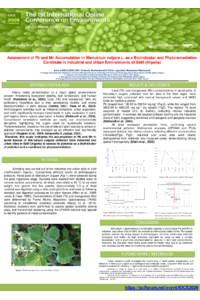
IOCE 2026 Poster BELGUIDOUM 162913.pdf
Nueva Esperanza rural settlement: Challenges of a public policy for environmental and territorial Development in the peri-urban area of Neuquén (1993–2018), Argentina.
Limnological characterization and phytoplankton structure in a stone tank located on an inselberg in the semiarid region of Paraíba, Brazil