Event submissions
Published
This submission belongs to the session S2. Environmental Impact and Risk Assessment of the event The 1st International Online Conference on Environments
Published date
27 Feb, 2026
Academic Editor
'%3e%3cpath%20d='M12.6657%2010.9104C12.4185%2010.325%2012.0599%209.79327%2011.6097%209.34482C11.1609%208.89508%2010.6293%208.5365%2010.0442%208.28888C10.0389%208.28626%2010.0337%208.28495%2010.0285%208.28233C10.8446%207.69279%2011.3752%206.73249%2011.3752%205.64904C11.3752%203.8542%209.92103%202.39999%208.1262%202.39999C6.33136%202.39999%204.87715%203.8542%204.87715%205.64904C4.87715%206.73249%205.40774%207.69279%206.22393%208.28364C6.21869%208.28626%206.21345%208.28757%206.20821%208.29019C5.62129%208.5378%205.09463%208.89284%204.64265%209.34613C4.1929%209.79493%203.83432%2010.3266%203.58671%2010.9117C3.34345%2011.4845%203.21226%2012.0987%203.20023%2012.7209C3.19988%2012.7349%203.20233%2012.7488%203.20744%2012.7619C3.21255%2012.7749%203.22022%2012.7867%203.22998%2012.7968C3.23975%2012.8068%203.25142%2012.8147%203.26431%2012.8202C3.2772%2012.8256%203.29105%2012.8284%203.30504%2012.8284H4.09109C4.14874%2012.8284%204.19459%2012.7825%204.1959%2012.7262C4.2221%2011.7148%204.62823%2010.7676%205.34617%2010.0497C6.08899%209.30683%207.0755%208.89808%208.1262%208.89808C9.17689%208.89808%2010.1634%209.30683%2010.9062%2010.0497C11.6242%2010.7676%2012.0303%2011.7148%2012.0565%2012.7262C12.0578%2012.7838%2012.1037%2012.8284%2012.1613%2012.8284H12.9474C12.9613%2012.8284%2012.9752%2012.8256%2012.9881%2012.8202C13.001%2012.8147%2013.0126%2012.8068%2013.0224%2012.7968C13.0322%2012.7867%2013.0398%2012.7749%2013.0449%2012.7619C13.0501%2012.7488%2013.0525%2012.7349%2013.0522%2012.7209C13.0391%2012.0947%2012.9094%2011.4855%2012.6657%2010.9104ZM8.1262%207.9024C7.52486%207.9024%206.9589%207.6679%206.53312%207.24211C6.10733%206.81633%205.87283%206.25037%205.87283%205.64904C5.87283%205.0477%206.10733%204.48174%206.53312%204.05596C6.9589%203.63018%207.52486%203.39567%208.1262%203.39567C8.72753%203.39567%209.29349%203.63018%209.71927%204.05596C10.1451%204.48174%2010.3796%205.0477%2010.3796%205.64904C10.3796%206.25037%2010.1451%206.81633%209.71927%207.24211C9.29349%207.6679%208.72753%207.9024%208.1262%207.9024Z'%20fill='%235D1EE1'/%3e%3c/g%3e%3c/svg%3e) Ioannis Kalavrouziotis
Ioannis KalavrouziotisCitation
Caroline Cristine Augusto, Tatiana Pedron, Renata Tatsuco Silva Fukuwara, Bruna Moreira Freire, Bruno Lemos Batista, Occurrence and characterization of microplastics and trace metals in aquatic matrices of the ABC Paulista region, in Proceedings of The 1st International Online Conference on Environments, 2 March–4 March 2026, MDPI: Basel, Switzerland
Share
Email
Facebook
Twitter
LinkedIn
Occurrence and characterization of microplastics and trace metals in aquatic matrices of the ABC Paulista region
'%3e%3cpath%20d='M12.6647%2010.9104C12.4176%2010.325%2012.0589%209.7933%2011.6088%209.34485C11.16%208.89511%2010.6283%208.53653%2010.0432%208.28891C10.038%208.28629%2010.0327%208.28498%2010.0275%208.28236C10.8437%207.69282%2011.3743%206.73252%2011.3743%205.64907C11.3743%203.85423%209.92005%202.40002%208.12522%202.40002C6.33038%202.40002%204.87618%203.85423%204.87618%205.64907C4.87618%206.73252%205.40677%207.69282%206.22296%208.28367C6.21772%208.28629%206.21248%208.2876%206.20724%208.29022C5.62031%208.53783%205.09365%208.89287%204.64167%209.34616C4.19192%209.79496%203.83334%2010.3266%203.58573%2010.9117C3.34247%2011.4846%203.21128%2012.0987%203.19925%2012.721C3.1989%2012.735%203.20135%2012.7489%203.20646%2012.7619C3.21157%2012.7749%203.21924%2012.7868%203.22901%2012.7968C3.23877%2012.8068%203.25045%2012.8148%203.26334%2012.8202C3.27623%2012.8256%203.29007%2012.8284%203.30406%2012.8284H4.09012C4.14776%2012.8284%204.19362%2012.7825%204.19493%2012.7262C4.22113%2011.7148%204.62726%2010.7676%205.34519%2010.0497C6.08802%209.30686%207.07452%208.89811%208.12522%208.89811C9.17592%208.89811%2010.1624%209.30686%2010.9052%2010.0497C11.6232%2010.7676%2012.0293%2011.7148%2012.0555%2012.7262C12.0568%2012.7839%2012.1027%2012.8284%2012.1603%2012.8284H12.9464C12.9604%2012.8284%2012.9742%2012.8256%2012.9871%2012.8202C13%2012.8148%2013.0117%2012.8068%2013.0214%2012.7968C13.0312%2012.7868%2013.0389%2012.7749%2013.044%2012.7619C13.0491%2012.7489%2013.0515%2012.735%2013.0512%2012.721C13.0381%2012.0947%2012.9084%2011.4856%2012.6647%2010.9104ZM8.12522%207.90243C7.52388%207.90243%206.95792%207.66793%206.53214%207.24215C6.10636%206.81636%205.87185%206.2504%205.87185%205.64907C5.87185%205.04773%206.10636%204.48177%206.53214%204.05599C6.95792%203.63021%207.52388%203.3957%208.12522%203.3957C8.72655%203.3957%209.29252%203.63021%209.7183%204.05599C10.1441%204.48177%2010.3786%205.04773%2010.3786%205.64907C10.3786%206.2504%2010.1441%206.81636%209.7183%207.24215C9.29252%207.66793%208.72655%207.90243%208.12522%207.90243Z'%20fill='%235D1EE1'/%3e%3c/g%3e%3c/svg%3e)
Caroline Cristine Augusto 1
Tatiana Pedron 1
Renata Tatsuco Silva Fukuwara 1

Bruna Moreira Freire 1

Bruno Lemos Batista 1
1. Department of Chemistry, Federal University of ABC, Santo André, São Paulo, Brazil
Abstract
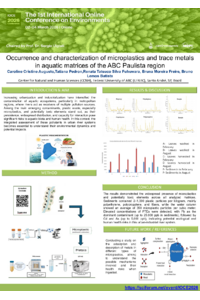
Plastic pollution represents a major environmental issue due to its persistence and interaction with chemical contaminants in aquatic ecosystems. Once released into the environment, plastics undergo biological and chemical transformations that influence their transport and fate. The fragmentation of larger plastic items results in microplastics (MPs), defined as particles ranging from 1 µm to 5 mm, which may be ingested by organisms and act as vectors for contaminants, including potentially toxic elements (PTEs). Elevated concentrations of these elements pose significant ecological and human health concerns. This study aimed to quantify the concentrations of As, Cd, Cu, Hg, Pb, and Zn, as well as to identify and quantify plastic and microplastic particles in rivers located in the ABC Paulista region (Brazil). The relationship between water quality parameters and contaminant occurrence was also investigated. Eight sampling sites were selected along downstream sections of the Tamanduateí River, covering areas influenced by residential, industrial, and tourist activities. Chemical element concentrations were determined using inductively coupled plasma mass spectrometry. Plastic and microplastic particles were identified and quantified following standardized National Oceanic and Atmospheric Administration (NOAA) protocols, using Raman and FT-IR spectroscopy. Sediment samples contained between 2 and 1,000 plastic particles per kilogram, predominantly composed of polyethylene, polypropylene, and fibers. In the water column, an average concentration of approximately 350 microplastic particles per cubic meter was observed. Analyses of leaves, water, and sediments revealed elevated concentrations of PTEs, with Pb identified as the dominant contaminant. Maximum Pb concentrations reached 7 ppb in water, 4000 ppb in leaves, and up to 25000 ppb in sediments. Cadmium and As were detected as secondary contaminants, with concentrations reaching up to 5000 ppb..Overall, the results demonstrate the widespread occurrence of microplastics and potentially toxic elements across multiple environmental matrices, highlighting potential risks to aquatic ecosystems and human health in urban-industrial river systems.
Keywords
Microplastics
ICP-MS
Sediments
Surface waters
Poster
Banner - Caroline .pdf
Ecotoxicity threshold of bentazone towards Lactuca sativa under Albufera lake conditions
Exploring the effects of glyphosate on the male reproductive system through in vivo studies on Podarcis siculus and in vitro studies on PNT1A cells