Event submissions
Published
This submission belongs to the session S2. Environmental Impact and Risk Assessment of the event The 1st International Online Conference on Environments
Published date
27 Feb, 2026
Academic Editor
'%3e%3cpath%20d='M12.6657%2010.9104C12.4185%2010.325%2012.0599%209.79327%2011.6097%209.34482C11.1609%208.89508%2010.6293%208.5365%2010.0442%208.28888C10.0389%208.28626%2010.0337%208.28495%2010.0285%208.28233C10.8446%207.69279%2011.3752%206.73249%2011.3752%205.64904C11.3752%203.8542%209.92103%202.39999%208.1262%202.39999C6.33136%202.39999%204.87715%203.8542%204.87715%205.64904C4.87715%206.73249%205.40774%207.69279%206.22393%208.28364C6.21869%208.28626%206.21345%208.28757%206.20821%208.29019C5.62129%208.5378%205.09463%208.89284%204.64265%209.34613C4.1929%209.79493%203.83432%2010.3266%203.58671%2010.9117C3.34345%2011.4845%203.21226%2012.0987%203.20023%2012.7209C3.19988%2012.7349%203.20233%2012.7488%203.20744%2012.7619C3.21255%2012.7749%203.22022%2012.7867%203.22998%2012.7968C3.23975%2012.8068%203.25142%2012.8147%203.26431%2012.8202C3.2772%2012.8256%203.29105%2012.8284%203.30504%2012.8284H4.09109C4.14874%2012.8284%204.19459%2012.7825%204.1959%2012.7262C4.2221%2011.7148%204.62823%2010.7676%205.34617%2010.0497C6.08899%209.30683%207.0755%208.89808%208.1262%208.89808C9.17689%208.89808%2010.1634%209.30683%2010.9062%2010.0497C11.6242%2010.7676%2012.0303%2011.7148%2012.0565%2012.7262C12.0578%2012.7838%2012.1037%2012.8284%2012.1613%2012.8284H12.9474C12.9613%2012.8284%2012.9752%2012.8256%2012.9881%2012.8202C13.001%2012.8147%2013.0126%2012.8068%2013.0224%2012.7968C13.0322%2012.7867%2013.0398%2012.7749%2013.0449%2012.7619C13.0501%2012.7488%2013.0525%2012.7349%2013.0522%2012.7209C13.0391%2012.0947%2012.9094%2011.4855%2012.6657%2010.9104ZM8.1262%207.9024C7.52486%207.9024%206.9589%207.6679%206.53312%207.24211C6.10733%206.81633%205.87283%206.25037%205.87283%205.64904C5.87283%205.0477%206.10733%204.48174%206.53312%204.05596C6.9589%203.63018%207.52486%203.39567%208.1262%203.39567C8.72753%203.39567%209.29349%203.63018%209.71927%204.05596C10.1451%204.48174%2010.3796%205.0477%2010.3796%205.64904C10.3796%206.25037%2010.1451%206.81633%209.71927%207.24211C9.29349%207.6679%208.72753%207.9024%208.1262%207.9024Z'%20fill='%235D1EE1'/%3e%3c/g%3e%3c/svg%3e) Gianniantonio Petruzzelli
Gianniantonio PetruzzelliCitation
Teresa Chianese, Sabrina Balsamo, Luigi Rosati, Giovanna Trinchese, Rosaria Scudiero, Exploring the effects of glyphosate on the male reproductive system through in vivo studies on Podarcis siculus and in vitro studies on PNT1A cells, in Proceedings of The 1st International Online Conference on Environments, 2 March–4 March 2026, MDPI: Basel, Switzerland
Share
Email
Facebook
Twitter
LinkedIn
Exploring the effects of glyphosate on the male reproductive system through in vivo studies on Podarcis siculus and in vitro studies on PNT1A cells
'%3e%3cpath%20d='M12.6647%2010.9104C12.4176%2010.325%2012.0589%209.7933%2011.6088%209.34485C11.16%208.89511%2010.6283%208.53653%2010.0432%208.28891C10.038%208.28629%2010.0327%208.28498%2010.0275%208.28236C10.8437%207.69282%2011.3743%206.73252%2011.3743%205.64907C11.3743%203.85423%209.92005%202.40002%208.12522%202.40002C6.33038%202.40002%204.87618%203.85423%204.87618%205.64907C4.87618%206.73252%205.40677%207.69282%206.22296%208.28367C6.21772%208.28629%206.21248%208.2876%206.20724%208.29022C5.62031%208.53783%205.09365%208.89287%204.64167%209.34616C4.19192%209.79496%203.83334%2010.3266%203.58573%2010.9117C3.34247%2011.4846%203.21128%2012.0987%203.19925%2012.721C3.1989%2012.735%203.20135%2012.7489%203.20646%2012.7619C3.21157%2012.7749%203.21924%2012.7868%203.22901%2012.7968C3.23877%2012.8068%203.25045%2012.8148%203.26334%2012.8202C3.27623%2012.8256%203.29007%2012.8284%203.30406%2012.8284H4.09012C4.14776%2012.8284%204.19362%2012.7825%204.19493%2012.7262C4.22113%2011.7148%204.62726%2010.7676%205.34519%2010.0497C6.08802%209.30686%207.07452%208.89811%208.12522%208.89811C9.17592%208.89811%2010.1624%209.30686%2010.9052%2010.0497C11.6232%2010.7676%2012.0293%2011.7148%2012.0555%2012.7262C12.0568%2012.7839%2012.1027%2012.8284%2012.1603%2012.8284H12.9464C12.9604%2012.8284%2012.9742%2012.8256%2012.9871%2012.8202C13%2012.8148%2013.0117%2012.8068%2013.0214%2012.7968C13.0312%2012.7868%2013.0389%2012.7749%2013.044%2012.7619C13.0491%2012.7489%2013.0515%2012.735%2013.0512%2012.721C13.0381%2012.0947%2012.9084%2011.4856%2012.6647%2010.9104ZM8.12522%207.90243C7.52388%207.90243%206.95792%207.66793%206.53214%207.24215C6.10636%206.81636%205.87185%206.2504%205.87185%205.64907C5.87185%205.04773%206.10636%204.48177%206.53214%204.05599C6.95792%203.63021%207.52388%203.3957%208.12522%203.3957C8.72655%203.3957%209.29252%203.63021%209.7183%204.05599C10.1441%204.48177%2010.3786%205.04773%2010.3786%205.64907C10.3786%206.2504%2010.1441%206.81636%209.7183%207.24215C9.29252%207.66793%208.72655%207.90243%208.12522%207.90243Z'%20fill='%235D1EE1'/%3e%3c/g%3e%3c/svg%3e)
Teresa Chianese 1
Sabrina Balsamo 1

Luigi Rosati 1

Giovanna Trinchese 1

Rosaria Scudiero 1
1. Department of Biology, University of Naples Federico II, Via Cinthia, Edificio 7, 80126 Naples, Italy
Abstract
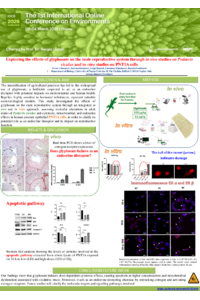
The expansion of intensive agricultural systems leads to increasing degradation of natural habitats, caused, among other factors, by the widespread use of herbicides such as glyphosate (Gly), whichis widely used despite growing evidence of its potential adverse effects. Among the vertebrates most exposed to ecotoxicological risk are reptiles, whose populations are particularly sensitive to habitat loss and endocrine disruption. In this context, this study combines in vivo and in vitro approaches to assess the impact of glyphosate on the male reproductive system.
In the in vivo model, adult males of Podarcis siculus lizards were exposed orally, every other day for three weeks, to two concentrations of Gly (0.05 and 0.5 μg/kg bw). The analyses conducted revealed marked alterations in testicular morphology, a reduction in spermatogenesis and changes in the cell junctions. In addition, the expression and localisation of oestrogen receptors (ERα and ERβ) in germ cells were significantly altered, with a dose-dependent increase in expression. Gly, at the concentrations tested, did not cause appreciable changes in steroidogenesis parameters. Overall, these results indicate that the herbicide can compromise the reproductive morphophysiology of male lizards, potentially reducing their reproductive fitness.
At the same time, in the in vitro model based on human prostate epithelial cells PNT1A, Gly induced cytotoxicity and rapid activation of oestrogen receptors via nuclear translocation. Functional analyses of mitochondrial metabolism showed reduced ATP production, respiratory reserve capacity and proton leak, suggesting the onset of mitochondrial dysfunction. Furthermore, the data suggest the activation of apoptotic pathways in response to treatment.
Overall, the evidence gathered confirms Gly as a potential endocrine disruptor, capable of altering reproductive function in both animal models and human cells, highlighting the urgent need for more controlled use of the herbicide.
Keywords
Glyphosate
endocrine disruption
male reproductive system
Podarcis siculus
oestrogen receptors
mitochondrial dysfunction.
Poster
IOCE 2026 Poster Teresa Chianese.pdf
Occurrence and characterization of microplastics and trace metals in aquatic matrices of the ABC Paulista region
Health Risk Assessment of PM2.5, NO2, and BC Exposure on Adults and Children in Karachi, Pakistan