Event submissions
Published
This submission belongs to the session S1. Environmental Assessment Methods and Management Technologies of the event The 1st International Online Conference on Environments
Published date
27 Feb, 2026
Academic Editor
'%3e%3cpath%20d='M12.6657%2010.9104C12.4185%2010.325%2012.0599%209.79327%2011.6097%209.34482C11.1609%208.89508%2010.6293%208.5365%2010.0442%208.28888C10.0389%208.28626%2010.0337%208.28495%2010.0285%208.28233C10.8446%207.69279%2011.3752%206.73249%2011.3752%205.64904C11.3752%203.8542%209.92103%202.39999%208.1262%202.39999C6.33136%202.39999%204.87715%203.8542%204.87715%205.64904C4.87715%206.73249%205.40774%207.69279%206.22393%208.28364C6.21869%208.28626%206.21345%208.28757%206.20821%208.29019C5.62129%208.5378%205.09463%208.89284%204.64265%209.34613C4.1929%209.79493%203.83432%2010.3266%203.58671%2010.9117C3.34345%2011.4845%203.21226%2012.0987%203.20023%2012.7209C3.19988%2012.7349%203.20233%2012.7488%203.20744%2012.7619C3.21255%2012.7749%203.22022%2012.7867%203.22998%2012.7968C3.23975%2012.8068%203.25142%2012.8147%203.26431%2012.8202C3.2772%2012.8256%203.29105%2012.8284%203.30504%2012.8284H4.09109C4.14874%2012.8284%204.19459%2012.7825%204.1959%2012.7262C4.2221%2011.7148%204.62823%2010.7676%205.34617%2010.0497C6.08899%209.30683%207.0755%208.89808%208.1262%208.89808C9.17689%208.89808%2010.1634%209.30683%2010.9062%2010.0497C11.6242%2010.7676%2012.0303%2011.7148%2012.0565%2012.7262C12.0578%2012.7838%2012.1037%2012.8284%2012.1613%2012.8284H12.9474C12.9613%2012.8284%2012.9752%2012.8256%2012.9881%2012.8202C13.001%2012.8147%2013.0126%2012.8068%2013.0224%2012.7968C13.0322%2012.7867%2013.0398%2012.7749%2013.0449%2012.7619C13.0501%2012.7488%2013.0525%2012.7349%2013.0522%2012.7209C13.0391%2012.0947%2012.9094%2011.4855%2012.6657%2010.9104ZM8.1262%207.9024C7.52486%207.9024%206.9589%207.6679%206.53312%207.24211C6.10733%206.81633%205.87283%206.25037%205.87283%205.64904C5.87283%205.0477%206.10733%204.48174%206.53312%204.05596C6.9589%203.63018%207.52486%203.39567%208.1262%203.39567C8.72753%203.39567%209.29349%203.63018%209.71927%204.05596C10.1451%204.48174%2010.3796%205.0477%2010.3796%205.64904C10.3796%206.25037%2010.1451%206.81633%209.71927%207.24211C9.29349%207.6679%208.72753%207.9024%208.1262%207.9024Z'%20fill='%235D1EE1'/%3e%3c/g%3e%3c/svg%3e) Milena Horvat
Milena HorvatCitation
Teresa Girona-Albuixech, Montserrat García-Gabaldón, Carlos Domingo-Torner, Valentín Pérez-Herranz, Maria Teresa Montañés, Effects of electrooxidation vs photoelectrooxidation on bentazone ecotoxicity for different supporting electrolytes, in Proceedings of The 1st International Online Conference on Environments, 2 March–4 March 2026, MDPI: Basel, Switzerland
Share
Email
Facebook
Twitter
LinkedIn
Effects of electrooxidation vs photoelectrooxidation on bentazone ecotoxicity for different supporting electrolytes

Teresa Girona-Albuixech 1
'%3e%3cpath%20d='M12.6647%2010.9104C12.4176%2010.325%2012.0589%209.7933%2011.6088%209.34485C11.16%208.89511%2010.6283%208.53653%2010.0432%208.28891C10.038%208.28629%2010.0327%208.28498%2010.0275%208.28236C10.8437%207.69282%2011.3743%206.73252%2011.3743%205.64907C11.3743%203.85423%209.92005%202.40002%208.12522%202.40002C6.33038%202.40002%204.87618%203.85423%204.87618%205.64907C4.87618%206.73252%205.40677%207.69282%206.22296%208.28367C6.21772%208.28629%206.21248%208.2876%206.20724%208.29022C5.62031%208.53783%205.09365%208.89287%204.64167%209.34616C4.19192%209.79496%203.83334%2010.3266%203.58573%2010.9117C3.34247%2011.4846%203.21128%2012.0987%203.19925%2012.721C3.1989%2012.735%203.20135%2012.7489%203.20646%2012.7619C3.21157%2012.7749%203.21924%2012.7868%203.22901%2012.7968C3.23877%2012.8068%203.25045%2012.8148%203.26334%2012.8202C3.27623%2012.8256%203.29007%2012.8284%203.30406%2012.8284H4.09012C4.14776%2012.8284%204.19362%2012.7825%204.19493%2012.7262C4.22113%2011.7148%204.62726%2010.7676%205.34519%2010.0497C6.08802%209.30686%207.07452%208.89811%208.12522%208.89811C9.17592%208.89811%2010.1624%209.30686%2010.9052%2010.0497C11.6232%2010.7676%2012.0293%2011.7148%2012.0555%2012.7262C12.0568%2012.7839%2012.1027%2012.8284%2012.1603%2012.8284H12.9464C12.9604%2012.8284%2012.9742%2012.8256%2012.9871%2012.8202C13%2012.8148%2013.0117%2012.8068%2013.0214%2012.7968C13.0312%2012.7868%2013.0389%2012.7749%2013.044%2012.7619C13.0491%2012.7489%2013.0515%2012.735%2013.0512%2012.721C13.0381%2012.0947%2012.9084%2011.4856%2012.6647%2010.9104ZM8.12522%207.90243C7.52388%207.90243%206.95792%207.66793%206.53214%207.24215C6.10636%206.81636%205.87185%206.2504%205.87185%205.64907C5.87185%205.04773%206.10636%204.48177%206.53214%204.05599C6.95792%203.63021%207.52388%203.3957%208.12522%203.3957C8.72655%203.3957%209.29252%203.63021%209.7183%204.05599C10.1441%204.48177%2010.3786%205.04773%2010.3786%205.64907C10.3786%206.2504%2010.1441%206.81636%209.7183%207.24215C9.29252%207.66793%208.72655%207.90243%208.12522%207.90243Z'%20fill='%235D1EE1'/%3e%3c/g%3e%3c/svg%3e)
Montserrat García-Gabaldón 1
Carlos Domingo-Torner 1

Valentín Pérez-Herranz 1
Maria Teresa Montañés 1
1. IEC Group, ISIRYM, Universitat Politècnica de València, Camí de Vera s/n, 46022, València, P.O. Box 22012, E-46071, Spain
Abstract
Introduction
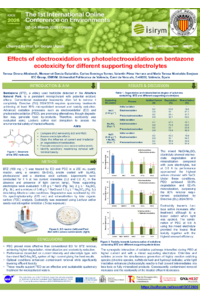
Directive (EU) 2024/3019 on the treatment of urban wastewater mandates using quaternary treatments for reducing both the concentration and toxicity of micropollutants. In this work the effectiveness of electrooxidation and photoelectrooxidation processes to eliminate bentazone (BTZ) was studied. BTZ is a micropollutant detected in the Albufera lake (Spain).
Methods
A new ceramic anode made of Sb-SnO2 and coated with a Bi2WO6 photocatalyst was used. Three supporting electrolytes were tested: 1.65 g L-1 of NaCl; 2 g L-1 of Na2SO4; and a mixture of 0.46 g L-1 of NaCl and 1.3 g L-1 of Na2SO4 (this last being similar to Albufera lake conditions). The initial concentration of BTZ was 100 mg L-1. Two current intensities (0.2 and 0.6 A) were applied, both in the absence and presence of light provided by a xenon lamp. After 4 h, the degradation and mineralization percentages were determined. Ecotoxicity was determined using Lactuca sativa seeds according to US EPA OPPTS 850.4200 standard, after adjusting the pH between 5.5-8, if necessary.
Results
The degradation and mineralization degrees achieved using the mixed electrolyte show intermediate values between those achieved with pure electrolytes. Applying 0.6 A, they are very close to the maximum values achieved with pure NaCl. Moreover, the final effluents toxicity is significantly lower, especially when light is applied. Therefore, the photoelectrooxidation process applying 0.6 A with the mixed electrolyte is the most effective technique from the combined point of view of final degradation (90.9%), mineralization (62.4%) and toxicity (elongation of 47.4% compared to control, p-value < 0.05). Furthermore, the degradation achieved is greater than 80%, minimum value required by Directive (EU) 2024/3019 (Table 3, Annex I) to reduce the micropollutants concentration.
Conclusions
Photoelectrooxidation is a good option as quaternary treatment in wastewater treatment plants with the following additional advantages. It does not need the addition of chemicals, and energy consumption could be supplied by alternative sources, especially in small communities.
Keywords
Albufera lake
bentazone
ecotoxicity
electrochemical oxidation
Lactuca sativa
micropollutant
photoelectrochemical oxidation
Poster
sciforum-162892.pdf
Local implementation pathways of the European Green Deal: integration between environmental monitoring and community-driven policy mechanisms.
Climate-Driven Vulnerability of Island Ecosystems: Quantitative Evidence of Precipitation Decline Leading to Mammoth Extinction on St. Paul Island