Event submissions
Published
This submission belongs to the session S1. Environmental Assessment Methods and Management Technologies of the event The 1st International Online Conference on Environments
Published date
27 Feb, 2026
Academic Editor
'%3e%3cpath%20d='M12.6657%2010.9104C12.4185%2010.325%2012.0599%209.79327%2011.6097%209.34482C11.1609%208.89508%2010.6293%208.5365%2010.0442%208.28888C10.0389%208.28626%2010.0337%208.28495%2010.0285%208.28233C10.8446%207.69279%2011.3752%206.73249%2011.3752%205.64904C11.3752%203.8542%209.92103%202.39999%208.1262%202.39999C6.33136%202.39999%204.87715%203.8542%204.87715%205.64904C4.87715%206.73249%205.40774%207.69279%206.22393%208.28364C6.21869%208.28626%206.21345%208.28757%206.20821%208.29019C5.62129%208.5378%205.09463%208.89284%204.64265%209.34613C4.1929%209.79493%203.83432%2010.3266%203.58671%2010.9117C3.34345%2011.4845%203.21226%2012.0987%203.20023%2012.7209C3.19988%2012.7349%203.20233%2012.7488%203.20744%2012.7619C3.21255%2012.7749%203.22022%2012.7867%203.22998%2012.7968C3.23975%2012.8068%203.25142%2012.8147%203.26431%2012.8202C3.2772%2012.8256%203.29105%2012.8284%203.30504%2012.8284H4.09109C4.14874%2012.8284%204.19459%2012.7825%204.1959%2012.7262C4.2221%2011.7148%204.62823%2010.7676%205.34617%2010.0497C6.08899%209.30683%207.0755%208.89808%208.1262%208.89808C9.17689%208.89808%2010.1634%209.30683%2010.9062%2010.0497C11.6242%2010.7676%2012.0303%2011.7148%2012.0565%2012.7262C12.0578%2012.7838%2012.1037%2012.8284%2012.1613%2012.8284H12.9474C12.9613%2012.8284%2012.9752%2012.8256%2012.9881%2012.8202C13.001%2012.8147%2013.0126%2012.8068%2013.0224%2012.7968C13.0322%2012.7867%2013.0398%2012.7749%2013.0449%2012.7619C13.0501%2012.7488%2013.0525%2012.7349%2013.0522%2012.7209C13.0391%2012.0947%2012.9094%2011.4855%2012.6657%2010.9104ZM8.1262%207.9024C7.52486%207.9024%206.9589%207.6679%206.53312%207.24211C6.10733%206.81633%205.87283%206.25037%205.87283%205.64904C5.87283%205.0477%206.10733%204.48174%206.53312%204.05596C6.9589%203.63018%207.52486%203.39567%208.1262%203.39567C8.72753%203.39567%209.29349%203.63018%209.71927%204.05596C10.1451%204.48174%2010.3796%205.0477%2010.3796%205.64904C10.3796%206.25037%2010.1451%206.81633%209.71927%207.24211C9.29349%207.6679%208.72753%207.9024%208.1262%207.9024Z'%20fill='%235D1EE1'/%3e%3c/g%3e%3c/svg%3e) Milena Horvat
Milena HorvatCitation
Gennaro Trancone, Advancing Low-Cost Biosorbent Engineering: Optimized Alkaline Activation of Agro-Industrial Biomass for Enhanced Removal of Cationic Dyes, in Proceedings of The 1st International Online Conference on Environments, 2 March–4 March 2026, MDPI: Basel, Switzerland
Share
Email
Facebook
Twitter
LinkedIn
Advancing Low-Cost Biosorbent Engineering: Optimized Alkaline Activation of Agro-Industrial Biomass for Enhanced Removal of Cationic Dyes

Gennaro Trancone 1
1. Department of Civil, Architectural and Environmental Engineering, University of Naples “Federico II”, Via Claudio 21, 80125 Naples, Italy
Abstract
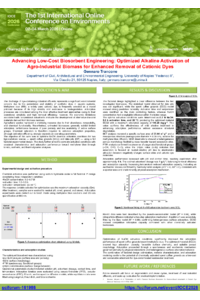
The growing need for sustainable and affordable technologies for wastewater treatment has driven the development of biosorbents derived from agricultural residues. This work investigates the optimization of alkaline chemical activation applied to two widespread biomasses—spent coffee grounds (SCG) and date pits (DP)—to enhance their capacity to remove methylene blue (MB) from aqueous solutions. Using a two-level full factorial design, the impact of NaOH concentration, activation time, and activation temperature on sorbent performance was assessed.
Among the tested materials, SCG demonstrated a strong response to chemical activation, whereas DP presented limited improvement. The optimal operating conditions for SCG (0.2 M NaOH, 5.5 h activation, and 22 °C) yielded the highest adsorption capacity (140.23 mg g⁻¹), confirming the key role of activation time and temperature in shaping surface reactivity. Textural and spectroscopic analyses (BET, SEM, and FTIR) revealed a mesoporous structure (37.44 m² g⁻¹; pore diameter 4.39 nm) and the presence of functional groups (O–H, C=O, and C–O) actively involved in dye uptake. The point of zero charge (pHpzc_\text{pzc}pzc = 5.42) indicated enhanced surface acidity following NaOH treatment.
Adsorption performance was strongly influenced by pH, dosage, and temperature, with higher pH and moderate dosages favoring MB removal. Kinetic modeling identified the pseudo-second-order model as the most suitable (R² = 0.96), supported by intraparticle diffusion analysis indicating multi-step mass transfer. Equilibrium data were best represented by the Sips isotherm (R² = 0.99), predicting a maximum capacity of 145.59 mg g⁻¹. Thermodynamic parameters revealed a spontaneous, exothermic, and entropy-driven process.
Overall, this study demonstrates that statistically optimized alkaline activation significantly enhances the adsorption performance of SCG, validating its potential as an efficient, low-cost biosorbent for treating dye-polluted wastewater, while contributing to the valorization of agro-industrial residues within circular economy frameworks.
Keywords
Biosorption
Spent coffee grounds
Chemical activation
Factorial design
Methylene blue removal
Kinetics
Isotherms.
Poster
IOCE 2026 Poster_Gennaro Trancone_definitive.pdf
Climate-Driven Vulnerability of Island Ecosystems: Quantitative Evidence of Precipitation Decline Leading to Mammoth Extinction on St. Paul Island
Evaluating the Initial Nutrient Content in Green-System Porous Media Through Aqueous Extraction