Event submissions
Published
This submission belongs to the session S3. Terrestrial and Marine Biodiversity and Habitat Loss Prevention of the event The 1st International Online Conference on Environments
Published date
27 Feb, 2026
Academic Editor
'%3e%3cpath%20d='M12.6657%2010.9104C12.4185%2010.325%2012.0599%209.79327%2011.6097%209.34482C11.1609%208.89508%2010.6293%208.5365%2010.0442%208.28888C10.0389%208.28626%2010.0337%208.28495%2010.0285%208.28233C10.8446%207.69279%2011.3752%206.73249%2011.3752%205.64904C11.3752%203.8542%209.92103%202.39999%208.1262%202.39999C6.33136%202.39999%204.87715%203.8542%204.87715%205.64904C4.87715%206.73249%205.40774%207.69279%206.22393%208.28364C6.21869%208.28626%206.21345%208.28757%206.20821%208.29019C5.62129%208.5378%205.09463%208.89284%204.64265%209.34613C4.1929%209.79493%203.83432%2010.3266%203.58671%2010.9117C3.34345%2011.4845%203.21226%2012.0987%203.20023%2012.7209C3.19988%2012.7349%203.20233%2012.7488%203.20744%2012.7619C3.21255%2012.7749%203.22022%2012.7867%203.22998%2012.7968C3.23975%2012.8068%203.25142%2012.8147%203.26431%2012.8202C3.2772%2012.8256%203.29105%2012.8284%203.30504%2012.8284H4.09109C4.14874%2012.8284%204.19459%2012.7825%204.1959%2012.7262C4.2221%2011.7148%204.62823%2010.7676%205.34617%2010.0497C6.08899%209.30683%207.0755%208.89808%208.1262%208.89808C9.17689%208.89808%2010.1634%209.30683%2010.9062%2010.0497C11.6242%2010.7676%2012.0303%2011.7148%2012.0565%2012.7262C12.0578%2012.7838%2012.1037%2012.8284%2012.1613%2012.8284H12.9474C12.9613%2012.8284%2012.9752%2012.8256%2012.9881%2012.8202C13.001%2012.8147%2013.0126%2012.8068%2013.0224%2012.7968C13.0322%2012.7867%2013.0398%2012.7749%2013.0449%2012.7619C13.0501%2012.7488%2013.0525%2012.7349%2013.0522%2012.7209C13.0391%2012.0947%2012.9094%2011.4855%2012.6657%2010.9104ZM8.1262%207.9024C7.52486%207.9024%206.9589%207.6679%206.53312%207.24211C6.10733%206.81633%205.87283%206.25037%205.87283%205.64904C5.87283%205.0477%206.10733%204.48174%206.53312%204.05596C6.9589%203.63018%207.52486%203.39567%208.1262%203.39567C8.72753%203.39567%209.29349%203.63018%209.71927%204.05596C10.1451%204.48174%2010.3796%205.0477%2010.3796%205.64904C10.3796%206.25037%2010.1451%206.81633%209.71927%207.24211C9.29349%207.6679%208.72753%207.9024%208.1262%207.9024Z'%20fill='%235D1EE1'/%3e%3c/g%3e%3c/svg%3e) Claudio Agnisola
Claudio AgnisolaCitation
Nidhi Dewangan, Integrating Land–Sea Connectivity to Prevent Global Biodiversity and Habitat Loss in Mangrove and Coral Reef Systems, in Proceedings of The 1st International Online Conference on Environments, 2 March–4 March 2026, MDPI: Basel, Switzerland
Share
Email
Facebook
Twitter
LinkedIn
Integrating Land–Sea Connectivity to Prevent Global Biodiversity and Habitat Loss in Mangrove and Coral Reef Systems
'%3e%3cpath%20d='M12.6647%2010.9104C12.4176%2010.325%2012.0589%209.7933%2011.6088%209.34485C11.16%208.89511%2010.6283%208.53653%2010.0432%208.28891C10.038%208.28629%2010.0327%208.28498%2010.0275%208.28236C10.8437%207.69282%2011.3743%206.73252%2011.3743%205.64907C11.3743%203.85423%209.92005%202.40002%208.12522%202.40002C6.33038%202.40002%204.87618%203.85423%204.87618%205.64907C4.87618%206.73252%205.40677%207.69282%206.22296%208.28367C6.21772%208.28629%206.21248%208.2876%206.20724%208.29022C5.62031%208.53783%205.09365%208.89287%204.64167%209.34616C4.19192%209.79496%203.83334%2010.3266%203.58573%2010.9117C3.34247%2011.4846%203.21128%2012.0987%203.19925%2012.721C3.1989%2012.735%203.20135%2012.7489%203.20646%2012.7619C3.21157%2012.7749%203.21924%2012.7868%203.22901%2012.7968C3.23877%2012.8068%203.25045%2012.8148%203.26334%2012.8202C3.27623%2012.8256%203.29007%2012.8284%203.30406%2012.8284H4.09012C4.14776%2012.8284%204.19362%2012.7825%204.19493%2012.7262C4.22113%2011.7148%204.62726%2010.7676%205.34519%2010.0497C6.08802%209.30686%207.07452%208.89811%208.12522%208.89811C9.17592%208.89811%2010.1624%209.30686%2010.9052%2010.0497C11.6232%2010.7676%2012.0293%2011.7148%2012.0555%2012.7262C12.0568%2012.7839%2012.1027%2012.8284%2012.1603%2012.8284H12.9464C12.9604%2012.8284%2012.9742%2012.8256%2012.9871%2012.8202C13%2012.8148%2013.0117%2012.8068%2013.0214%2012.7968C13.0312%2012.7868%2013.0389%2012.7749%2013.044%2012.7619C13.0491%2012.7489%2013.0515%2012.735%2013.0512%2012.721C13.0381%2012.0947%2012.9084%2011.4856%2012.6647%2010.9104ZM8.12522%207.90243C7.52388%207.90243%206.95792%207.66793%206.53214%207.24215C6.10636%206.81636%205.87185%206.2504%205.87185%205.64907C5.87185%205.04773%206.10636%204.48177%206.53214%204.05599C6.95792%203.63021%207.52388%203.3957%208.12522%203.3957C8.72655%203.3957%209.29252%203.63021%209.7183%204.05599C10.1441%204.48177%2010.3786%205.04773%2010.3786%205.64907C10.3786%206.2504%2010.1441%206.81636%209.7183%207.24215C9.29252%207.66793%208.72655%207.90243%208.12522%207.90243Z'%20fill='%235D1EE1'/%3e%3c/g%3e%3c/svg%3e)
Nidhi Dewangan 1
1. Independent Researcher, Raipur 492016, India
Abstract
Introduction:
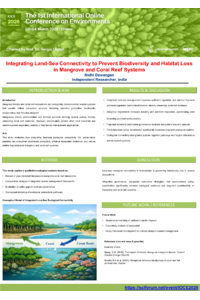
Across many tropical coastlines, mangroves and coral reefs support each other in ways that are often overlooked. Mangroves trap sediments, reduce erosion, and serve as breeding and feeding grounds for marine species, while coral reefs safeguard shorelines and host exceptionally rich biodiversity. Since these ecosystems rely on one another, disturbances affecting one system inevitably influence the other. However, conservation practices around the world still tend to treat land-based and marine habitats as separate entities. With increasing pressures from climate change and coastal development, recognizing this ecological link is more urgent than ever. This study argues that effective global biodiversity protection requires conserving mangroves and coral reefs through a land–sea connectivity approach.
Methods:
This research develops a conceptual model for conservation that views mangroves and coral reefs as an interconnected ecological unit. It compiles insights from global literature, remote sensing observations, and examples from various coastal regions to illustrate how these ecosystems interact and collectively support biodiversity. Policy analysis and evaluations of community-driven conservation initiatives were conducted to identify strategies that strengthen ecological linkages, enhance resilience, and promote unified land–sea management practices.
Results:
The findings indicate that restoration strategies connecting mangroves and coral reefs produce stronger outcomes than projects managed separately. Integrated conservation leads to faster ecosystem recovery, higher species retention, and greater ecosystem service benefits. Long-term resilience improves when scientific monitoring, community participation, and supportive policy frameworks work together. Coastal regions applying connectivity-based management report healthier fisheries, reduced shoreline degradation, and enhanced carbon sequestration.
Conclusion:
Preventing global habitat and biodiversity loss requires viewing mangroves and coral reefs as one interconnected system. Coordinated policies, ecological restoration, and community stewardship can sustain biodiversity, support climate resilience, and protect coastal livelihoods. Effective conservation must safeguard ecosystems along with the ecological relationships that keep them functioning.
Keywords
Coastal ecosystems
global biodiversity
mangrove conservation
coral reef protection
integrated management
land sea connectivity
climate resilience
ecosystem restoration
habitat loss prevention
community-based conservation.
Poster
IOCE 2026 Poster.pdf
Evaluating the Use of Scanning Electron Microscopy with Energy-Dispersive X-ray Spectroscopy for Identifying Airborne Particles in Industrial Areas
Eco-Friendly Wastewater Treatment Using Biochar Adsorbents: Removal of Tyrosol and Hydroxytyrosol and Life Cycle Assessment